Plastic Manufacturing

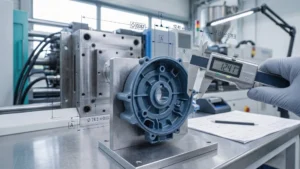
Technician inspecting an injection molded plastic part using a digital measurement system during a DFM and quality review.

DFM for Injection Molding: 12 Design Rules That Reduce Cost and Improve Part Quality

12 design rules that reduce tooling cost, improve part quality, and shorten development cycles — from the engineers at Texas Injection Molding. Design for Manufacturability (DFM) in injection molding is the practice of designing parts with the constraints and capabilities of the injection molding process in mind from the beginning. Parts designed without DFM principles […]

DFM for Injection Molding: 12 Design Rules That Reduce Cost and Improve Part Quality Read More »

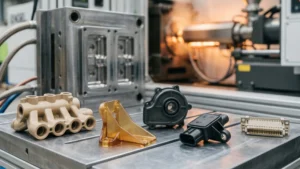
Precision injection mold tooling used to produce custom plastic parts

Injection Molding Cost Explained: What Drives Tooling Price, Part Cost, and How to Reduce Both

Understanding tooling cost, piece price, and the key variables that drive injection molding program economics. Injection molding cost has two distinct components that must be understood separately: tooling cost, the one-time investment to build the mold, and piece price, the per-part cost to run production. Conflating them leads to poor sourcing decisions — either over-investing

Injection Molding Cost Explained: What Drives Tooling Price, Part Cost, and How to Reduce Both Read More »

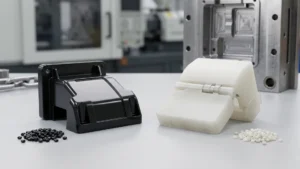
Engineer reviewing technical drawings, plastic resin pellets, and a molded part sample for injection molded part design.

Designing Injection Molded Parts: The Engineer’s Guide to Wall Thickness, Draft Angles, and Gating

Part design determines everything in injection molding. The shape of the part defines what the mold must do, what the process must achieve, and what the finished part can cost. Design decisions made before the mold is cut are essentially free to change. The same decisions after steel is cut can cost tens of thousands

Designing Injection Molded Parts: The Engineer’s Guide to Wall Thickness, Draft Angles, and Gating Read More »

Temperature gauge placed in plastic resin pellets to represent glass transition temperature and thermal performance in injection molding.

Glass Transition Temperature (Tg) Explained: Why It Matters for Injection Molded Plastics

How Tg defines the upper thermal limit of injection molded plastics — and why it matters for material selection, mold design, and part performance. Glass transition temperature (Tg) is the temperature at which an amorphous thermoplastic transitions from a hard, glassy state to a soft, rubbery one. Below Tg, the polymer chains are locked in

Glass Transition Temperature (Tg) Explained: Why It Matters for Injection Molded Plastics Read More »

Orange flame-rated plastic electrical connector on a circuit board for UL 94 injection molding applications.

UL 94 Flame Retardant Classifications: What Each Rating Means for Your Plastic Part

What V-0, V-1, V-2, HB, and 5V mean for injection molded plastic parts — and how to specify the right rating for your application. UL 94 is the standard for flammability testing of plastic materials for parts in devices and appliances, published by Underwriters Laboratories. It classifies plastics by how they respond to a standardized

UL 94 Flame Retardant Classifications: What Each Rating Means for Your Plastic Part Read More »

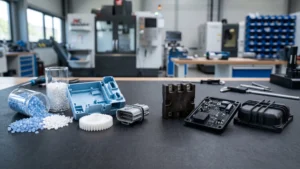
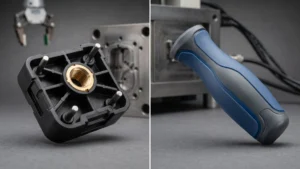
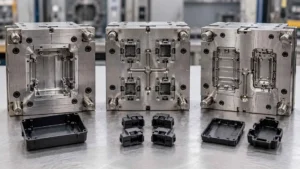
Overmolding Tooling with Molded Plastic Parts

Overmolding Explained: Process Overview, Design Rules, and Material Combinations

How the overmolding process works, which material combinations bond, and the design rules that determine whether your overmolded part succeeds or fails. Overmolding is an injection molding process that produces a single part from two different materials by molding the second material directly over the first. The result is a multi-material part — a rigid

Overmolding Explained: Process Overview, Design Rules, and Material Combinations Read More »

Plastic Manufacturing Explained: Which Process Is Right for Your Part?

A practical comparison of plastic manufacturing processes — injection molding, blow molding, thermoforming, rotational molding, extrusion, compression molding, and more — to help you choose the right method for your part. Plastic manufacturing encompasses a range of processes, and the choice of method is one of the highest-leverage decisions in product development. Choose the right

Plastic Manufacturing Explained: Which Process Is Right for Your Part? Read More »

Medical manufacturing equipment in a cleanroom environment used for producing healthcare devices

What Is Medical Manufacturing? Process, Devices & Standards Explained

Medical manufacturing is the design, production, assembly, and quality control of products used in healthcare settings. It includes everything from surgical instruments and implantable devices to diagnostic equipment, injection molded components, sterile packaging, and single-use medical consumables. Unlike many other industries, medical manufacturing operates under strict regulatory expectations, advanced material requirements, and zero-tolerance quality standards.

What Is Medical Manufacturing? Process, Devices & Standards Explained Read More »

Do I invest in In-House Automation Capabilities?

At Texas Injection Molding, we understand that engineering precision, process consistency, and uptime are non-negotiable. In today’s competitive manufacturing landscape, having the ability to design, engineer, and build custom automation solutions in-house isn’t just a value-add—it’s a strategic necessity. For engineering teams that rely on predictable, scalable production, our internal automation capabilities offer a significant

Do I invest in In-House Automation Capabilities? Read More »

Texas Injection Molding Maximizes Building Envelope for Storing Plastic Resin

Texas Injection Molding completed the expansion of it’s new materials warehouse in 2024.  Injection molding facilities handle a constant flow of plastic resin, most often delivered in bulk containers like gaylords or super sacks. Storing and moving these heavy loads safely and efficiently is critical to keeping production lines running smoothly. Texas Injection Molding worked

Texas Injection Molding Maximizes Building Envelope for Storing Plastic Resin Read More »