Properties, advantages, disadvantages, and injection molding considerations for glass-fiber-reinforced nylon.
Glass-filled nylon is polyamide reinforced with chopped glass fibers — typically 15%, 30%, or 50% by weight — that dramatically improve stiffness, strength, and dimensional stability compared to unfilled nylon. It is one of the most widely used engineering thermoplastics in injection molding for applications that demand both structural performance and the processing economics of thermoplastic molding.
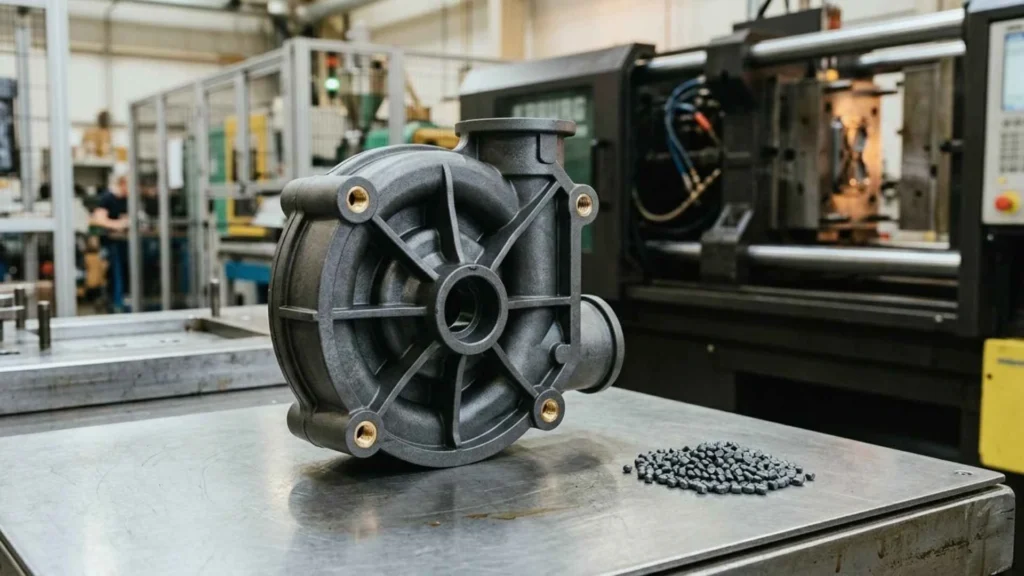
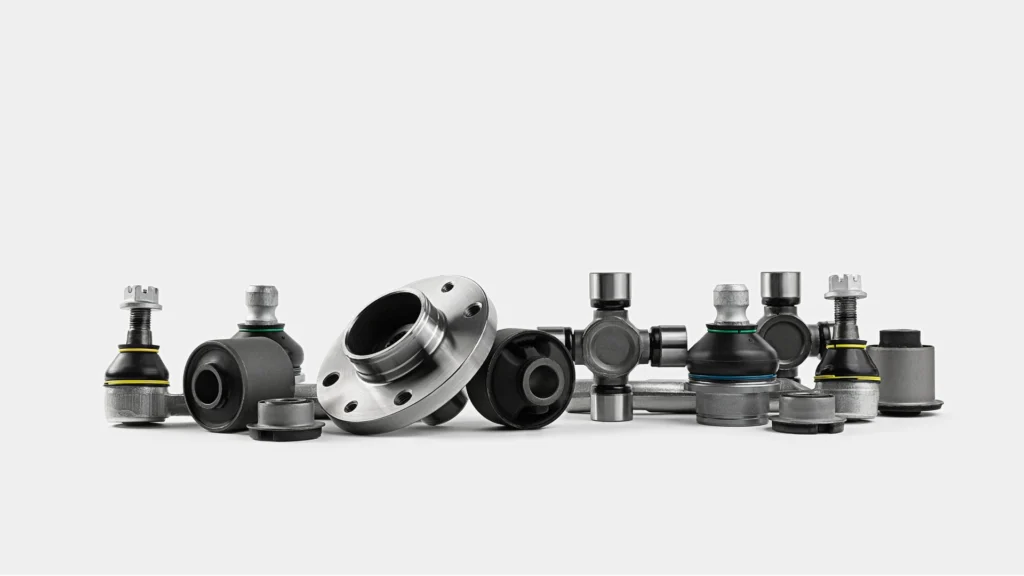
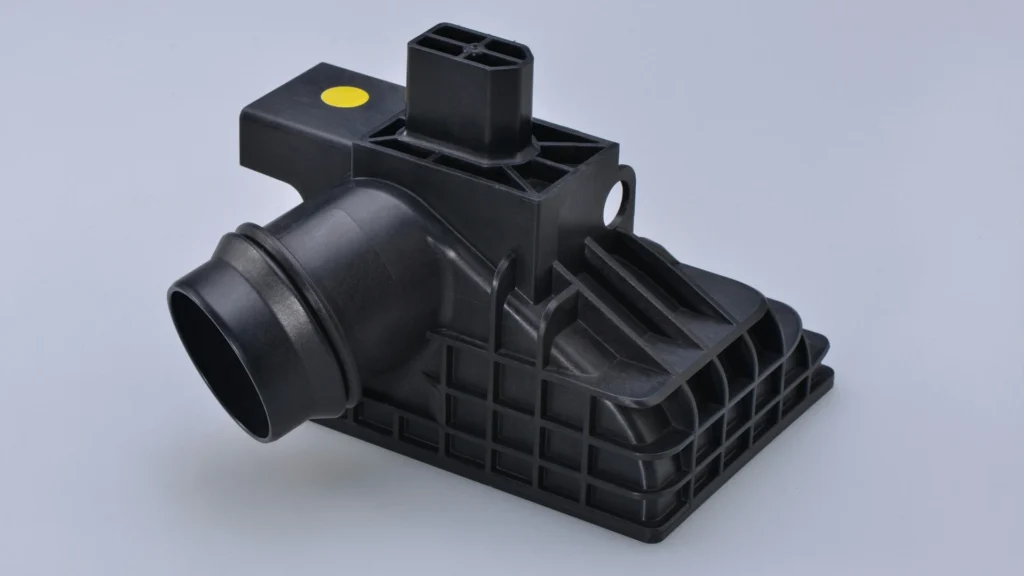
From automotive intake manifolds and gear housings to industrial pump components and electrical connector bodies, glass-filled nylon is used where a molded plastic part must provide metal-like stiffness, dimensional stability, or structural performance at a substantially lower weight.
How Glass Reinforcement Changes Nylon
Adding chopped glass fibers changes the mechanical, thermal, and dimensional properties of nylon across almost every major performance category.
| Property | Effect of Glass Reinforcement |
|---|---|
| Stiffness | GF30 PA 6/6 can have approximately two to three times the tensile modulus of an unfilled PA 6/6 grade, increasing from roughly 3 GPa to 9–10 GPa. |
| Tensile Strength | Tensile strength can increase from approximately 85 MPa for an unfilled PA 6/6 grade to 170–185 MPa for certain GF30 PA 6/6 formulations. |
| Heat Deflection Temperature | Unfilled PA 6/6 may have a heat deflection temperature around 65°C at 1.8 MPa, while certain GF30 PA 6/6 grades can reach approximately 240°C under comparable test conditions. |
| Shrinkage | Molding shrinkage may be reduced from approximately 1.5–2.0% to 0.3–0.7%, improving dimensional control. |
| Moisture Absorption | Glass reinforcement can reduce overall moisture absorption and moisture-related dimensional change compared with unfilled nylon. |
| Impact Resistance | Impact resistance generally decreases because glass-filled grades are more brittle and notch-sensitive than unfilled nylon. |
| Surface Finish | Surface appearance generally degrades as glass content increases because fibers may become visible at the part surface. |
Actual values vary by nylon grade, glass content, moisture conditioning, resin formulation, and test method. Always confirm final design properties using the material supplier’s technical data sheet.
Key Material Trade-Off
Glass reinforcement substantially improves stiffness, strength, heat resistance, and dimensional stability. The trade-off is lower impact toughness, a more visible fiber texture, increased tool wear, and greater sensitivity to gate placement and fiber orientation.
Glass Content Selection
The percentage of glass fiber determines where the material falls on the stiffness, toughness, processability, and cost spectrum.
GF15 Nylon
GF15 nylon contains approximately 15% glass fiber by weight. It provides a modest increase in stiffness and dimensional stability while retaining more toughness and a better surface finish than higher glass-content grades.
Typical applications include:
- Electrical housings
- Protective covers
- Moderately loaded structural components
- Brackets and clips requiring improved rigidity
GF30 Nylon
GF30 nylon contains approximately 30% glass fiber and is one of the most widely used reinforced nylon grades. It provides a strong balance of stiffness, strength, heat resistance, dimensional stability, and injection molding processability.
Typical applications include:
- Automotive structural components
- Industrial equipment housings
- Precision brackets
- Gear housings
- Pump and fluid-handling components
GF50 Nylon
GF50 nylon contains approximately 50% glass fiber and is selected when maximum stiffness, strength, and heat resistance are required.
The higher glass loading makes the material more brittle and more difficult to process. It can also create a rougher surface finish and increase wear on injection molding equipment and tooling.
Typical applications include:
- Highly loaded industrial components
- Structural electrical components
- Metal-replacement applications
- Components exposed to sustained mechanical loads and elevated temperatures
Injection Molding Considerations for Glass-Filled Nylon
Glass-filled nylon requires different tooling, gate design, processing, and quality controls than unfilled nylon.
Tool Wear
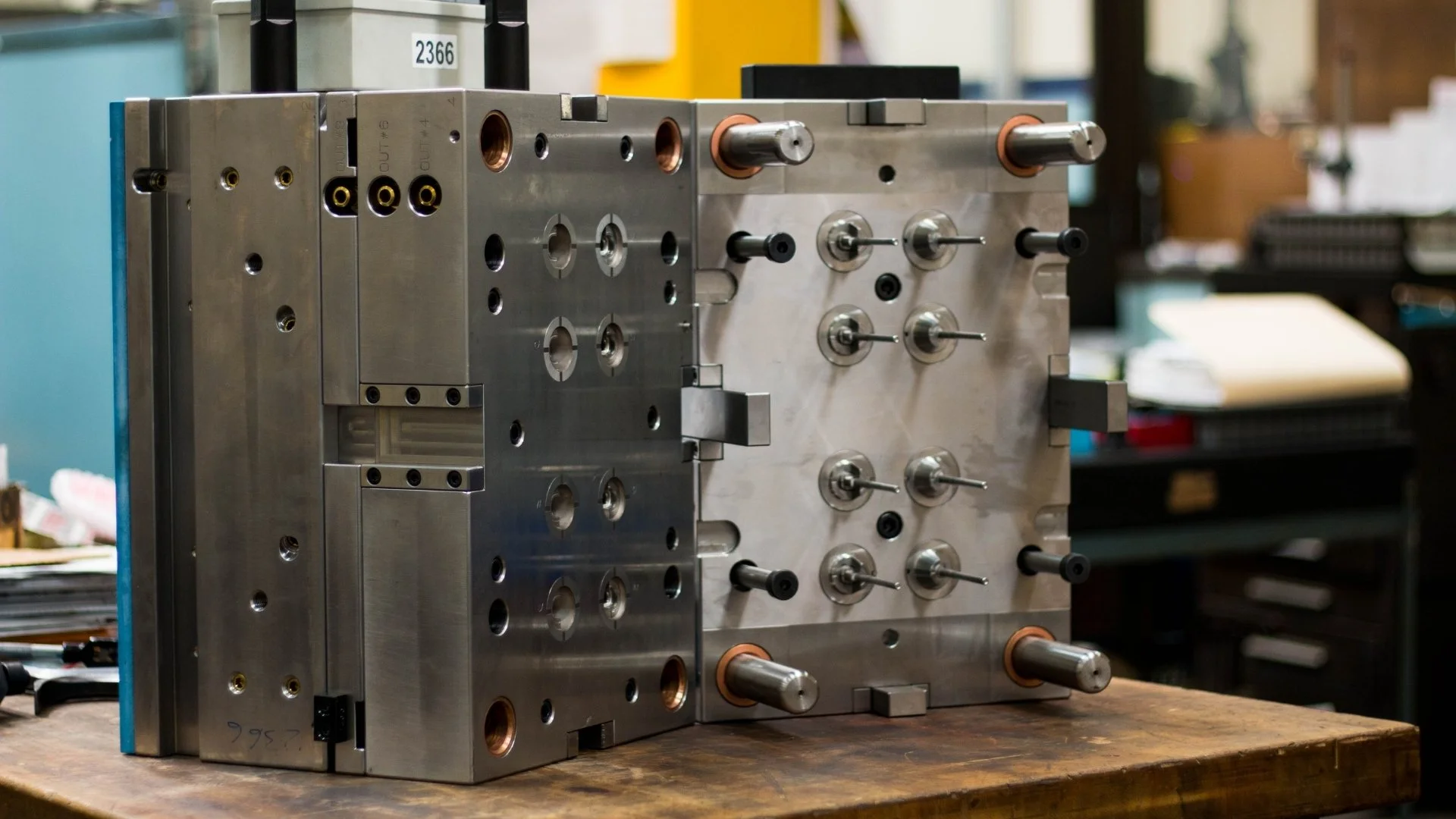
Glass fibers are abrasive. They wear gate inserts, cavity surfaces, screws, barrels, and runner channels significantly faster than unfilled resins.
Molds running GF30 or higher should typically use:
- Hardened gate inserts made from H13 or a comparable tool steel
- Tool hardness of approximately 50 Rockwell C or higher in high-wear areas
- Hard chrome, nitriding, or physical vapor deposition coatings on critical cavity surfaces
- Replaceable gate and runner inserts where practical
Gate and runner dimensions must also accommodate the altered flow behavior and fiber content of the reinforced melt.
Fiber Orientation and Warpage
Glass fibers align primarily in the direction of material flow during injection. This makes glass-filled nylon anisotropic, meaning its mechanical properties and shrinkage differ depending on direction.
The material typically shrinks less in the direction of fiber orientation and more across the fibers. This differential shrinkage can cause twisting, bowing, and dimensional variation.
Careful gate placement, balanced filling, uniform wall thickness, and controlled mold temperature are essential for reducing warpage. Fan gates and film gates can help distribute flow and reduce abrupt fiber orientation gradients.
Weld Lines
Weld lines are often weaker in glass-filled nylon than in unfilled nylon because the fibers do not cross and reinforce the interface where two flow fronts meet.
Gate locations should be selected to keep weld lines away from:
- Highly loaded structural areas
- Screw bosses and fastening points
- Snap fits and flexing features
- Thin sections exposed to impact or vibration
Where weld lines cannot be avoided, the part should be designed so the weld line experiences minimal stress during use.
Material Drying
Glass-filled nylon remains hygroscopic and must be dried before molding. Material moisture should generally be reduced below 0.2%, subject to the resin supplier’s processing specifications.
Molding wet glass-filled nylon can cause:
- Splay and silver streaking
- Poor surface appearance
- Voids and gas formation
- Polymer degradation
- Reduced mechanical performance
Design and Tooling Note
Glass content should be selected before the mold design is finalized. Fiber orientation, shrinkage, gate placement, expected tool wear, surface finish, and weld-line location all influence the mold design and the long-term performance of the finished part.
Advantages of Glass-Filled Nylon
- Higher stiffness — glass reinforcement significantly increases tensile and flexural modulus.
- Greater tensile strength — reinforced grades withstand higher sustained structural loads.
- Improved heat resistance — glass-filled nylon maintains mechanical performance at higher temperatures than unfilled nylon.
- Reduced shrinkage — lower molding shrinkage supports tighter dimensional control.
- Improved dimensional stability — reinforcement reduces moisture-related dimensional change.
- Metal replacement potential — the high strength-to-weight ratio makes glass-filled nylon suitable for replacing certain die-cast or machined metal parts.
- Lower component weight — reinforced nylon is much lighter than steel, aluminum, and many other structural materials.
Disadvantages of Glass-Filled Nylon
- Reduced impact toughness — reinforced grades are more brittle and notch-sensitive than unfilled nylon.
- Visible fibers — higher glass content can produce a rougher or less uniform cosmetic surface.
- Increased tool wear — abrasive fibers shorten the service life of unprotected mold components.
- Anisotropic performance — strength and shrinkage vary based on fiber orientation.
- Greater warpage risk — directional shrinkage can distort parts with uneven geometry or poorly positioned gates.
- Weaker weld lines — structural performance can decline where separate flow fronts meet.
- More demanding processing — drying, temperature control, gate design, and mold construction require greater attention.
Common Applications for Glass-Filled Nylon
Glass-filled nylon is commonly used for components that require a combination of structural performance, heat resistance, chemical resistance, and low weight.
| Industry | Common Applications |
|---|---|
| Automotive | Intake manifolds, engine covers, structural brackets, gear housings, under-hood components, and fluid-handling parts |
| Industrial Equipment | Pump components, valve bodies, machine housings, rollers, structural supports, and wear components |
| Electrical and Electronics | Connector bodies, circuit-breaker components, relay housings, terminal blocks, and structural enclosures |
| Consumer Products | Power-tool housings, appliance components, handles, frames, and load-bearing internal structures |
| Building Systems | Fasteners, mounting brackets, plumbing components, hardware, and structural clips |
Frequently Asked Questions
Is glass-filled nylon stronger than steel?
No. Certain GF50 PA 6/6 grades may reach tensile strengths around 250 MPa, compared with approximately 400–500 MPa for mild steel. However, glass-filled nylon has a much lower density, around 1.4 g/cm³ compared with approximately 7.8 g/cm³ for steel. Its strength-to-weight ratio can therefore make it competitive in weight-sensitive applications where the loading, geometry, and service conditions are appropriate.
Can glass-filled nylon be used outdoors?
Glass-filled nylon can be used outdoors when a UV-stabilized or weather-resistant grade is specified. Standard PA 6/6 without UV stabilizers can yellow, lose surface toughness, and become brittle after prolonged sunlight exposure. The glass fibers are not the primary concern; the nylon polymer matrix requires protection from ultraviolet degradation.
What is the difference between glass-filled and mineral-filled nylon?
Glass fibers provide greater stiffness and strength, primarily in the direction of fiber orientation. Mineral fillers such as talc, calcium carbonate, or glass beads tend to improve stiffness more evenly in all directions. Mineral-filled nylon generally offers better surface finish and less anisotropic warpage, while glass-filled nylon is usually preferred for more demanding structural applications.
What does GF30 mean?
GF30 means that the nylon resin contains approximately 30% glass fiber by weight. GF30 is one of the most common reinforced nylon grades because it provides a practical balance of stiffness, strength, heat resistance, dimensional stability, and moldability.
Does glass-filled nylon absorb moisture?
Yes. The nylon matrix remains hygroscopic even after glass reinforcement is added. Glass fibers reduce the overall proportion of moisture-absorbing polymer and can limit dimensional change, but the material must still be dried properly before molding and evaluated for moisture exposure in service.