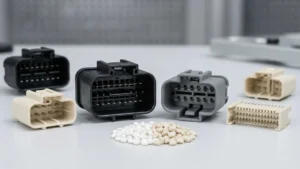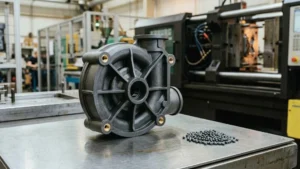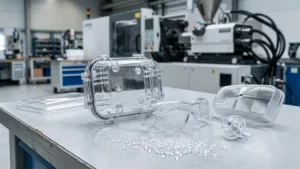
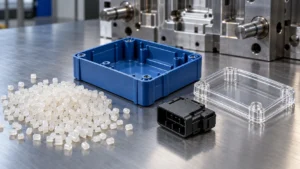
Thermoplastic pellets and molded plastic parts compared with heat-resistant thermoset electrical components

Thermoplastic vs. Thermoset Materials: How They Differ and Which to Choose for Your Part

The fundamental difference between thermoplastics and thermosets — and what it means for injection molding process selection and part design. The most fundamental distinction in plastic material science is the difference between thermoplastics and thermosets. Understanding which type of material you are working with determines the manufacturing process, tooling requirements, processing parameters, and end-use limitations […]

Thermoplastic vs. Thermoset Materials: How They Differ and Which to Choose for Your Part Read More »

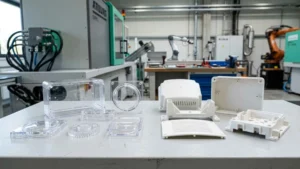
Injection molded plastic parts with sink marks, flash, warpage, and a short shot arranged for quality inspection.

10 Common Injection Molding Defects: What Causes Them and How to Prevent Each One

10 common injection molding defects — what causes each one, how to identify it, and how to prevent it through design and process control. Injection molding defects cost time and money. Some are immediately visible; others only show up in service under load, temperature cycling, or chemical exposure. Understanding the root cause of each defect

10 Common Injection Molding Defects: What Causes Them and How to Prevent Each One Read More »

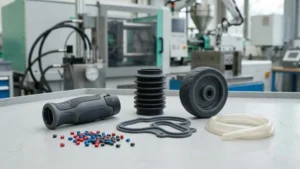
Split-screen comparison of an insert-molded plastic part with a brass threaded insert and an overmolded handle with a soft elastomer grip

Insert Molding vs. Overmolding: What is the Difference ?

A side-by-side comparison of two multi-material injection molding processes — when to use each and what each requires from the part design. Insert molding and overmolding are both multi-material injection molding processes that produce a single molded part integrating more than one material. Engineers frequently ask which manufacturing process to use between overmolding and insert

Insert Molding vs. Overmolding: What is the Difference ? Read More »

Injection-molded glass-filled nylon automotive housing with reinforced ribs and structural mounting features

Glass-Filled Nylon: How It Works, Pros & Cons, and Key Molding Considerations

Properties, advantages, disadvantages, and injection molding considerations for glass-fiber-reinforced nylon. Glass-filled nylon is polyamide reinforced with chopped glass fibers — typically 15%, 30%, or 50% by weight — that dramatically improve stiffness, strength, and dimensional stability compared to unfilled nylon. It is one of the most widely used engineering thermoplastics in injection molding for applications

Glass-Filled Nylon: How It Works, Pros & Cons, and Key Molding Considerations Read More »

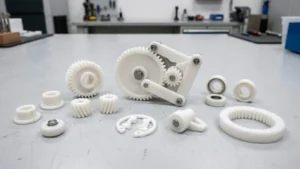
White Delrin acetal gears used in precision mechanical applications

Delrin (POM Acetal) Explained: Material Properties, Common Applications & Molding Considerations

Material properties, injection molding considerations, and applications for Delrin — one of the most dimensionally stable engineering plastics. Delrin is DuPont’s trade name for acetal homopolymer (polyoxymethylene, POM) — a semi-crystalline engineering thermoplastic that delivers exceptional dimensional stability, a naturally low coefficient of friction, high surface hardness, and excellent fatigue resistance. It is the material

Delrin (POM Acetal) Explained: Material Properties, Common Applications & Molding Considerations Read More »

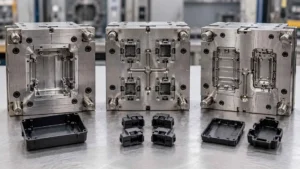
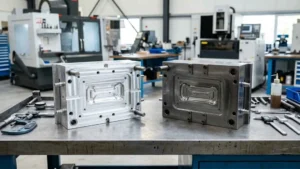
Precision injection mold tooling used to produce custom plastic parts

How Much Does Injection Molding Cost? Estimating Costs for Tooling & Parts

Understanding tooling cost, piece price, and the key factors driving injection molding program economics. Injection molding cost has two distinct components that must be understood separately: tooling cost, the one-time investment to build the mold, and piece price, the per-part cost to run production. Conflating them leads to poor sourcing decisions — either over-investing in

How Much Does Injection Molding Cost? Estimating Costs for Tooling & Parts Read More »

3D printer and injection molding machine comparing plastic part manufacturing methods

Injection Molding vs. 3D Printing: A Practical Guide to Choosing the Right Manufacturing Method for Your Part

A practical framework for choosing between injection molding and 3D printing based on volume, geometry, material requirements, and timeline. Injection molding and 3D printing are both plastic part manufacturing processes, but they serve fundamentally different points in a product’s lifecycle. The choice between them is not primarily about quality or capability — it is about

Injection Molding vs. 3D Printing: A Practical Guide to Choosing the Right Manufacturing Method for Your Part Read More »