A practical comparison of aluminum and steel injection molds, including tooling cost, lead time, mold life, tolerances, cycle time, and production volume.
The injection mold is one of the largest upfront investments in an injection molding program. The material used to build that tool affects how quickly it can be manufactured, how long it can remain in production, and how the tooling investment is distributed across each molded part.
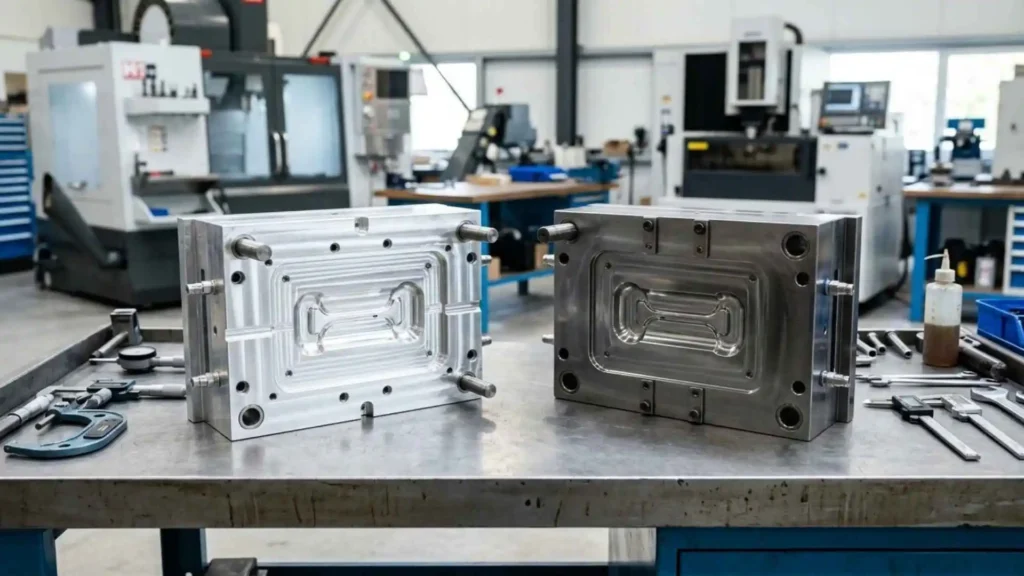
Aluminum tooling generally offers a lower upfront cost and shorter build time. Steel tooling requires a larger initial investment but provides greater wear resistance and a much longer production life.
The right choice depends on expected production volume, resin, tolerance requirements, launch timing, and the expected life of the program.
Why Injection Mold Material Matters
An injection mold operates under repeated heat, pressure, cooling, and mechanical movement. Over thousands or millions of molding cycles, those conditions gradually wear the mold cavity, gates, slides, shutoffs, and other tooling components.
Tool material affects how quickly that wear occurs.
Aluminum is comparatively easy to machine, which can reduce mold manufacturing time and upfront cost. However, it is also softer and less wear-resistant than common tool steels.
Steel takes longer to machine and typically costs more to build, but its hardness and durability make it better suited to sustained production, abrasive materials, complex tooling, and programs that must maintain dimensional consistency over long production runs.
As a result, tooling material is fundamentally a trade-off between speed and upfront investment versus durability and long-term production requirements.
Aluminum Injection Mold Tooling
Aluminum tooling is commonly used for bridge production, design validation, short-run programs, and lower-volume production where speed and initial tooling cost are important.
Why Aluminum Tooling Is Faster and Less Expensive
Aluminum is softer and easier to machine than tool steel. Cutting the mold cavity, drilling features, and making engineering changes can therefore require less machining time.
That typically translates into shorter tooling lead times and a lower initial investment.
Aluminum also has high thermal conductivity. It transfers heat efficiently from the molded part into the mold, which can help reduce cooling time in appropriately designed applications. Actual cycle time still depends on the resin, part geometry, cooling system, and molding process.
How Long Does an Aluminum Injection Mold Last?
There is no universal shot count for an aluminum mold.
Thousands to tens of thousands of molding cycles are common benchmarks for aluminum tooling, while some tools can produce significantly more under favorable conditions. Tool life depends heavily on the aluminum alloy, resin, part geometry, mold construction, maintenance, tolerances, and processing conditions.
Abrasive materials such as heavily glass-filled resins can accelerate wear and reduce tool life.
For programs with modest or uncertain lifetime volume, however, the lower tooling investment may outweigh the shorter mold life.
Steel Injection Mold Tooling
Steel tooling is generally preferred for sustained production programs that require long mold life, dimensional consistency, complex tooling features, or resistance to abrasive materials.
Why Steel Injection Molds Last Longer
Tool steels are substantially harder and more wear-resistant than aluminum. Depending on the steel grade, heat treatment, resin, maintenance, and mold design, a production steel mold may support hundreds of thousands to millions of molding cycles.
That durability becomes especially important when molding abrasive materials such as glass-filled engineering resins or when critical mold surfaces must remain consistent over a long production run.
Steel also supports a wide range of polishing, texturing, repair, and tooling options depending on the selected grade.
The Trade-Off: Cost and Lead Time
Steel tooling typically requires a higher upfront investment and longer manufacturing lead time because the material is more difficult to machine.
For a high-volume program, however, the economics can reverse.
When the tooling investment is distributed across hundreds of thousands or millions of molded parts, its contribution to the cost of each individual part becomes relatively small. The longer tool life can also reduce the risk of premature replacement or significant refurbishment during the program.
Aluminum vs. Steel Injection Molds at a Glance
| Factor | Aluminum Tooling | Steel Tooling |
|---|---|---|
| Tooling Lead Time | Generally shorter | Generally longer |
| Upfront Tooling Cost | Generally lower | Generally higher |
| Typical Tool Life | Thousands to tens of thousands of cycles, sometimes more | Hundreds of thousands to millions of cycles, depending on steel grade and application |
| Wear Resistance | Lower | Higher |
| Long-Term Dimensional Stability | Good for appropriate production volumes, but wear becomes a greater consideration over time | Better suited to maintaining critical tooling dimensions through long production runs |
| Heat Transfer | High thermal conductivity can support efficient cooling | Lower thermal conductivity, but advanced cooling strategies can be incorporated into production tooling |
| Abrasive Resins | Greater risk of accelerated wear | Better suited to abrasive and glass-filled materials when an appropriate steel grade is selected |
| Best Fit | Bridge production, short runs, lower-volume programs, and designs that may still change | Medium- to high-volume production and long-term manufacturing programs |
How to Choose Between Aluminum and Steel Tooling
The correct mold material should be selected around the economics and technical requirements of the complete production program rather than tooling price alone.
Four factors deserve particular attention:
- Production volume: Lower or uncertain lifetime volumes may favor aluminum because the lower initial tooling investment is easier to justify. High, sustained production volumes generally favor steel because the tool must remain productive for far more cycles.
- Launch timeline: When production needs to begin before a full production tool can be completed, aluminum tooling may provide a bridge while longer-life tooling is manufactured.
- Tolerance and part requirements: Tight dimensional requirements over a long production run may favor harder, more wear-resistant steel tooling. Actual molded-part capability still depends on resin, geometry, process control, mold design, and measurement.
- Resin and wear: Abrasive compounds, including many glass-filled materials, increase mold wear and can make hardened steel a better long-term choice.
Budget also matters, but it should be evaluated over the expected life of the program. Aluminum can reduce the upfront tooling investment, while a properly specified steel mold can reduce tooling cost per part when production volumes are high enough.
Can a Program Use Both Aluminum and Steel Tooling?
Yes. Some manufacturing programs use the two tooling approaches in sequence.
For example, an aluminum bridge tool can support early production while a longer-life steel production mold is being completed. Once production requirements and the design are stable, the steel tool can take over sustained manufacturing.
This approach can reduce the conflict between launch timing and long-term tooling requirements. However, it is not automatically the lowest-cost strategy. Expected volume, resin, tooling complexity, part requirements, and the cost of building two tools should all be considered.
Texas Injection Molding’s engineering team can evaluate tooling strategy alongside part design, material selection, production requirements, and launch timing before the tooling investment is committed.
Learn more about Texas Injection Molding’s plastics engineering services.
Frequently Asked Questions
Is an aluminum or steel injection mold cheaper?
Aluminum molds generally have a lower upfront tooling cost because aluminum is easier and faster to machine. Steel tooling usually costs more initially, but its much longer production life can reduce tooling cost per part on high-volume programs.
How many parts can an aluminum injection mold produce?
Aluminum molds commonly support thousands to tens of thousands of molding cycles, and some applications can run significantly longer. Actual mold life depends on the aluminum alloy, resin, part geometry, tolerances, mold design, processing conditions, and maintenance. Abrasive materials can shorten tool life considerably.
When should aluminum tooling be used?
Aluminum tooling can make sense for bridge production, lower-volume programs, design validation, short production runs, or applications where reducing tooling lead time and upfront investment is more important than maximizing mold life.
When should steel injection mold tooling be used?
Steel tooling is generally preferred for sustained medium- to high-volume production, abrasive resins, demanding tooling features, and programs that require the mold to maintain dimensional consistency over hundreds of thousands or millions of molding cycles.
Does mold material affect injection molding cycle time?
It can. Aluminum transfers heat more efficiently than most tool steels, which can help parts cool more quickly in some applications. However, mold design, cooling-channel layout, resin, wall thickness, part geometry, and process settings also influence total cycle time.
Does steel tooling produce tighter tolerances than aluminum tooling?
Steel’s greater hardness and wear resistance can make it better suited to maintaining critical mold dimensions through long production runs. However, mold material alone does not determine part tolerance. Resin shrinkage, part geometry, tooling accuracy, process control, temperature, and measurement capability all affect the dimensional results of an injection molded part.
Related Guides
- How Much Does Injection Molding Cost? Tooling, Parts & Key Drivers
- What Is Rapid Injection Molding? How It Works & When to Use It
- Design for Manufacturability (DFM) in Injection Molding
- Injection Molding Tolerances: What’s Achievable and How to Specify Them
- Injection Molding vs. 3D Printing: How to Choose the Right Process