A complete guide to the properties, grades, and molding of nylon — for engineers and buyers replacing metal with plastic.
If you are an engineer designing a load-bearing part, a product manager evaluating a metal-replacement opportunity, or a buyer sourcing a molder, this guide explains what nylon is, how its grades differ, where it excels, and what to watch for when molding it.
At Texas Injection Molding, we mold nylon — including glass-filled grades — for automotive, industrial, and mechanical programs. Everything here reflects the real decisions our customers face.
What Is Nylon?
Nylon — known technically as polyamide, or PA — is a family of high-performance engineering thermoplastics valued for exceptional strength, wear resistance, and the ability to replace metal in demanding mechanical parts. It was the world’s first commercially successful synthetic engineering polymer, and it remains one of the most specified engineering resins today.
Chemically, nylon is a polyamide: a polymer whose repeating units are joined by amide bonds. Different starting monomers produce different nylon “types,” each with slightly different behavior.
Nylon Grades
- Nylon 6: Made from a single monomer (caprolactam). Easier to process, with better surface finish and impact absorption.
- Nylon 66: Made from two monomers. Higher melting point, greater stiffness, and better heat resistance.
- Specialty grades (11, 12, 46, 610): Targeted improvements in moisture resistance, flexibility, or thermal performance.
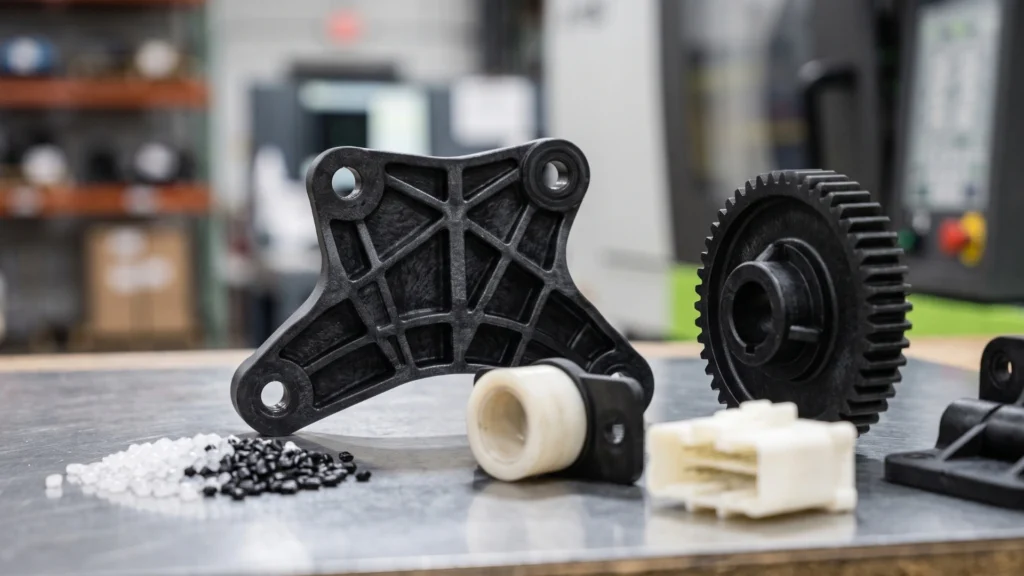
Nylon is very often reinforced. Glass-filled and mineral-filled grades dramatically increase stiffness, strength, and heat resistance — turning nylon into a legitimate metal-replacement material.
Properties of Nylon
| Property | Characteristic | Design Note |
|---|---|---|
| Tensile Strength | High | Among the strongest unreinforced thermoplastics |
| Wear Resistance | Excellent, self-lubricating | Ideal for gears and bearings |
| Heat Resistance | Good (Nylon 66 ~121°C) | Higher with glass fill |
| Chemical Resistance | Strong vs. oils and fuels | Poor vs. strong acids |
| Fatigue Resistance | Excellent | Good for repeated-flex parts |
| Moisture Absorption | High | Affects dimensions — design for it |
| Reinforcement | Takes glass fill well | Approaches light-metal stiffness |
Key Material Consideration
The one thing to design around is moisture. Nylon absorbs water from the air, which increases toughness but reduces stiffness and causes slight swelling. Precision parts are designed for it, and the resin must be thoroughly dried before molding — molding wet nylon produces splay, bubbles, and weak parts.
Advantages of Nylon
- Outstanding mechanical strength: High tensile and impact strength enable metal replacement.
- Self-lubricating: Low friction makes nylon ideal for gears, bearings, and bushings.
- Excellent wear resistance: Holds up under abrasion and repeated stress.
- Chemical and fuel resistance: Resists oils, greases, fuels, and many solvents.
- Reinforcement-friendly: Glass-filled grades approach light-metal performance.
Limitations of Nylon
- Moisture absorption: Causes dimensional change and must be designed and processed for.
- Requires careful drying: Wet resin produces defective parts.
- Higher shrinkage: Demands experienced tooling design for tight tolerances.
- UV sensitivity: Unstabilized nylon degrades in sunlight.
What Products Are Made from Nylon?
| Industry | Typical Nylon Parts |
|---|---|
| Automotive | Intake manifolds, engine covers, gears, connectors, and under-hood parts, often using glass-filled grades |
| Industrial | Gears, bearings, rollers, cams, and wear pads |
| Consumer | Power-tool housings, cookware handles, zip ties, and sporting goods |
| Electrical | Connectors, cable ties, and insulating components |
Nylon in Injection Molding
Nylon is a workhorse of engineering molding, but it rewards discipline. Because it absorbs moisture, resin drying is non-negotiable. It has a sharp melting point and flows readily when molten, so process control and well-designed tooling matter for consistent parts.
The payoff is versatility: by selecting between Nylon 6 and 66 and specifying glass or mineral fill, an experienced molder can tune one material family from flexible clips to rigid, heat-resistant brackets that replace die-cast metal. For a broader comparison, see our Injection Molding Material Selection Guide.
Injection Molding Insight
Nylon grade selection, moisture control, reinforcement level, tooling design, and process control all work together. The right resin can deliver excellent mechanical performance, but improper drying or tooling can compromise otherwise well-designed parts.
Frequently Asked Questions
Is nylon stronger than ABS?
Yes. Nylon has higher tensile strength, better wear resistance, and greater heat and chemical resistance. ABS is easier to finish cosmetically and more dimensionally stable because it does not absorb moisture. The choice depends on whether the part is mechanical or cosmetic.
Why does nylon absorb water, and does it matter?
Nylon’s amide chemistry attracts water. Absorbed moisture increases toughness but reduces stiffness and causes slight swelling. For precision parts, designers account for it and molders dry the resin thoroughly before processing.
What is glass-filled nylon used for?
Adding 30–50% glass fiber dramatically increases stiffness, strength, and heat resistance while reducing moisture sensitivity. It is widely used for automotive under-hood parts, structural brackets, and metal-replacement components.
What is the difference between Nylon 6 and Nylon 66?
Nylon 66 has a higher melting point, greater rigidity, and better heat resistance; Nylon 6 processes more easily with better surface finish and impact absorption. Both are widely used.
Working with Texas Injection Molding
At Texas Injection Molding, we help teams select the right nylon grade and fill level, review designs for manufacturability and moisture behavior before tooling, and run them with scientific process control and thorough resin drying. We manufacture in Texas — shorter lead times, simpler communication, no overseas exposure.
If you are evaluating nylon — especially for a metal-replacement program — contact us to discuss your project. We will tell you directly whether nylon is the right material and what your tooling and lead time will involve.