A complete guide to acrylic plastic — its optical clarity, properties, and molding — for engineers and buyers choosing a transparent material.
If you are an engineer who needs a glass-clear part, a product manager weighing acrylic against polycarbonate, or a buyer sourcing a molder, this guide explains what acrylic is, how it behaves, and when it is the right choice.
In plastics manufacturing, “acrylic” refers to polymethyl methacrylate (PMMA) — not acrylic paint, fibers, or nail products. It is a rigid, transparent thermoplastic best known by trade names like Plexiglas, Lucite, and Acrylite.
Understanding transparent and optical-grade thermoplastics — how they perform, where they excel, and how they are molded — is the foundation of smart material selection for injection molding.
What Is Acrylic?
Acrylic (PMMA) is a transparent thermoplastic prized for glass-like optical clarity, weather resistance, and rigidity. Clear grades can transmit about 92% of visible light while weighing about half as much as glass and offering significantly greater impact resistance than conventional plate glass. It is a go-to material when a part must be crystal clear and hold up outdoors.
Properties of Acrylic
| Property | Characteristic | Design Note |
|---|---|---|
| Optical Clarity | Excellent (up to ~92% transmission) | Exceptional clarity for lenses and transparent parts |
| Weather / UV Resistance | Excellent | Ideal for outdoor use |
| Rigidity | High, but brittle | Can crack under sharp impact |
| Scratch Resistance | Good (better than PC) | Takes hard-coat well |
| Heat Resistance | Moderate (~80°C service) | Not for high heat |
| Chemical Resistance | Fair | Attacked by many solvents |
Acrylic vs. Polycarbonate
The classic decision: acrylic is clearer, more scratch-resistant, more rigid, and often lower in material cost; polycarbonate is far more impact-resistant and generally more heat-tolerant. Choose acrylic for clarity and appearance, and polycarbonate for toughness and safety.
Advantages of Acrylic
- Outstanding optical clarity: Clear grades can transmit about 92% of visible light and maintain excellent transparency.
- Excellent weatherability: Holds up to years of UV and outdoor exposure.
- Rigid and lightweight: Provides a stiff structural feel at about half the weight of glass.
- Good scratch resistance: Better than polycarbonate and accepts hard coatings.
- Easy to finish: Polishes to a flawless edge and bonds cleanly.
Limitations of Acrylic
- Brittle: Can crack under sharp impact where polycarbonate would flex.
- Moderate heat tolerance: Softens well below many higher-temperature engineering resins.
- Solvent sensitivity: Attacked by acetone and many cleaners and can stress-crack under some chemicals.
- Requires drying: PMMA molding resin should be properly dried before injection molding; moisture control is especially critical for optical parts.
What Products Are Made from Acrylic?
| Industry | Typical Acrylic Parts |
|---|---|
| Lighting | Lenses, diffusers, light guides, luminaire covers |
| Signage & Display | Illuminated signs, retail displays, POP fixtures |
| Automotive | Taillight lenses, interior trim, badges |
| Consumer | Cosmetic packaging, appliance windows, housewares |
| Medical | Clear housings, fluid-sight components (non-implant) |
Acrylic in Injection Molding
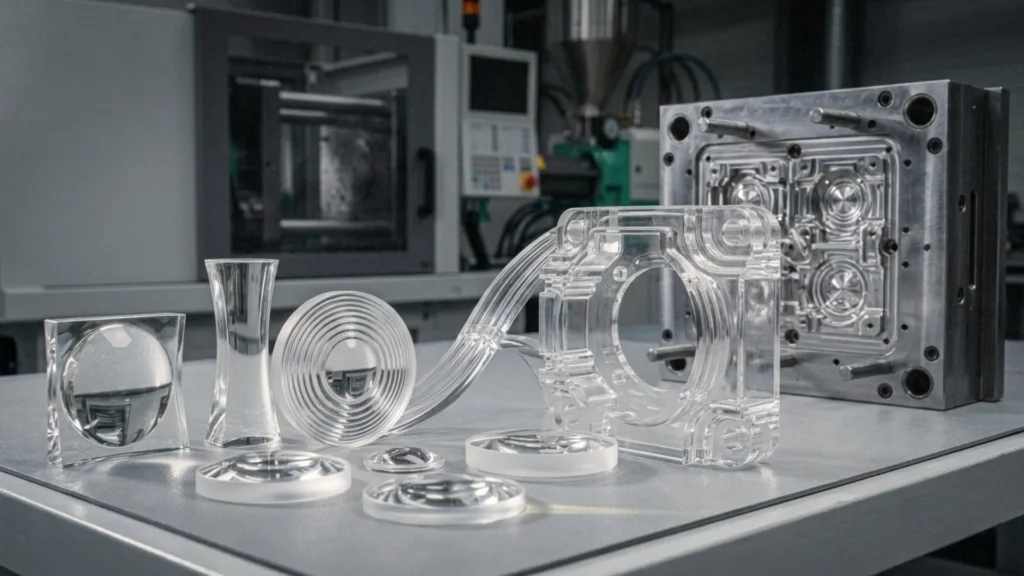
Acrylic molds into brilliant, glass-clear parts, but optical work is demanding: the resin must be thoroughly dried, the tool cavity polished to an optical finish, and the process tuned to avoid flow lines, splay, and internal stress that show up the moment light passes through. Because acrylic is brittle, gate location and wall transitions matter to help minimize stress concentration and cracking.
For parts that must be clear but also survive impact, molders often compare acrylic with polycarbonate. Material selection should account for optical requirements, impact resistance, temperature exposure, chemical environment, part geometry, and cost before tooling is finalized.
Optical Molding Consideration
For transparent acrylic parts, resin drying, mold surface finish, gate placement, wall transitions, and process control all directly affect the finished part’s optical appearance.
Frequently Asked Questions
Is acrylic the same as plexiglass?
Yes. Plexiglas is a brand name for acrylic (PMMA), as are Lucite and Acrylite. They all refer to the same base polymer.
Is acrylic more impact-resistant than glass?
Yes. Acrylic is significantly more impact-resistant than conventional plate glass while weighing about half as much. If it does break, acrylic typically cracks or fractures into larger pieces with edges that are less sharp than broken ordinary glass. However, acrylic scratches more easily than glass and has lower heat resistance.
What is the difference between acrylic and polycarbonate?
Acrylic is clearer, more scratch-resistant, more rigid, and often lower in material cost; polycarbonate is dramatically more impact-resistant and generally more heat-tolerant. Clarity and appearance favor acrylic, while toughness and safety favor polycarbonate.
Can acrylic be used outdoors?
Yes. Acrylic has excellent inherent UV and weather resistance and is one of the strongest transparent plastic options for long-term outdoor applications where maintaining clarity and resisting yellowing are important.
Choosing the Right Material for Your Part
Whether to specify acrylic (PMMA) comes down to matching the material’s properties — strength, temperature and chemical resistance, clarity, and cost — to the real demands of the application. The strongest material choice is the one whose advantages line up with what the part must do, and whose limitations do not matter for that use.
For any injection molding project, the most reliable path is to confirm material selection alongside a design-for-manufacturability (DFM) review before tooling is cut. Getting the resin and the part geometry right early is what protects cost, quality, and lead time down the line.
Related Guides
- Polycarbonate Injection Molding: Properties, Design Tips & Uses
- Injection Molding Material Selection: How to Choose the Best Material for Your Part
- Injection Molding Surface Finishes: SPI Standards & Texture Options
- What Is Glass Transition Temperature (Tg)? A Guide for Engineers
- DFM for Injection Molding: 12 Design Rules