A complete guide to PPS, including its heat, chemical, and flame resistance, for engineers specifying a high-performance resin.
If you are an engineer designing for extreme heat or chemical exposure, evaluating a metal replacement, or sourcing a molder for a demanding part, this guide explains what PPS is and when it is worth specifying.
Understanding high-performance engineering resins, how they perform, where they excel, and how they are molded, is the foundation of smart material selection for injection molding.
What Is Polyphenylene Sulfide?
Polyphenylene sulfide, or PPS, is a high-performance semi-crystalline thermoplastic known for its combination of heat resistance, chemical resistance, dimensional stability, and inherent flame resistance.
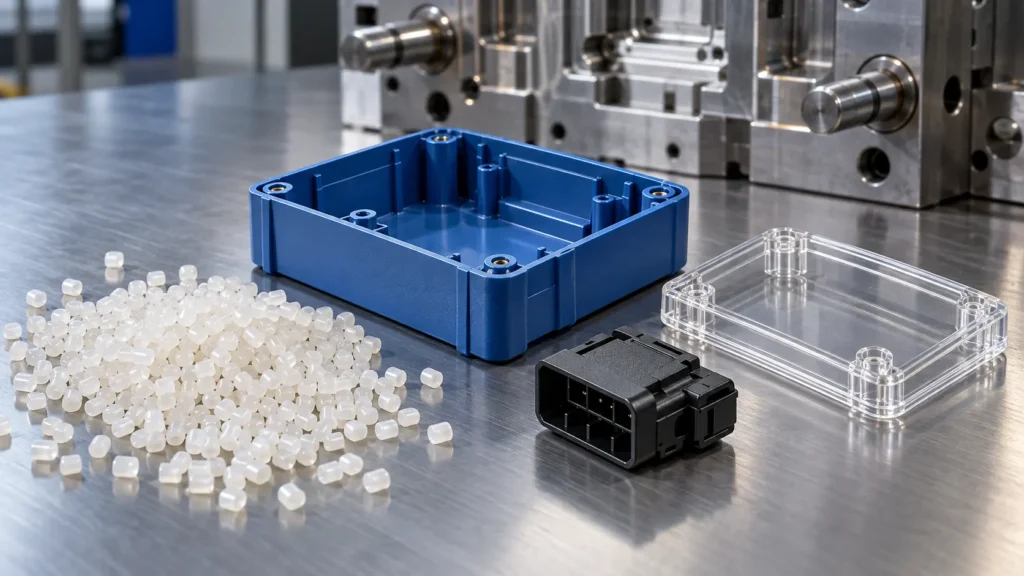
Many injection-molding grades are reinforced with glass fiber, mineral fillers, or a combination of the two. These reinforced compounds can provide high stiffness, strength, and dimensional stability at temperatures beyond the practical range of many engineering thermoplastics.
PPS also offers exceptional resistance to a broad range of solvents, fuels, oils, acids, and bases. No known solvent dissolves PPS below approximately 200°C, although actual chemical compatibility depends on the specific chemical, concentration, temperature, exposure time, and PPS grade.
Properties of PPS
| Property | Characteristic | Design Note |
|---|---|---|
| Long-term temperature capability | Approximately 200°C for many grades | Some PPS compounds have published service temperatures or thermal ratings approaching 240°C; verify the specific grade |
| Chemical resistance | Excellent | Resists a broad range of fuels, oils, solvents, acids, and bases; compatibility remains chemical- and temperature-dependent |
| Flame resistance | Inherent | Many PPS compounds achieve UL 94 V-0 without added flame-retardant packages; rating depends on grade and tested thickness |
| Dimensional stability | Excellent, especially in reinforced grades | Low moisture absorption and controlled shrinkage support precision applications |
| Stiffness | Very high for a thermoplastic when reinforced | Can support metal-replacement designs where the application’s mechanical requirements are met |
| Moisture absorption | Very low | Helps maintain dimensional stability in humid and wet environments |
| Cost | High | Typically reserved for applications that justify high-performance material pricing |
Why PPS Is Considered for Metal Replacement
Reinforced PPS can maintain stiffness, dimensional stability, and chemical resistance at elevated temperatures while allowing complex features to be molded into a single component. In suitable applications, this can reduce part count and provide an alternative to machined or assembled metal components.
Advantages of PPS
- High temperature capability: Many PPS grades are used for long-term service around 200°C, with some commercial grades carrying higher published thermal ratings.
- Excellent chemical resistance: PPS resists a broad range of automotive fluids, fuels, oils, solvents, acids, and bases.
- Inherent flame resistance: Many PPS compounds can achieve UL 94 V-0 ratings without added flame-retardant packages.
- Excellent dimensional stability: Low moisture absorption and controlled shrinkage help PPS maintain dimensions in demanding environments.
- High stiffness: Glass- and mineral-reinforced grades provide high stiffness for a thermoplastic and can support certain metal-replacement applications.
Limitations of PPS
- Limited toughness in some grades: Standard unmodified PPS can be relatively brittle compared with tougher engineering thermoplastics. Impact-modified and other specialized grades are available.
- High cost: PPS is a premium engineering resin and is generally specified when its performance advantages justify the material cost.
- High processing temperatures: PPS requires substantially higher melt and mold temperatures than commodity plastics and many conventional engineering thermoplastics.
- Tooling wear with reinforced grades: Glass- and mineral-filled PPS compounds are abrasive, so tooling materials and surface treatments should be selected with expected production volume and wear in mind.
What Products Are Made from PPS?
| Industry | Typical PPS Parts |
|---|---|
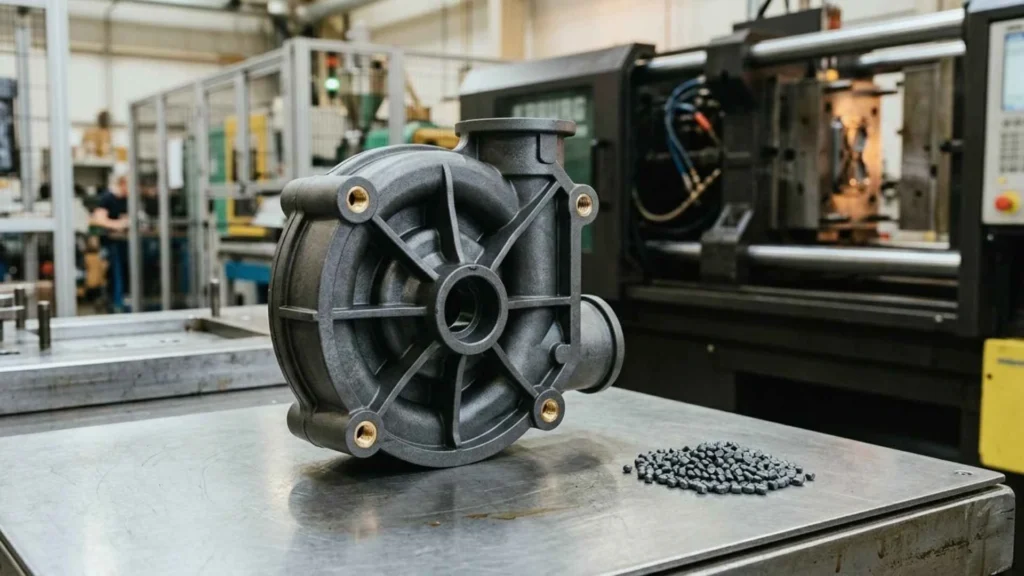
| Automotive | Pump housings, thermostat components, EV components, and other under-hood parts |
| Electrical | Connectors, coil bobbins, sockets, and components exposed to elevated temperatures |
| Industrial | Pump and valve components, chemical-handling parts, and fluid-system components |
| Appliance | High-temperature components positioned near heating elements |
| Aerospace | Heat- and chemical-resistant components where the selected PPS grade meets application requirements |
PPS in Injection Molding
PPS can produce precise, dimensionally stable parts with thin or intricate features because of its strong flow characteristics. However, processing temperatures are considerably higher than those used for commodity plastics and many conventional engineering thermoplastics.
The specific melt temperature, mold temperature, drying requirements, and processing window depend on the PPS grade and resin manufacturer’s recommendations. Proper mold temperature control is particularly important because crystallinity can affect dimensional stability and long-term thermal performance.
Reinforced PPS compounds also require attention to tooling wear because glass and mineral fillers are abrasive. Tool steel, gating, venting, and processing conditions should therefore be selected for the specific PPS compound and expected production volume.
PPS is most often considered when a molded component needs a combination of elevated-temperature performance, chemical resistance, dimensional stability, electrical performance, or flame resistance.
Frequently Asked Questions
How heat-resistant is PPS?
PPS is commonly used for long-term service around 200°C, while some commercial grades have published service temperatures or thermal ratings approaching 240°C. The allowable temperature depends on the specific grade, mechanical load, environment, and required service life.
Is PPS chemically resistant?
Yes. PPS offers excellent resistance to a broad range of solvents, fuels, oils, acids, bases, and automotive fluids. No known solvent dissolves PPS below approximately 200°C. However, chemical compatibility still depends on the specific chemical, concentration, temperature, exposure duration, and PPS grade.
Why is PPS often glass- or mineral-filled?
Glass and mineral reinforcement can increase the stiffness, strength, dimensional stability, and thermal performance of PPS while reducing shrinkage. These properties make reinforced grades useful for precision structural components and some metal-replacement applications. Unfilled, impact-modified, and other specialized PPS grades are also available for applications with different performance requirements.
What is the difference between PPS and PEEK?
Both PPS and PEEK are high-performance thermoplastics used in demanding applications. PEEK generally provides higher temperature capability and greater toughness, but it also typically carries a significantly higher material cost. PPS can be a more economical option when its thermal, chemical, mechanical, and dimensional properties meet the application’s requirements.
Choosing the Right Material for Your Part
Whether to specify PPS comes down to matching its stiffness, temperature capability, chemical resistance, dimensional stability, flame performance, processing requirements, and cost to the actual demands of the application.
The strongest material choice is not necessarily the material with the highest performance on every specification. Instead, engineers should select a resin whose strengths align with the operating conditions of the part and whose limitations do not create unnecessary cost or design risk.
For an injection molding project, material selection should be confirmed alongside a design-for-manufacturability review before tooling is finalized. The selected PPS grade can affect shrinkage, tooling materials, mold temperature, gating, part geometry, and other processing decisions.