A complete guide to PEI — its heat resistance, flame resistance, and molding — for engineers specifying a high-performance resin.
If you are designing for high heat or strict flame ratings, evaluating a metal or ceramic replacement, or sourcing a molder for a demanding program, this guide explains what PEI is, why it commands a premium, and when it is worth it.
Understanding high-performance engineering resins — how they perform, where they excel, and how they are molded — is the foundation of smart material selection for injection molding.
What Is Polyetherimide?
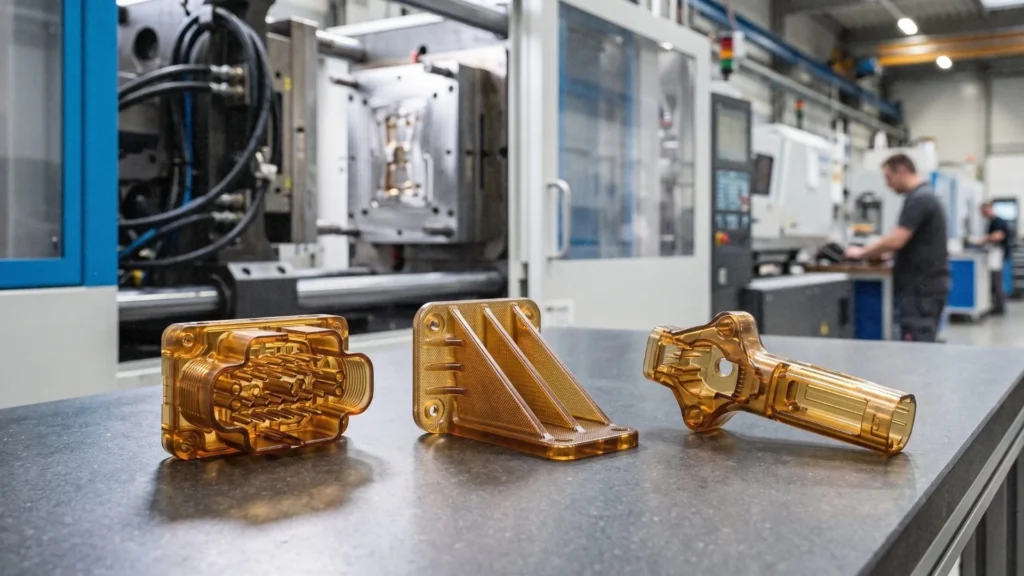
Polyetherimide — PEI, best known by the ULTEM™ brand name — is a high-performance amorphous thermoplastic combining exceptional heat resistance, inherent flame resistance, and high strength. Its imide structure contributes high thermal stability and rigidity, while ether linkages increase chain flexibility and melt processability, allowing PEI to be injection molded.
Originally commercialized by General Electric under the ULTEM name in 1982, the ULTEM resin family is now produced by SABIC.
Properties of Polyetherimide
| Property | Characteristic | Design Note |
|---|---|---|
| Long-term heat resistance | Up to approximately 170–180°C, depending on grade and test criterion | Exceptional thermal performance for an injection-moldable thermoplastic |
| Flame resistance | Inherently flame resistant; many grades achieve UL 94 V-0 | Low smoke; verify the UL rating and minimum thickness for the specific grade |
| Strength & rigidity | Very high | Excellent dimensional stability and creep resistance |
| Chemical resistance | Good resistance to many fluids and aqueous environments | Vulnerable to certain solvents and strong chemicals; verify compatibility |
| Electrical properties | Excellent dielectric performance | Stable across a broad range of temperatures and frequencies |
| Sterilization | Compatible grades withstand steam, gamma, and EtO sterilization | Medical-grade PEI is available for repeated sterilization cycles |
| Cost | High | Typically specified when its performance advantages are required |
When PEI Earns Its Premium
Consider an aircraft interior component made from an aerospace-qualified PEI grade to meet stringent flame, smoke, toxicity, and heat-release requirements, or a reusable medical component made from a healthcare grade designed to withstand repeated sterilization cycles. In applications like these, PEI can enable metal replacement, weight reduction, and part consolidation.
Advantages of Polyetherimide
- Exceptional heat resistance: Maintains useful mechanical properties at temperatures where many thermoplastics begin to soften or lose performance.
- Inherent flame resistance: Many PEI grades achieve UL 94 V-0 with low smoke without added flame-retardant modifiers.
- High strength and creep resistance: Provides strong dimensional stability under sustained load and elevated temperatures.
- Excellent electrical insulation: Maintains stable dielectric properties across demanding electrical and electronic applications.
- Sterilization capability: Healthcare grades are available that tolerate repeated steam, gamma, and ethylene-oxide sterilization cycles.
Limitations of Polyetherimide
- High cost: PEI is significantly more expensive than commodity and standard engineering thermoplastics.
- Demanding processing requirements: High melt temperatures, elevated mold temperatures, and thorough resin drying are required.
- Notch sensitivity: Sharp corners and stress concentrations should be minimized through careful part design.
- Selective chemical resistance: Certain chlorinated solvents, ketones, aromatic hydrocarbons, and strong alkaline environments can attack standard PEI grades.
What Products Are Made from PEI?
| Industry | Typical PEI / ULTEM Parts |
|---|---|
| Aerospace | Interior components, air ducts, and parts requiring low flame, smoke, and toxicity (FST) performance |
| Medical | Reusable surgical instruments, sterilization trays, and other components designed for repeated sterilization |
| Electronics | Connectors, sockets, burn-in test components, and heat-exposed electrical insulators |
| Automotive | Under-hood sensors, lighting components, and electrical parts exposed to elevated temperatures |
| Industrial | High-temperature fluid-handling components, valves, and structural components |
PEI in Injection Molding
Injection molding PEI requires capable equipment and tight process control. High melt and mold temperatures, thorough resin drying, and consistent processing conditions are essential for producing reliable parts.
Because PEI is an expensive resin, robust tooling and disciplined process control are especially important for minimizing scrap and maintaining consistent part quality. Specific processing conditions should always be based on the selected resin grade and the material supplier’s recommendations.
See the Guide to Injection Molding Material Selection for how PEI compares to other engineering and high-performance resins.
Processing Consideration
PEI’s high material cost and demanding processing requirements make drying, temperature control, tooling design, and process consistency especially important. Selecting the exact resin grade before finalizing tooling helps ensure that processing conditions, shrinkage expectations, and part requirements are aligned.
Frequently Asked Questions
Is PEI the same as ULTEM?
PEI is the generic name for polyetherimide, while ULTEM is SABIC’s best-known brand of PEI resin. ULTEM grades are therefore PEI, but PEI is the broader material classification rather than a specific brand.
Why is polyetherimide so expensive?
PEI delivers capabilities that commodity and many standard engineering plastics cannot, including high-temperature performance, inherent flame resistance, strong dimensional stability, and specialized grades for applications such as repeated sterilization. Its more complex chemistry and demanding manufacturing requirements contribute to its higher cost, so it is typically specified when those performance advantages are necessary.
How heat-resistant is PEI?
Depending on the grade and application, PEI can support long-term service at temperatures around 170°C, with some ULTEM grades carrying relative thermal indices up to approximately 180°C. Continuous-use temperature, relative thermal index, heat-deflection temperature, and glass-transition temperature are different measurements, so the appropriate value should be confirmed for the specific grade and application.
Can PEI be sterilized for medical use?
Yes. Healthcare grades of PEI are available that withstand repeated steam autoclave, gamma, and ethylene-oxide sterilization cycles, which is one reason PEI is used for reusable medical instruments and trays. Sterilization compatibility should always be confirmed for the specific resin grade and intended number of cycles.
Choosing the Right Material for Your Part
Whether to specify PEI comes down to matching the material’s properties — strength, heat resistance, chemical resistance, optical requirements, and cost — to the real demands of the application. The best material choice is the one whose advantages align with what the part must do and whose limitations are acceptable for the application.
Because PEI properties and certifications can vary by grade, engineers should evaluate the specific resin datasheet rather than relying on the general properties of the PEI material family alone.
For any injection molding project, the most reliable path is to confirm material selection alongside a design-for-manufacturability (DFM) review before tooling is cut. Getting the resin and the part geometry right early helps protect cost, quality, and lead time down the line.