A complete guide to HDPE — its toughness, chemical resistance, and molding — for engineers and buyers selecting a durable, low-cost resin.
If you are an engineer designing a rugged container or component, a product manager targeting low cost, or a buyer sourcing a molder, this guide explains what HDPE is, how it behaves, and when it is the right choice.
Understanding polyethylene and other commodity resins — how they perform, where they excel, and how manufacturers mold them — provides the foundation for smart material selection in injection molding.
What Is HDPE?
High-density polyethylene — HDPE — is a tough, lightweight, semi-crystalline thermoplastic and one of the most widely produced plastics in the world. Its mostly linear polymer chains have relatively little branching, which allows them to pack closely together and form a highly crystalline structure.
As a result, HDPE offers a high strength-to-density ratio, excellent resistance to many chemicals, and negligible moisture absorption. Manufacturers use it for everything from bottles and chemical containers to crates, fittings, closures, and industrial components.
Properties of HDPE
HDPE combines toughness, chemical resistance, and low moisture absorption at a relatively low material cost. However, its semi-crystalline structure also creates relatively high molding shrinkage, so designers must account for dimensional behavior during part and tool development.
| Property | Characteristic | Design Note |
|---|---|---|
| Density | 0.94–0.97 g/cm³ | Denser and stiffer than LDPE |
| Chemical Resistance | Excellent | Handles many acids, bases, and aqueous chemicals; compatibility depends on the specific chemical and conditions |
| Moisture Absorption | Negligible | Performs well in wet and humid environments |
| Impact Resistance | Good, including at low temperatures | Provides tough and forgiving performance |
| Melting Point | Approximately 125–135°C | Varies by grade and molecular structure |
| Stiffness | Moderate | Stiffer than LDPE but generally less stiff than polypropylene |
| Cost | Very low | Widely available commodity resin |
HDPE vs. LDPE
HDPE and LDPE are both forms of polyethylene, but their molecular structures differ. HDPE has less chain branching, so its polymer chains pack more closely and form a more crystalline structure. Consequently, HDPE offers greater density, stiffness, and strength. By contrast, LDPE has greater branching, which gives it lower density, greater flexibility, and a softer feel.
Advantages of HDPE
HDPE delivers a useful combination of durability, chemical resistance, and affordability. In addition, manufacturers can process it efficiently for many high-volume applications.
- Excellent chemical resistance: HDPE handles many acids, bases, detergents, and other chemicals well. However, engineers should confirm compatibility with the specific chemical and operating conditions.
- Tough and impact-resistant: The material maintains good toughness even at relatively low temperatures.
- Negligible moisture absorption: Because HDPE absorbs very little water, it performs well in wet or humid environments.
- Food-contact grades: Resin suppliers offer HDPE grades for food packaging and handling applications. Manufacturers should select a compliant grade for the intended conditions of use.
- Low cost: HDPE’s broad availability and commodity pricing support cost-effective high-volume production.
- Commonly recyclable: HDPE carries resin identification code 2, and many recycling programs accept products made from it.
Limitations of HDPE
Despite its versatility, HDPE does not suit every application. Designers should consider several limitations before specifying the material.
- Hard to bond and paint: HDPE has low surface energy, which can make adhesives, printing, and coatings difficult without surface treatment.
- UV degradation: Prolonged sunlight exposure can reduce the mechanical properties of unstabilized HDPE. For outdoor applications, manufacturers can instead use UV-stabilized grades.
- Moderate stiffness and heat resistance: Other engineering plastics may provide better performance for highly rigid structural components or sustained high-temperature service.
- Relatively high molding shrinkage: Because HDPE has a semi-crystalline structure, designers must carefully account for shrinkage and warpage during part and tool development.
What Products Are Made from HDPE?
Manufacturers process HDPE through several methods, including injection molding, blow molding, extrusion, and rotational molding. Therefore, not every familiar HDPE product comes from an injection molding process.
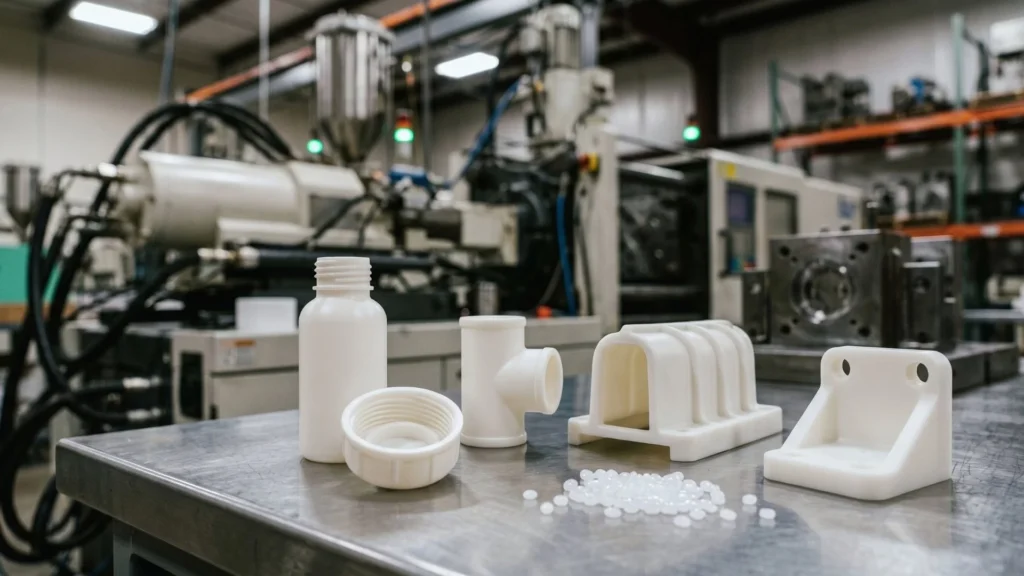
For example, manufacturers typically blow mold products such as milk jugs and large containers. Injection molding, meanwhile, works well for caps, closures, fittings, crates, totes, housings, and other durable components.
| Industry | Typical HDPE Products | Common Manufacturing Process |
|---|---|---|
| Packaging | Bottles, jugs, caps, closures, and tubs | Blow molding and injection molding |
| Consumer | Storage bins, toys, housewares, and cutting boards | Injection molding, extrusion, and other processes |
| Industrial | Pipe fittings, liners, containers, and protective components | Injection molding, extrusion, and rotational molding |
| Automotive | Fuel tanks, fluid reservoirs, clips, and molded components | Blow molding and injection molding |
| Material Handling | Crates, totes, pallets, and bins | Injection molding |
HDPE in Injection Molding
HDPE works well for economical, high-volume injection molding. The resin flows readily through the mold and releases cleanly from tooling. In addition, HDPE is not hygroscopic, so processors generally do not need to pre-dry the resin.
Because of these processing characteristics, manufacturers commonly choose HDPE for caps, closures, fittings, crates, containers, housings, and other durable molded products.
However, shrinkage remains an important design consideration. HDPE’s semi-crystalline structure causes it to shrink more than many amorphous plastics as it cools. Therefore, engineers must consider part geometry, wall thickness, gate location, mold temperature, and processing conditions when planning final dimensions.
For a broader comparison of common injection molding resins, see the Guide to Injection Molding Material Selection.
HDPE Injection Molding Considerations
Material selection represents only one part of developing a successful HDPE component. Because the resin’s semi-crystalline structure affects shrinkage and dimensional behavior, engineers should consider its processing characteristics before finalizing the part and mold.
- Shrinkage: HDPE typically experiences relatively high molding shrinkage compared with amorphous materials. Therefore, toolmakers must account for the expected shrinkage of the specific resin grade when sizing the mold cavity.
- Warpage: Uneven cooling, inconsistent wall thickness, and material orientation can create differential shrinkage. As a result, these factors can distort the finished part.
- Wall thickness: Reasonably uniform wall sections promote more consistent filling, cooling, and shrinkage throughout the component.
- Gate location: Gate placement influences material flow, weld lines, packing, and shrinkage direction. Consequently, engineers should evaluate gate strategy alongside the overall part geometry.
- Mold temperature: Mold temperature affects cooling rate, crystallinity, surface appearance, cycle time, and dimensional behavior. Processors should therefore match molding conditions to the selected HDPE grade and part requirements.
- Material drying: HDPE does not absorb significant moisture from the atmosphere. Unlike nylon, polycarbonate, or PET, it generally does not require pre-drying before molding.
Design Consideration
Engineers should finalize HDPE grade selection and part design together. Resin grade, geometry, wall thickness, gate location, cooling, and processing conditions all influence shrinkage, warpage, and final dimensional accuracy.
Frequently Asked Questions
What is the difference between HDPE and LDPE?
HDPE has less molecular branching, so its polymer chains pack more closely together. As a result, HDPE has greater density, stiffness, and strength. LDPE contains more branching, which makes it lower in density, softer, and more flexible. Manufacturers commonly use HDPE for rigid containers and molded components, while LDPE often serves flexible films, packaging, and squeeze applications.
Is HDPE food-safe?
Resin suppliers offer food-contact HDPE grades for packaging, containers, caps, closures, and food-handling applications. However, HDPE alone does not automatically make a product suitable for every food-contact use. Manufacturers must select a compliant resin grade based on the intended food type, temperature, and conditions of use.
Is HDPE stronger than polypropylene?
Neither material is universally stronger. Polypropylene generally provides greater stiffness and better heat resistance. HDPE, however, often provides better low-temperature toughness and impact performance. Therefore, the right choice depends on the application’s stiffness, impact, temperature, chemical resistance, and flexibility requirements.
Does HDPE need to be dried before injection molding?
No in most cases. HDPE is not hygroscopic, so processors generally do not need to pre-dry it before injection molding. As a result, material handling is simpler than with moisture-sensitive engineering plastics such as nylon and polycarbonate.
Can HDPE be recycled?
Yes. HDPE is a thermoplastic, so manufacturers can re-melt and reprocess it under appropriate conditions. It also carries resin identification code 2. In addition, many recycling programs accept HDPE products, although acceptance varies by product type and local recycling system.
Choosing the Right Material for Your Part
Choosing HDPE comes down to matching its properties with the real demands of the application. Engineers should consider toughness, stiffness, temperature resistance, chemical resistance, dimensional requirements, and cost together.
Ultimately, the strongest material choice is the one whose advantages support what the part must do without introducing limitations that create problems for the application.
For any injection molding project, engineers should confirm material selection alongside a design-for-manufacturability (DFM) review before tooling begins. By getting the resin and part geometry right early, manufacturers can better protect cost, quality, dimensional performance, and lead time throughout the program.