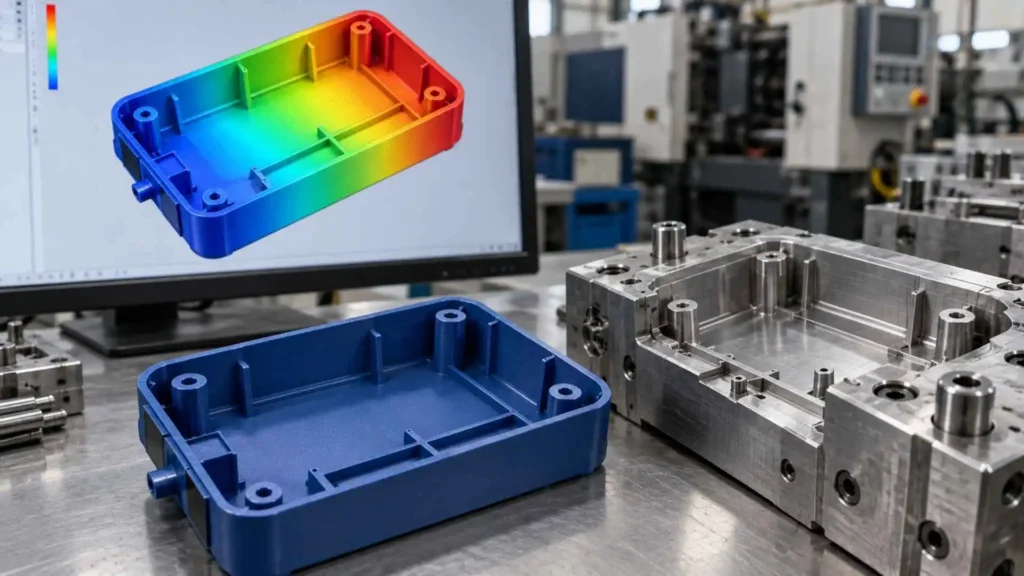
How mold flow simulation helps engineers evaluate filling, identify potential defects, and refine a part before the mold is built.
Mold flow analysis is a computer simulation used to predict how molten plastic moves through an injection mold. Depending on the study, it can also evaluate packing, cooling, shrinkage, and warpage.
Running the analysis before tooling begins helps engineers identify problems while the part and mold designs can still be changed in CAD. Those changes are typically easier and less expensive than modifying a completed tool.
How Mold Flow Analysis Works
The analysis starts with the part geometry, the selected resin grade, and proposed gate locations. Engineers also define processing conditions and, where needed, model the runner system and cooling channels.
The software calculates how the plastic flow front advances through the cavity and how pressure and temperature change during filling. Additional packing, cooling, and warpage analyses evaluate how the material shrinks and how the part may distort.
Engineers use these predictions to compare design options, adjust gate locations, and refine the tooling concept before mold construction begins.
What Mold Flow Analysis Can Predict
The results depend on the software, material data, and analysis sequence. Common outputs include:
- Fill pattern and short-shot risk: How the cavity fills and where the material may stop before the part is complete.
- Weld and knit lines: Where separate flow fronts meet, potentially creating visible seams or areas of reduced strength.
- Air traps: Locations where air may become trapped, helping engineers evaluate venting needs and the risk of incomplete filling or burn marks.
- Warpage: How uneven shrinkage and cooling may cause the part to deviate from its intended shape.
- Sink-mark risk: Areas where thick sections may shrink enough to create surface depressions.
- Injection pressure and clamp force: Estimated requirements that help engineers assess whether the proposed process fits the intended molding machine.
When Mold Flow Simulation Is Worth Doing
Simulation is especially valuable when a design has limited room for error or when tooling changes would be costly. Common examples include:
- Complex, high-value, or high-volume parts.
- Thin-wall designs or parts with challenging flow paths.
- Parts with tight cosmetic or dimensional requirements.
- Programs where a tooling correction could delay production.
For simpler parts, a basic study combined with an experienced molder’s design review may be sufficient. More demanding applications can justify a detailed filling, packing, cooling, and warpage study.
The Benefits of Mold Flow Analysis
Used early in development, simulation helps engineers make informed decisions before committing to tooling.
- Fewer avoidable tooling revisions: Potential problems can be addressed in the design rather than in a completed mold.
- Better gate and runner decisions: Engineers can compare options and evaluate their effects on filling and weld-line locations.
- Lower defect risk: Predictions help identify potential cosmetic and dimensional problems before production trials.
- Greater confidence in manufacturability: The analysis supports a more informed review of the part, resin, mold, and proposed process.
The Limitations of Mold Flow Simulation
A simulation is only as reliable as its inputs and assumptions. The CAD geometry, resin data, mesh quality, and processing conditions must represent the intended application. Incomplete or inaccurate inputs can produce misleading results.
The scope of the study also matters. A basic fill analysis does not provide the same information as a study that includes packing, cooling, and warpage.
Simulation Supports Physical Validation
Mold flow analysis reduces uncertainty, but it does not guarantee a defect-free part. Mold trials, first-article inspection, and process validation are still needed to confirm performance.
Paired with experienced engineering judgment, flow analysis helps reduce tooling risk. Texas Injection Molding uses flow analysis on demanding parts before tooling is committed.
Frequently Asked Questions
What is mold flow analysis used for?
Mold flow analysis predicts how molten plastic fills a mold and helps identify potential short shots, weld lines, and air traps. Additional analyses can evaluate sink-mark risk, cooling, shrinkage, and warpage. Engineers use the results to refine part and mold designs before tooling is built.
When is mold flow simulation worth it?
It is especially useful for complex, thin-wall, high-volume, or appearance-critical parts, as well as programs where a tooling error would be expensive to correct. The level of analysis should match the design’s risks and requirements.
Does mold flow analysis guarantee a perfect part?
No. Results depend on accurate inputs and realistic assumptions. Physical mold trials, part inspection, and process validation are still needed to confirm that the mold produces parts that meet requirements.
Can mold flow analysis help choose a gate location?
Yes. Engineers can compare gate positions to evaluate fill balance, pressure requirements, and weld-line locations. When the study includes warpage analysis, they can also assess how gating changes may affect dimensional distortion.
Related Guides
- How to Design Injection Molded Parts: Wall Thickness, Draft & Gates
- Injection Molding Defects: Causes, Examples & How to Fix Each One
- DFM for Injection Molding: 12 Design Rules
- Aluminum vs. Steel Injection Molds: Cost, Tool Life & Lead Time
- What Is Scientific Injection Molding and Why Does It Matter?