A practical comparison of two of the most common injection molding plastics — how they differ and how to choose between them.
ABS and polypropylene (PP) are the two most produced engineering and commodity thermoplastics in injection molding. Together they cover a large fraction of all plastic parts manufactured globally — consumer goods, automotive components, packaging, industrial equipment, and medical devices. They process in fundamentally similar ways but have very different property profiles, and selecting the wrong one for an application is a common and costly mistake.
Key Property Comparison
| Property | ABS | Polypropylene (PP) |
|---|---|---|
| Density | 1.04–1.06 g/cm³ | 0.89–0.91 g/cm³ — significantly lighter, advantageous for weight-sensitive applications |
| Tensile Strength | 6,000–8,000 psi | 4,500–6,000 psi — ABS is stronger in structural loading |
| Impact Resistance | Good impact resistance at room temperature | Similar room-temperature impact resistance; better low-temperature toughness in copolymer grades |
| Flexural Modulus | Stiffer — 300,000–400,000 psi | More flexible — 150,000–250,000 psi |
| Heat Resistance | HDT 85–100°C | HDT 55–65°C — ABS handles higher service temperatures |
| Chemical Resistance | Poor resistance to aromatic solvents and ketones | Excellent resistance to most acids, bases, and solvents |
| Moisture Absorption | Minimal but measurable | Essentially zero — excellent for humid or wet environments |
| Surface Finish | Excellent — accepts high gloss, paint, and plating | Waxy surface is difficult to paint or bond without treatment |
| Cost | Generally higher material cost | Generally lower cost per pound — a meaningful factor for high-volume, cost-sensitive programs |
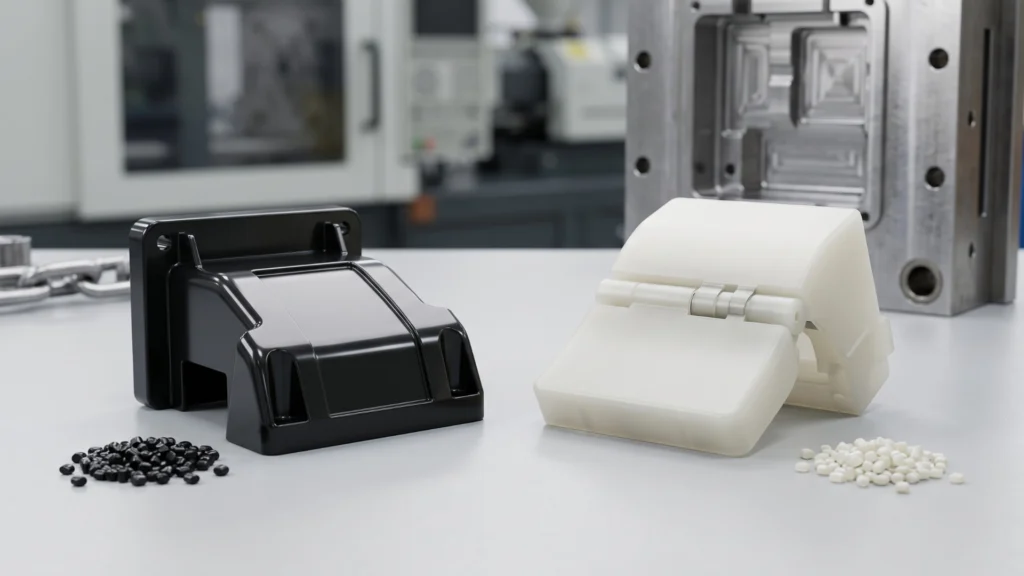
| Living Hinge Performance | Living hinges crack relatively quickly | The natural choice — extraordinary fatigue resistance in living hinges |
Key Material Selection Factor
ABS is generally the stronger choice when stiffness, dimensional precision, heat resistance, and surface appearance are priorities. Polypropylene is usually better when chemical resistance, low weight, moisture resistance, living-hinge performance, or lower material cost matter most.
When ABS Wins
- Appearance-critical parts requiring gloss, paint, or electroplating: ABS accepts surface treatments that PP resists.
- Parts operating at elevated temperatures: ABS handles 85–100°C service; PP softens above 60°C under load.
- Structural parts requiring stiffness: ABS is stiffer at equivalent wall thickness.
- Parts requiring dimensional precision: ABS has lower, more predictable shrinkage than PP.
- Parts with snap fits that must remain rigid: ABS snap fits are stiffer and less prone to creep under sustained load.
When Polypropylene Wins
- Living hinges: PP is essentially the only injection molding material with sufficient fatigue life for a living hinge cycled thousands of times.
- Chemical resistance: PP handles acids, bases, solvents, and cleaning agents that attack ABS.
- Wet or humid environments: PP absorbs no moisture; dimensions and properties are stable across all humidity conditions.
- Food and medical contact: FDA-grade PP is widely available and widely approved; ABS grades require more specific documentation.
- Weight-sensitive applications: PP is roughly 15% lighter than ABS at equivalent volume.
- Cost-sensitive high-volume programs: PP typically costs less per pound and per part than ABS.
Processing Differences
Both materials process in standard injection molding machines, but with different parameters:
- Shrinkage: PP shrinks 1.5–2.5% — significantly more than ABS at 0.4–0.8%. PP molds must be cut larger to account for more shrinkage, and PP parts are more prone to warpage from differential shrinkage.
- Mold temperature: PP requires a mold temperature of approximately 40–80°C to achieve sufficient crystallinity for good mechanical properties. ABS runs well at approximately 60–80°C mold temperature.
- Moisture management: PP is more forgiving of moisture and does not need to be dried before molding. ABS benefits from drying at approximately 80°C for 2–4 hours before processing.
Design Note
ABS and polypropylene are not interchangeable on an existing mold without careful evaluation. Their substantially different shrinkage rates can affect cavity dimensions, tolerances, warpage, and final part geometry.
Frequently Asked Questions
Is ABS or polypropylene more recyclable?
Both are thermoplastics and recyclable in principle. Polypropylene (PP, resin code #5) has a more developed recycling infrastructure in most markets than ABS (#7 or unlabeled). For applications where end-of-life recyclability is a design requirement, PP is typically the better choice.
Why is PP used for living hinges and not ABS?
Polypropylene has an extraordinary ability to withstand repeated flexing — a correctly designed PP living hinge can cycle millions of times without failure. This is due to PP’s semi-crystalline structure, which allows the hinge zone to orient under bending stress and actually strengthen with flexing. ABS lacks this property and will crack after hundreds to thousands of cycles.
Related Guides
- What is ABS? Advantages and Usage of Acrylonitrile Butadiene Styrene in Injection Molding
- Polycarbonate Injection Molding: How to Design, Process, and Specify PC Parts
- How Plastic Manufacturing Works: Which Process is Right for Your Part?
- Types of Nylon: How to Choose the Right Grade for Your Part?
- Guide to Injection Molding Material Selection