A complete guide to polycarbonate — its impact strength, clarity, heat performance, and molding — for engineers and buyers who need tough, transparent parts.
If you are designing a part that must remain clear while handling significant impact, comparing PC with acrylic, or sourcing an injection molding partner, this guide explains what polycarbonate is, where it performs well, and when it may be the right material.
Understanding polycarbonate and other engineering thermoplastics — how they perform, where they excel, and how they are molded — helps engineers make better material decisions before tooling begins.
What Is Polycarbonate?
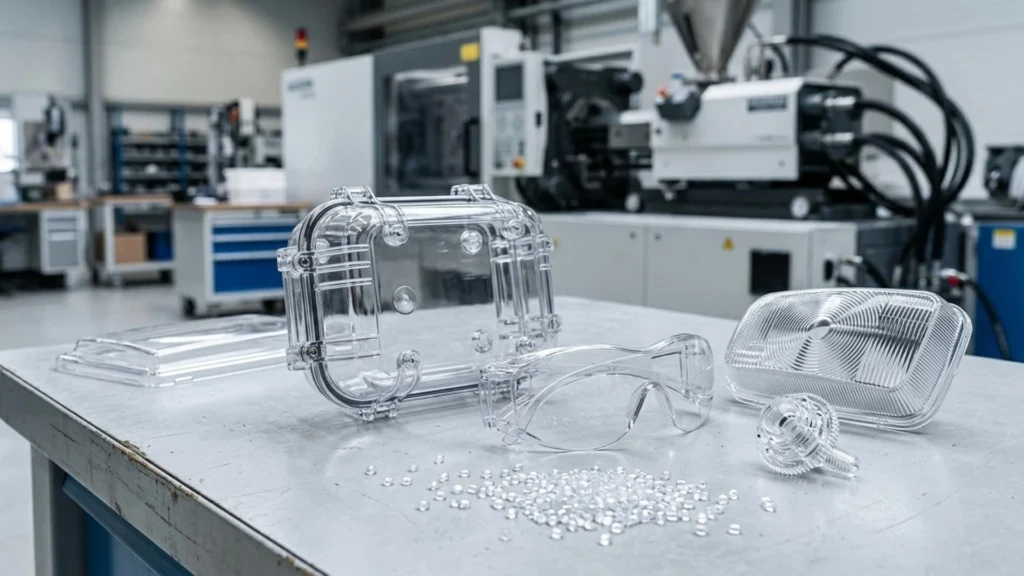
Polycarbonate — PC — is a transparent engineering thermoplastic known for its combination of optical clarity, impact resistance, and heat performance. It is used in applications ranging from safety helmets and eyewear lenses to machine guards and impact-resistant or bullet-resistant glazing systems.
Compared with many transparent plastics, PC can absorb substantial impact without cracking or shattering. In addition, it generally tolerates higher operating temperatures than materials such as acrylic or ABS.
However, polycarbonate also has limitations. Its surface scratches more easily than acrylic, certain chemicals can cause stress cracking, and standard grades may lose optical performance during prolonged ultraviolet exposure.
Key Material Selection Factor
Polycarbonate is a strong candidate when a part requires transparency, high impact resistance, dimensional stability, and good heat performance. However, acrylic or another engineering plastic may be better when scratch resistance, long-term outdoor weatherability, chemical resistance, or cost is the primary concern.
Properties of Polycarbonate
Polycarbonate offers an unusual balance of toughness, transparency, and thermal performance. Still, the exact properties vary by resin grade, additives, reinforcement, part geometry, and processing conditions.
| Property | Characteristic | Design Note |
|---|---|---|
| Impact Resistance | Exceptional | Among the most impact-resistant commonly used transparent plastics |
| Optical Clarity | Very good | Transparent grades offer high clarity, although acrylic generally provides better optical transmission |
| Heat Resistance | Good | Grade-dependent; generally higher than acrylic and many commodity plastics |
| Dimensional Stability | Good | Amorphous structure and relatively low molding shrinkage can support dimensionally demanding parts |
| Scratch Resistance | Limited without coating | Softer surface than acrylic; abrasion-prone applications may require a hard coating |
| Chemical Resistance | Fair | Certain solvents and chemicals can cause environmental stress cracking |
| Flame Performance | Grade-dependent | Flame-retardant grades are available for applications requiring specific UL 94 ratings |
| UV Weatherability | Grade-dependent | UV-stabilized grades or protective coatings are preferred for demanding outdoor applications |
Polycarbonate vs. Acrylic
Polycarbonate and acrylic are both transparent thermoplastics, but they solve different design problems.
Polycarbonate generally offers much greater impact resistance and higher heat capability. Acrylic, meanwhile, typically provides better optical clarity, surface hardness, scratch resistance, and long-term UV weatherability.
Material cost can also differ; however, pricing depends on grade, supplier, quantity, additives, and market conditions.
As a result, PC is often preferred when toughness and heat performance are critical. Acrylic may be the better choice when maximum clarity, surface appearance, and outdoor weatherability matter more.
Advantages of Polycarbonate
- Exceptional impact resistance: Polycarbonate can withstand impacts that would fracture many other transparent plastics.
- Good optical clarity: Clear grades provide strong transparency, while tinting, coatings, and specialty optical grades expand the available design options.
- Good heat performance: Many PC grades tolerate higher temperatures than acrylic, ABS, and several commodity thermoplastics.
- Dimensional stability: Because PC is amorphous and generally has relatively low molding shrinkage, it can support dimensionally demanding applications when tooling and processing are properly controlled.
- Specialty grades: Manufacturers offer flame-retardant, UV-stabilized, medical, optical, reinforced, and other application-specific formulations.
Limitations of Polycarbonate
- Limited scratch resistance: Polycarbonate has a relatively soft surface, so abrasion-prone parts may require a hard coating.
- Chemical sensitivity: Certain cleaners, solvents, oils, and other chemicals can contribute to environmental stress cracking, especially when the part is under mechanical stress.
- UV weathering: Standard PC can yellow or lose optical performance during prolonged UV exposure. Therefore, outdoor applications may require UV-stabilized grades or protective coatings.
- Moisture-sensitive processing: PC is hygroscopic and must be dried properly before molding.
- Notch sensitivity: Sharp corners, abrupt transitions, and molded-in stress can reduce impact performance.
What Products Are Made from Polycarbonate?
Because of its combination of transparency, toughness, and heat resistance, polycarbonate appears in products across several industries.
| Industry | Typical Polycarbonate Parts |
|---|---|
| Safety | Face shields, helmets, machine guards, protective covers, and impact-resistant glazing |
| Electronics | Housings, connectors, lighting components, covers, and display components |
| Automotive | Headlamp lenses, lighting components, instrument clusters, interior trim, and protective covers |
| Medical | Device housings, transparent components, diagnostic equipment components, and selected instrument parts made from appropriate medical-grade PC |
| Consumer | Eyewear, appliance components, protective covers, reusable housings, and other durable transparent products |
Polycarbonate in Injection Molding
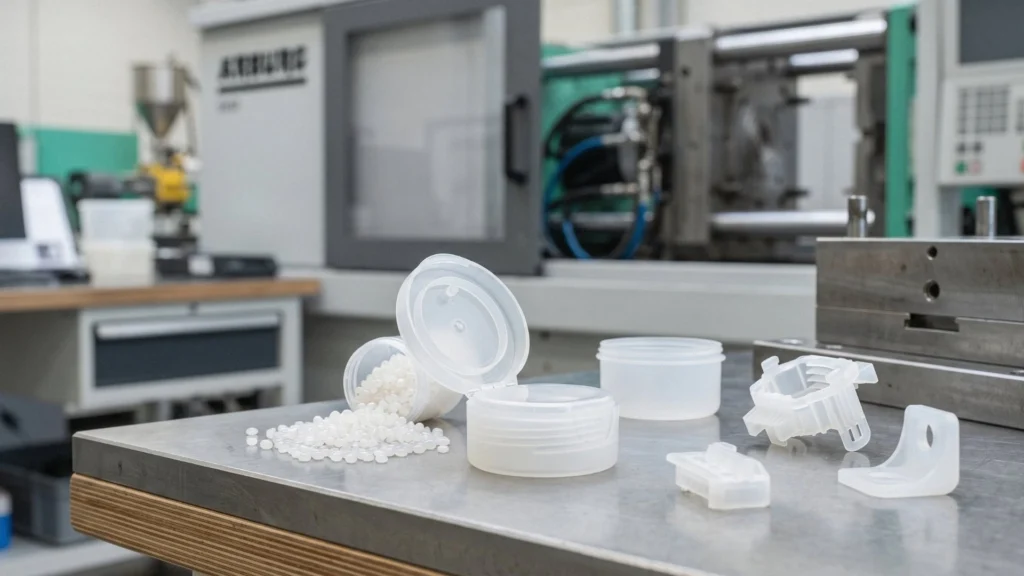
Polycarbonate can produce strong, transparent, dimensionally stable injection molded parts. However, achieving those properties requires careful control of material preparation, processing conditions, mold design, and part geometry.
Material Drying
PC is hygroscopic, meaning the resin absorbs moisture from the surrounding environment. Consequently, processors must dry the material thoroughly before it enters the molding machine.
If excessive moisture remains in the resin at processing temperatures, hydrolytic degradation can occur. This may reduce molecular weight and mechanical performance while also contributing to cosmetic defects such as streaking or splay.
Drying requirements vary by grade and resin supplier. Therefore, processors should follow the material manufacturer’s recommended drying temperature, time, and allowable moisture level.
Processing Temperature and Flow
Polycarbonate requires relatively high melt temperatures compared with many commodity thermoplastics. At the same time, PC has relatively high melt viscosity, so thin walls, long flow lengths, and restrictive gates can make filling more difficult.
For that reason, part geometry and runner and gate design should support predictable material flow without requiring excessive injection pressure.
Mold temperature also influences surface quality, flow behavior, residual stress, and dimensional consistency. As a result, processors should establish temperatures according to the specific PC grade and part requirements rather than relying on one universal process window.
Residual Stress and Part Geometry
Residual stress is an important consideration when molding polycarbonate. Excessive packing pressure, uneven cooling, sharp internal corners, abrupt wall transitions, or poor gate placement can introduce stress into the finished part.
That stress can become particularly important if the component later encounters solvents, cleaners, or other chemicals. In those conditions, molded-in stress may increase the risk of environmental stress cracking.
Generous radii, smooth wall transitions, balanced filling, and appropriate gate placement can help reduce these risks.
Optical Polycarbonate Parts
Transparent components create additional molding challenges because small defects become highly visible.
For optical or cosmetic applications, resin cleanliness, mold polishing, gate location, venting, flow balance, drying, cooling, and process consistency can all affect appearance. Scratches, flow marks, bubbles, contamination, and excessive residual stress may prevent a molded part from meeting optical requirements.
Therefore, optical PC applications should be evaluated as both a material-selection problem and a molding-process problem.
PC/ABS Blends
Polycarbonate is also commonly blended with ABS. These PC/ABS materials combine some of PC’s toughness and heat resistance with the processability and cost characteristics of ABS.
As a result, PC/ABS is widely used for automotive interiors, electronics housings, industrial enclosures, and other applications where transparency is not required.
For applications where the primary material decision is between transparency, impact strength, and surface performance, compare these characteristics with those covered in our Acrylic (PMMA) guide.
Polycarbonate Design Consideration
Material drying, wall thickness, generous radii, smooth transitions, gate placement, mold temperature, and surface finish can all affect polycarbonate part quality. These considerations become especially important when the finished component must be transparent, cosmetic, or resistant to environmental stress cracking.
Frequently Asked Questions
Is polycarbonate stronger than acrylic?
Polycarbonate generally offers substantially greater impact resistance than acrylic and can also provide higher heat capability. Acrylic, however, typically offers better optical clarity, surface hardness, scratch resistance, and outdoor weatherability. Therefore, the right material depends on which properties matter most for the application.
Is polycarbonate bulletproof?
Polycarbonate is used in engineered bullet-resistant glazing systems because of its high impact resistance. However, ballistic performance depends on the complete glazing construction, thickness, layering, projectile, velocity, and applicable test standard. An ordinary thin injection molded PC part should not be described as bulletproof.
Why does polycarbonate scratch so easily?
Polycarbonate has a relatively soft surface compared with acrylic and glass. As a result, abrasion-prone applications such as lenses, shields, and transparent covers may use hard coatings to improve scratch resistance.
Does polycarbonate yellow in sunlight?
Standard polycarbonate can yellow or lose optical performance after prolonged exposure to ultraviolet radiation. However, UV-stabilized grades and protective surface treatments are available for outdoor applications. Material selection should therefore account for the expected exposure time and environment.
Does polycarbonate need to be dried before injection molding?
Yes. Polycarbonate is hygroscopic and can absorb moisture while stored. If that moisture remains in the resin during molding, the high processing temperature can cause hydrolytic degradation and cosmetic defects. Therefore, the material should be dried according to the resin manufacturer’s recommendations before processing.
What is PC/ABS?
PC/ABS is a polymer blend that combines characteristics of polycarbonate and ABS. It can provide a useful balance of impact strength, heat performance, processability, surface quality, and cost. Consequently, manufacturers frequently use PC/ABS for automotive interiors, electronics housings, industrial enclosures, and similar applications where transparency is not required.
Choosing the Right Material for Your Part
Whether to specify polycarbonate depends on how its properties align with the actual demands of the application. Engineers should consider mechanical loading, impact exposure, operating temperature, chemical contact, UV exposure, optical requirements, dimensional tolerances, and cost together.
For example, PC may be a strong candidate for a transparent guard that must withstand repeated impact. On the other hand, acrylic may be more appropriate when optical clarity, scratch resistance, and outdoor appearance take priority over extreme toughness.
Chemical exposure deserves similar consideration. Although polycarbonate performs well in many applications, contact with incompatible chemicals can cause stress cracking. Therefore, engineers should review the selected resin grade against the actual service environment rather than relying only on general PC property data.
Ultimately, the right material is the one whose properties match the application’s mechanical, thermal, environmental, optical, and cost requirements.
For an injection molding project, material selection should also be reviewed alongside part geometry and design for manufacturability before tooling is cut. Selecting the appropriate resin and validating the design early can reduce tooling changes, quality problems, and production delays later in the project.