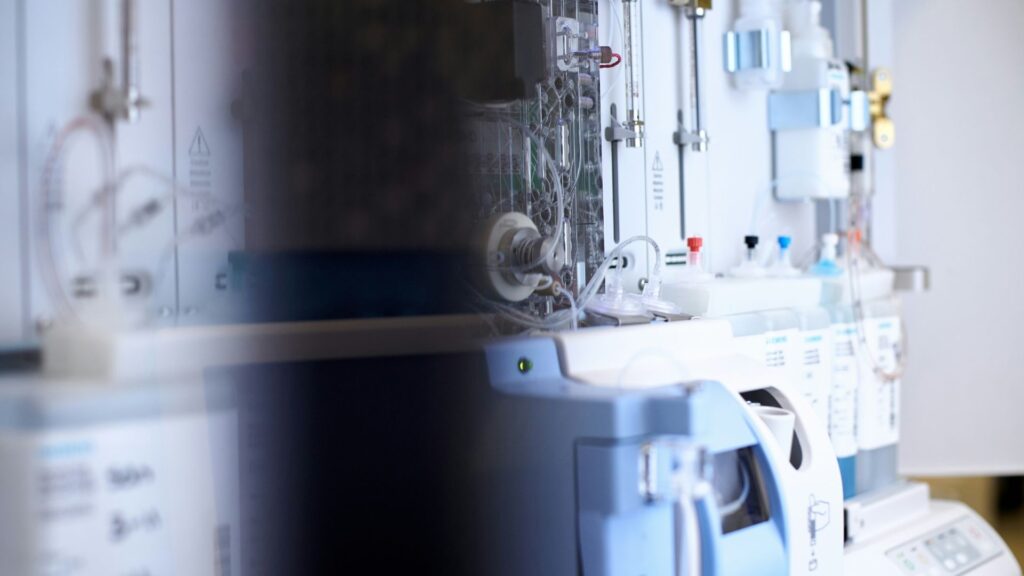
Medical manufacturing equipment in a cleanroom environment used for producing healthcare devices

What Is Medical Manufacturing? Process, Devices & Standards Explained

Medical manufacturing refers to the design, production, assembly, and quality control of products used in healthcare settings. This includes everything from surgical instruments and implantable devices to diagnostic equipment and single-use consumables.

Unlike many other industries, medical manufacturing operates under strict regulatory requirements, advanced material standards, and zero-tolerance quality expectations. Patient safety, product reliability, and compliance are at the core of every process.

What Does Medical Manufacturing Include?

Syringe, medical supplies, and laboratory testing equipment representing different types of medical manufacturing products

Medical manufacturing spans multiple product categories:

1. Medical Devices

  • Surgical tools (scalpels, forceps, clamps)
  • Diagnostic equipment (MRI machines, ultrasound devices)
  • Monitoring systems (ECG machines, blood pressure monitors)
  • Disposable supplies (syringes, catheters, IV sets)

2. Implantable Devices

  • Orthopedic implants (hip and knee replacements)
  • Dental implants
  • Pacemakers
  • Stents

3. Components & Subassemblies

  • Precision machined parts
  • Injection-molded plastic housings
  • Electronic circuit boards
  • Tubing and fluid control systems

4. Pharmaceutical & Biotech Manufacturing

Although distinct, pharmaceutical production often overlaps with medical manufacturing through sterile environments, packaging systems, and regulatory compliance standards.

The Medical Manufacturing Process
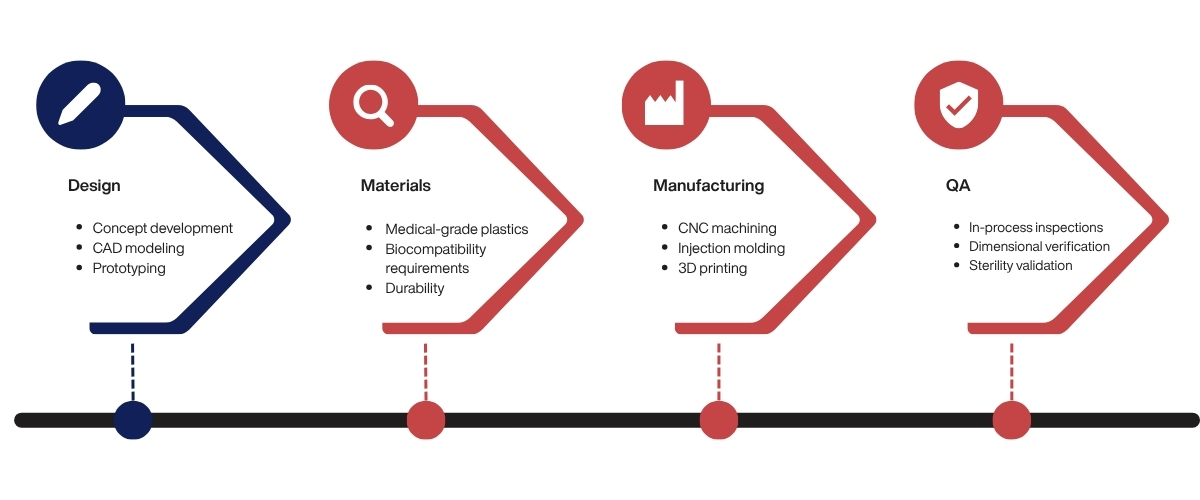
Diagram showing the medical manufacturing process including design, material selection, manufacturing, and quality control stages

The process typically involves multiple stages, each governed by strict documentation and validation procedures.

1. Product Design & Engineering

  • Concept development
  • CAD modeling
  • Prototyping
  • Design verification and validation (V&V)

Design must comply with regulatory frameworks such as:

  • FDA 21 CFR Part 820 (U.S.)
  • ISO 13485 quality management systems

2. Material Selection

Common materials include:

  • Medical-grade stainless steel
  • Titanium (for implants)
  • Medical-grade plastics (PEEK, polycarbonate)
  • Silicone and elastomers

Materials must be biocompatible, sterilizable, and durable.

3. Manufacturing Techniques

  • CNC Machining: Used for precision components like implants and surgical instruments.
  • Injection Molding: Ideal for high-volume plastic parts such as syringes and housings.
  • Additive Manufacturing (3D Printing): Enables patient-specific implants and rapid prototyping.
  • Cleanroom Assembly: Critical for sterile and implantable products.

Regulatory Standards in Medical Manufacturing
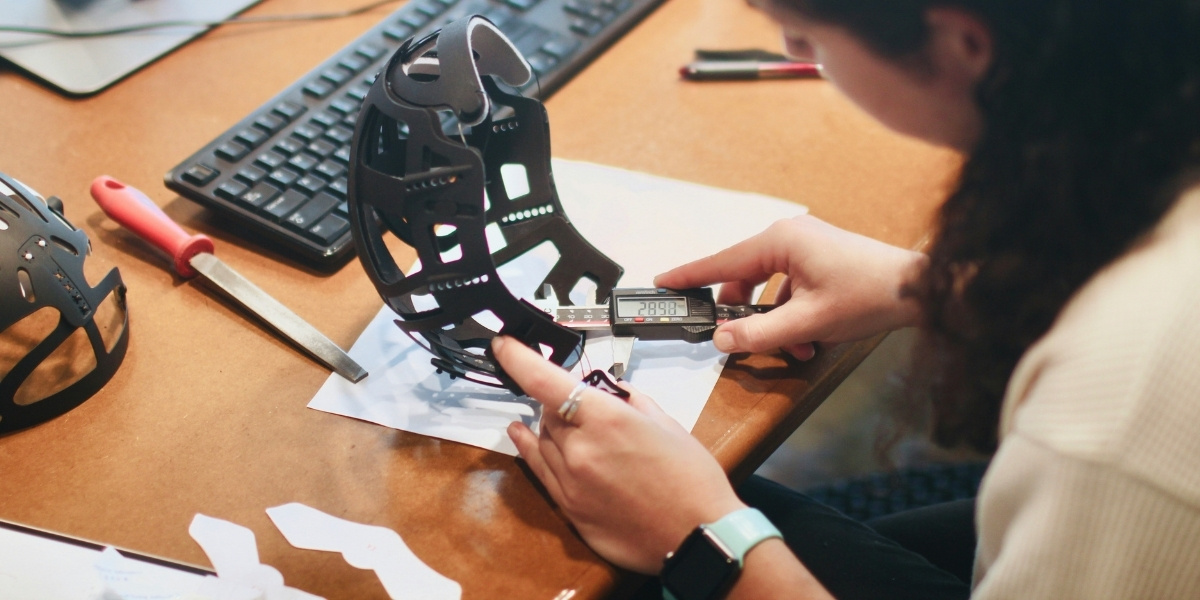
Technician measuring a medical component with precision tools to ensure quality and dimensional accuracy

Medical manufacturing is heavily regulated to ensure patient safety.

Key Regulatory Bodies:

  • FDA (United States)
  • European Medicines Agency (EMA)
  • ISO (International Organization for Standardization)

Important Standards:

  • ISO 13485 – Medical device quality management
  • ISO 14971 – Risk management
  • GMP (Good Manufacturing Practices)

Manufacturers must maintain:

  • Full traceability of materials
  • Documented quality systems
  • Risk management files
  • Post-market surveillance systems

Why Quality Control Is Critical

In medical manufacturing, defects can lead to serious health risks. Therefore, manufacturers implement:

  • In-process inspections
  • Automated optical inspection (AOI)
  • Sterility validation
  • Mechanical stress testing
  • Biocompatibility testing

Quality assurance ensures products meet both regulatory standards and clinical performance expectations.

Emerging Trends in Medical Manufacturing

1. Automation & Robotics

Robotic assembly improves precision and reduces contamination risks.

2. Smart Manufacturing (Industry 4.0)

IoT sensors and real-time monitoring enhance traceability and predictive maintenance.

3. Custom & Patient-Specific Devices

3D printing allows tailored implants and prosthetics.

4. Sustainable Manufacturing

Focus on recyclable materials and energy-efficient production processes.

Medical manufacturing requires a higher level of compliance, documentation, and quality validation compared to most other sectors.

Who Works in Medical Manufacturing?

Key roles include:

  • Biomedical engineers
  • Manufacturing engineers
  • Quality assurance specialists
  • Regulatory affairs professionals
  • Cleanroom technicians
  • Supply chain specialists

This industry blends engineering precision with healthcare responsibility.

Why Medical Manufacturing Matters

Medical manufacturing plays a critical role in:

  • Improving patient outcomes
  • Enabling minimally invasive procedures
  • Supporting life-saving technologies
  • Advancing global healthcare access

Without rigorous manufacturing processes, even the most innovative medical technologies could not safely reach patients.

Medical manufacturing is a specialized, highly regulated sector focused on producing safe, reliable, and compliant healthcare products. It combines advanced engineering, strict quality control, and regulatory expertise to ensure that every device used in patient care meets the highest standards.

As technology advances, medical manufacturing continues to evolve—embracing automation, digitalization, and customization to meet the growing demands of modern healthcare.

Why Partner with Texas Injection Molding for Medical Projects?
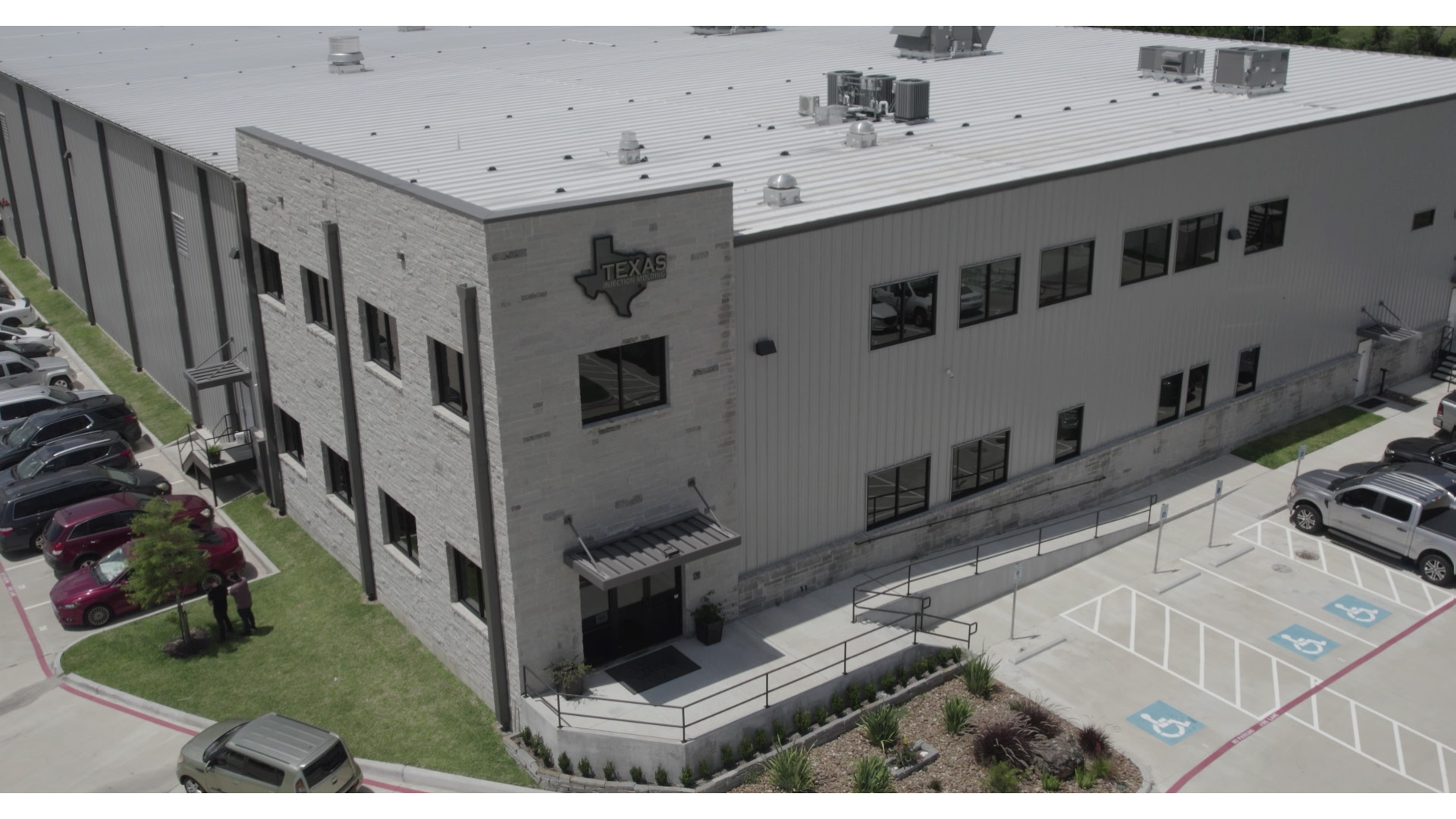
Exterior view of Texas Injection Molding facility in Houston specializing in medical and plastic injection molding

Located in Houston—home to the world-renowned Texas Medical Center—we understand the urgency and precision required by the healthcare industry. We offer:

  • Engineering Excellence: Decades of experience in engineering-grade resins.
  • Regional Proximity: Fast, face-to-face collaboration for Texas-based medical startups and established OEMs.
  • Risk Mitigation: Our robust quality systems reduce the risk of recalls and production delays.

Start Your Medical Manufacturing Project Today

Navigating the complexities of medical-grade production requires a partner who understands the stakes.

Call us at 281-489-4292 or visit our Contact Page to discuss your medical device design and how we can support your path to market.

What Is Medical Manufacturing? Process, Devices & Standards Explained Read More »
Do I invest in In-House Automation Capabilities?

At Texas Injection Molding, we understand that engineering precision, process consistency, and uptime are non-negotiable. In today’s competitive manufacturing landscape, having the ability to design, engineer, and build custom automation solutions in-house isn’t just a value-add—it’s a strategic necessity. For engineering teams that rely on predictable, scalable production, our internal automation capabilities offer a significant technical and operational edge.

Why In-House Automation Matters to Engineering Teams

Many injection molding companies depend on third-party integrators or off-the-shelf automation platforms. While these solutions can serve their purpose, they often fall short when it comes to application-specific requirements, long-term maintainability, and the agility needed for continuous improvement.

By contrast, our in-house automation team brings the full development cycle—design, build, integration, and support—under one roof. Here’s what that means for engineering professionals like you:

1. Tailored Solutions for Complex Applications

No two molding programs are alike. Whether you’re dealing with delicate overmolded electronics, tight-tolerance components, or multi-cavity tooling, automation must be as unique as the parts being produced. Our in-house engineering team collaborates closely with our customers to:

  • Design custom end-of-arm tooling (EOAT) for complex part handling

  • Integrate vision systems for part inspection, orientation, or verification

  • Develop pick-and-place robotics, conveyors, and post-molding assembly stations tailored to the application

This level of customization ensures that automation is optimized for part geometry, material behavior, and cycle time—something generic equipment simply can’t match.

2. Accelerated Project Timelines

One of the most significant engineering constraints is time. When automation is outsourced, lead times can stretch for weeks or months due to back-and-forth communication, design misalignment, and long delivery cycles.

Our vertically integrated model allows us to prototype, test, and iterate automation systems quickly. This directly reduces time-to-production and gives your team greater agility when responding to design revisions or scaling requirements.

3. Improved Uptime and On-Site Support

Downtime on an automated production cell can cripple throughput and delay deliveries. With in-house-built equipment, we eliminate the finger-pointing and wait times that often come with third-party service providers.

Our automation and maintenance teams are cross-trained, enabling real-time troubleshooting, repairs, and continuous improvement without external dependencies. For engineering and operations teams, this means greater confidence in meeting production targets and quality benchmarks.

4. Scalable Innovation and Cost Control

By controlling the design and fabrication process internally, we can scale and replicate successful automation cells across multiple lines or facilities without starting from scratch. This scalability drives down costs per part and supports long-term program viability—especially in high-volume, high-mix production environments.

A Competitive Advantage Built Into Every Program

At Texas Injection Molding, our commitment to in-house automation isn’t just about reducing costs or increasing speed—it’s about enabling smarter manufacturing for our customers. For engineering teams looking to partner with a molder that brings real problem-solving and system-level thinking to the table, our internal automation capabilities are a critical differentiator.

Whether it’s optimizing cycle times, reducing labor, or ensuring zero-defect part handling, our automation team is fully integrated with tooling, molding, and quality engineering to deliver performance that goes beyond the press.

Do I invest in In-House Automation Capabilities? Read More »

Texas Injection Molding Maximizes Building Envelope for Storing Plastic Resin

Texas Injection Molding completed the expansion of it’s new materials warehouse in 2024.  Injection molding facilities handle a constant flow of plastic resin, most often delivered in bulk containers like gaylords or super sacks. Storing and moving these heavy loads safely and efficiently is critical to keeping production lines running smoothly. Texas Injection Molding worked with Crown to efficiently lay out the rack locations and place a magnetic wire in the floor to guide the Crown TSP 6500-33 lift.

Built for Heavy Loads

The TSP 6500-33 is designed to lift and maneuver heavy materials with ease. Most plastic resin is supplied in Gaylords and Supersacks. These bulk containers typically weigh 1,500 to 2,500 pounds. With the Crown lift, operators can safely transport these bulky loads without the risk of spills, damage, or injury.

Efficient Use of Floor Space

The wire guided Turret lift allows for narrow isles providing for significantly more rows.  The Crown lift allows us to utilize all of our 32′ ceiling height with a high pile permit from the City of Houston.

Safety and Stability

The Crown TSP 6500-33 provides excellent stability while lifting and transporting, giving operators confidence that their loads are secure. The magnetic wire guidance system ensures that the lift travels between the narrow isles in the exact position to avoid drifting off course or running into the racking system.  This translates into fewer accidents, less product loss, and a smoother workflow overall.

Long-Term Value

Because it is built to handle demanding industrial applications, the Crown TSP 6500-33 provides durability that injection molding companies can rely on. Texas Injection Molding operates 24 hours a day and pushes the equipment hard.  Fork lifts are a critical piece of equipment to our operation and any downtime causes significant disruption. Investing in equipment that supports both safety and productivity makes a noticeable difference in the bottom line.

Texas Injection Molding Maximizes Building Envelope for Storing Plastic Resin Read More »

How To Move Injection Molding Machines

What Is a Robotic Skate—and Why It’s a Game-Changer for Moving Injection Molding Machines

When you need to relocate an injection molding press, CNC, or any other multi-ton machine, the safest and most precise way to do it is with a robotic skate system. Unlike traditional pinch bars and manual roller sets, robotic skates are low-profile, battery-powered transporters that slide under the equipment and move it with inch-level accuracy. Using a wireless remote, a single operator can steer, start/stop, and fine-position loads—often up to tens of tons—without the jerks and risks of forklifts or pry bars.

Why they’re better

  • Precision & control: Smooth, variable speed and 360° maneuverability for tight aisles and exact placement on anchor bolts.

  • Floor-friendly: Non-marking rollers and distributed load reduce point pressure and protect epoxy or tile floors.

  • Safety first: Built-in braking, controlled acceleration, and clear sight lines keep teams and assets safer.

  • Faster setups: Minimal cribbing and re-rigging means less downtime and more predictable schedules.

Where they shine

  • Plant reconfigurations, line changeovers, and machine swaps

  • Clean facilities (food, pharma, medical) where floor protection matters

  • Precision picks where millimeter-level alignment is required

A huge thank-you to Jason Thorsteson and the team at All Pro Machinery Movers for bringing their robotic skates (and seasoned rigging expertise) to our project. Their planning, care for the floor, and spot-on positioning made a complex move look easy.

If you’re planning a heavy move in Texas and want it done safely and precisely, check out All Pro Machinery Movers:
allpromachinerymoverstx.hibuwebsites.com

How To Move Injection Molding Machines Read More »

Launching Large Tooling Projects into Production

Streamlining Complex Projects: Lessons from the Manufacturing Floor

What does it take to efficiently manage large-scale industrial projects with numerous components and tight timelines? Insights from Texas Injection Molding offer a compelling glimpse into the intricacies of coordinating complex projects in today’s competitive manufacturing landscape.

Collaborative Efforts and Strategic Planning

Butch Baker, Engineering Manager at Texas Injection Molding, highlights the tremendous collaborative effort required to tackle their latest project, involving 75 individual components housed in over 50 molds. The project kicked off with the arrival of three shipping containers filled with molds, setting the stage for a substantial undertaking that necessitated meticulous planning and coordination.

The first challenge was executing a comprehensive inspection of all incoming molds—a task accomplished within a week and a half due to strategic planning that included hiring extra personnel and implementing a second shift. This level of coordination demonstrates the necessity of precise scheduling and resource allocation in ensuring successful project outcomes.

Integration of Cross-Functional Teams

Once inspection was complete, cross-functional teams, including scheduling, quality control, and engineering, took over. Their role was to navigate each phase, from placing molds into machines to assembling quality plans. This multi-departmental collaboration ensured that the project advanced smoothly and effectively through its various phases.

The involvement of diverse teams underscores the importance of integrated operations in managing complex projects, where seamless communication and shared responsibilities are key drivers of success.

Optimizing Production through Real-Time Adjustments

With initial phases completed, the team focused on translating plans into action on the manufacturing floor. This involved setting up machines and running test shots to refine production processes. Engineers, alongside material handlers and mold setters, evaluated outcomes to ensure parts met client standards before ramping up to full-scale production.

The emphasis on real-time adjustments highlights the flexibility required in manufacturing, where quick decision-making and adaptability can significantly impact project success.

Documenting Success for Continuous Improvement

Quality assurance teams conducted comprehensive First Article Inspections (FAIs) and shared detailed production documentation with the client. This transparent approach not only builds trust but also provides a basis for continuous improvement and knowledge capture for future projects.

Such documentation is vital for creating a feedback loop that aids in refining processes and enhancing future project outcomes, illustrating the ongoing learning and development inherent in robust manufacturing practices.

In conclusion, the Texas Injection Molding project serves as a powerful example of how complex manufacturing projects can be managed successfully through strategic planning, collaborative teamwork, and real-time adaptability. For executives and decision-makers, these insights offer practical guidance on enhancing efficiency and achieving harmonious project execution within their own organizations.

Ready to elevate your project’s success? Discover how Texas Injection Molding’s solutions can benefit you by visiting www.texasinjectionmolding.com.

Launching Large Tooling Projects into Production Read More »

Texas Injection Molding Incorporates Presses, Cranes and tools to Safely Move Heavy Injection Molds

Texas Injection Molding Incorporates Presses, Cranes and tools to Safely Move Heavy Injection Molds.

Using proper tools to open and close injection molds and move them safely from storage locations to the molding machines is critical to an efficient and safe injection molding operation. Texas Injection Molding demonstrates the process of moving and installing injection molds into molding machines. Proper handling of heavy injection molds requires meticulous attention to ensure operational efficiency and minimize risks. Let’s explore the essential tools and practices that bolster safety and effectiveness during this phase.

Understanding the Vital Tools in Mold Handling

The foundation of any successful injection mold operation begins with the right tools. Hoists and cranes are indispensable for lifting heavy molds with precision. Choose equipment with adequate load capacity to handle the weight and size of your specific molds securely. Additionally, mold carts and trolleys facilitate smooth transportation within the facility, reducing manual handling and potential injury risks.

Opening and closing molds can be very difficult and dangerous. Machines like the Die Sep use magnets to secure the platens and a hydraulic cylinder controls the safe opening and closing of the molds.  Often it is required to rotate or tip molds and the use of a die tipper allows for safe rotation of heavy molds.

When you are working on molds, having a bench that is properly rated to support the weight of the molds is a must in every shop.  Alongside mechanical tools, digital innovations like barcode and RFID technology can streamline the tracking and management of molds, offering real-time data that enhances the overall process efficiency. At Texas Injection Molding, we incorporate mold locations into our ERP system and track the location and cycles of every mold. This technological integration ensures that all equipment is accessible when needed, minimizing delays and misplacements.

Safety Practices: Protecting Personnel and Equipment

Executing an effective mold installation requires a robust safety framework. Begin with thorough training programs that educate employees about the potential hazards and proper handling techniques. Texas Injection Molding controls the authorization of use of lifting equipment through employee training certifications.

Refining the Installation Process with Precision

When the mold reaches the machine, precision in alignment is essential. Use alignment tools and techniques such as laser guides and dowel pins to ensure the mold fits perfectly within the machine, preventing misalignment and potential operational issues. Proper alignment can significantly enhance the mold’s performance and longevity.

Implementing detailed checklists can help maintain standard operating procedures, ensuring that each step of the installation process is followed meticulously. This approach not only promotes safety but also boosts the efficiency and quality of production cycles.

Conclusion: Towards a Safer and More Efficient Future

At Texas Injection Molding, the movement and installation of molds are pivotal operations that require a blend of the right tools, safety practices, and precision techniques to ensure successful outcomes. Having the proper lifting equipment and prioritizing safety and efficiency not only protects the workforce and equipment but also enhances the overall productivity and quality of manufacturing processes.

Texas Injection Molding Incorporates Presses, Cranes and tools to Safely Move Heavy Injection Molds Read More »

How’s It Made – Injection Molded Meter Covers

What may look like a simple product that you see everyday in streets, yards and places of business where water meters record the delivery of water to a specific address is actually quite involved.  For plastic injection molded commercial water meters we start with a single cavity mold weighing nearly 5,000 lbs that has the detail of the part machined into the steel halves of the mold.  The “core” is the male side of the mold and forms the inside geometry of the part. The “cavity” is the female side of he mold and forms the geometry of the outside of the part.

The mold is mounted into a 1,000 ton injection molding machine that is the size of a semi-trailer.  The machine has 1,000 tons of clamping force to hold the two halves of the mold together when filling the mold with melted plastic resin under very high pressure. In this particular part we inserting a 1″ diameter metal rebar into the cavity side of the mold.  The machine closes and fills the cavity of the mold with plastic encapsulating the metal rebar in the part.

The metal rebar adds weight to ensure that the meter cover does not float away when the street floods. In this design, the part requires drain holes to be drilled through the side and ribs of the part and was more cost effective to use a CNC milling machine to drill these holes.  The insert molding and machining operations are capabilities that set Texas Injection Molding apart by including in the supply of finished parts.  See the attached short video to see the process in action.


How’s It Made – Injection Molded Meter Covers Read More »

Drying Plastic Resin Is Critical To Quality

Why Proper Resin Drying Is Key to Injection Molding Success

Getting quality results in injection molding isn’t just about using the right machines—it’s about drying your plastic resins correctly before they ever reach the mold. Skipping this step or doing it inadequately can lead to subpar mechanical strength and surface flaws in the final product. For anyone in the manufacturing sector, understanding and applying these principles means better products and smoother operations.

Mechanical Performance Hinges on Resin Moisture Content

Moisture in resins can wreak havoc on the structural integrity of molded items. When resins aren’t adequately dried, they often retain moisture, leading to hydrolysis during injection molding. This chemical breakdown can drastically weaken the material, which in turn undermines mechanical performance. For companies that stake their reputation on the durability of their products, this is an avoidable risk with the right drying process. By ensuring low moisture levels in your resins, you’re securing the strength and reliability customers expect.

Perfecting Cosmetic Appearance Through Proper Drying

Beyond strength, the cosmetic appearance of your products is often the first impression your customers have. Moisture can cause surface defects such as splay marks, a cosmetic defect that can ruin the appearance of an otherwise perfect product. Proper resin drying eliminates this risk, ensuring a smooth, glossy finish that speaks to the quality consumers demand.

Texas Injection Molding’s Strategic Investment

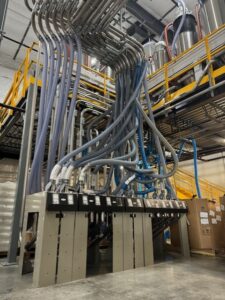
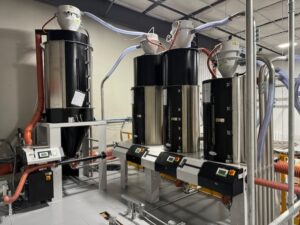
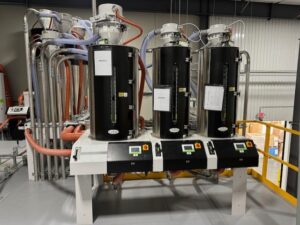
Texas Injection Molding partnered with Conair to design and implement a material handling and material drying system suited to the hygroscopic material utilized in parts manufactured by Texas Injection Molding. By leveraging Conair’s advanced equipment, they’ve not only optimized their operational efficiency but also ensured consistent product quality. This strategic investment highlights how investing in the right technology can set a business apart in terms of product integrity and production efficiency.

Your Path to Improved Outcomes

The takeaway here is simple: if you’re not prioritizing resin drying, you’re leaving the door open to potential quality issues. Whether you’re ironing out kinks in your current process or setting up a new line, focus on integrating reliable drying systems into your production line to prevent problems before they start. This single step is a powerful way to boost both the performance and appearance of your final products.

To align your processes with industry best practices, consider what systems you have in place and where improvements can be made. Investing in quality drying equipment might be the game changer your operations need to meet, or even exceed, your production goals. Be proactive, and your attention to detail will pay off in every product that leaves your facility.

Drying Plastic Resin Is Critical To Quality Read More »

Best Practices for Injection Molds

Best Practices for Storage, Lifting, and Handling Injection Molds

In manufacturing, maintaining the performance and lifespan of injection molds is critical. These molds are central to producing high-quality plastic parts, and their care involves proper storage, lifting, and handling. Adopting best practices not only optimizes mold performance but also ensures the safety of those who work with them. Here, we explore strategies that make a difference, spotlighting Texas Injection Molding’s innovative approaches as industry-leading examples.

The Role of Proper Mold Storage

Proper storage of injection molds is foundational to their longevity. A prime example is Texas Injection Molding’s climate-controlled storage system. By maintaining optimal environmental conditions, this system prevents rust and deterioration, crucial for preserving mold quality. Such systems shield molds from harmful elements, ensuring they are ready for use when needed. Clear organization within storage areas also helps prevent accidents and mishandling.

Effective Lifting and Handling Techniques

Given the weight and complexity of injection molds, safe lifting and handling are paramount. Texas Injection Molding excels with its use of overhead cranes. These cranes are designed to move molds safely and efficiently, minimizing the risk of accidents. Training employees in using these tools and emphasizing balanced load lifting ensures molds are handled with care, reducing potential damage and enhancing operator safety.

Smooth Installation Processes

Once molds are in place, proper installation on injection molding machines is crucial. Ensuring that molds are correctly aligned prevents production defects and mechanical issues. Following a step-by-step installation process maintains the quality of manufactured parts and the integrity of the equipment, avoiding costly downtime and repairs.

Prioritizing Operator Safety

Ensuring the safety of operators is non-negotiable. Comprehensive training on the risks and precautions involved in handling injection molds is essential. This involves the correct use of protective gear and understanding the handling equipment. By adopting a safety-first mindset, companies can foster a confident workforce and improve overall operational efficiency.

Conclusion

Optimizing the storage, lifting, and handling of injection molds significantly boosts their performance and life. By incorporating industry best practices, like those of Texas Injection Molding, manufacturers can protect their investment in molds and enhance worker safety. These practices not only extend mold life but also ensure the consistent production of top-quality parts.

To explore more about plastic injection molding services, visit Texas Injection Molding at www.texasinjectionmolding.com. By learning from leaders in the field, you can implement strategies that elevate your manufacturing process and ensure the future readiness of your operation.

Best Practices for Injection Molds Read More »