A complete guide to acetal, its stiffness, low friction, dimensional stability, and precision, for engineers designing mechanical and moving parts.
If you are an engineer designing gears, bearings, or precision components, a product manager evaluating metal replacement, or a buyer sourcing a molder, this guide explains what acetal is and when it is the right choice.
Polyoxymethylene (POM), commonly called acetal, is an engineering thermoplastic used in precision mechanical applications. Delrin® is one well-known brand of homopolymer acetal.
Understanding acetal and other engineering thermoplastics, how they perform, where they excel, and how manufacturers mold them, provides a foundation for smart material selection in injection molding.
What Is Acetal (POM)?
Polyoxymethylene, or POM, is a semi-crystalline engineering thermoplastic known for high stiffness, excellent dimensional stability, low friction, wear resistance, and strong fatigue performance.
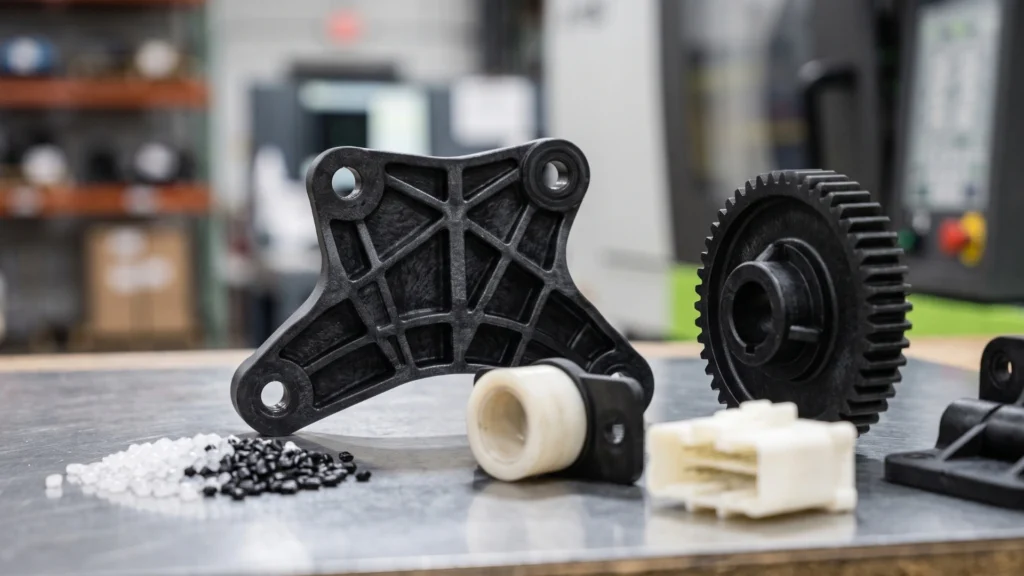
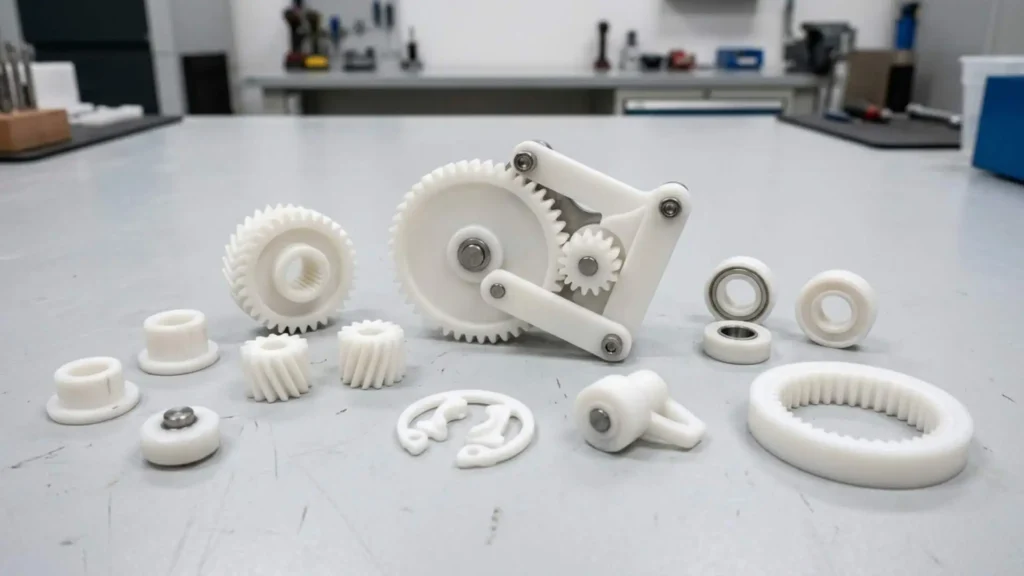
Manufacturers commonly use acetal for precision mechanical parts such as gears, bushings, cams, and snap-fit components. These applications benefit from a material that moves smoothly and maintains dimensional stability through repeated cycling.
Homopolymer vs. Copolymer Acetal
- Homopolymer (e.g. Delrin®): Typically provides slightly higher strength, stiffness, and hardness.
- Copolymer: Typically provides better chemical and hot-water resistance, greater resistance to thermal degradation, and a wider processing window.
Both forms serve a wide range of applications. However, the right choice depends on the required balance of mechanical performance, chemical exposure, thermal stability, processing conditions, and dimensional requirements.
Properties of Acetal
Acetal combines several properties that make it useful for mechanical and moving components. In particular, designers often specify it when they need dimensional stability, low friction, and reliable performance during repeated movement.
| Property | Characteristic | Design Note |
|---|---|---|
| Stiffness | High | Supports rigid, precision mechanical parts |
| Friction & Wear | Low friction, wear-resistant | Works well in moving and sliding components |
| Dimensional Stability | Excellent, with low moisture uptake | Helps parts maintain tight tolerances |
| Fatigue Resistance | Excellent | Performs well in repeatedly cycled applications |
| Chemical Resistance | Good, especially in many copolymer grades | Varies by chemical, concentration, temperature, and grade |
| Heat Resistance | Moderate | Grade and mechanical load influence allowable service temperature |
| Surface & Sliding Behavior | Hard, low-friction surface | Supports gears, bearings, bushings, and sliding parts |
Why Acetal Works Well in Mechanisms
Acetal combines stiffness, dimensional stability, low friction, wear resistance, and fatigue performance. As a result, designers often use it for gears, bushings, cams, snap fits, and other components that move or cycle repeatedly.
Advantages of Acetal
Acetal offers a combination of mechanical and dimensional properties that suits many precision applications. Most importantly, it performs well where parts must move, resist wear, and maintain consistent dimensions.
- High stiffness and strength: Supports rigid, precise mechanical parts.
- Low friction and wear: Works well for gears, bearings, bushings, and sliding components. In many applications, it also reduces lubrication requirements compared with metal-to-metal systems.
- Excellent dimensional stability: Low moisture uptake helps parts maintain dimensions and tolerances.
- Strong fatigue resistance: Supports snap fits, spring-like features, and repeatedly cycled components.
- Good chemical resistance: Many grades perform well around fuels, solvents, and other chemicals. However, compatibility depends on the specific grade and exposure conditions.
Limitations of Acetal
Despite its advantages, acetal does not fit every application. Therefore, designers should consider its chemical, thermal, bonding, and processing limitations early in material selection.
- Chemical limitations: Strong acids and certain other aggressive chemicals can attack acetal. Therefore, engineers should confirm compatibility with the specific operating environment.
- UV exposure: Prolonged outdoor exposure can degrade unstabilized grades. For outdoor applications, designers should evaluate a suitable stabilized grade.
- Flammability: Standard acetal grades are combustible. In addition, achieving flame-retardant performance can be more difficult than with some other engineering plastics.
- Difficult to bond: Acetal’s low surface energy makes adhesive bonding challenging. Surface treatment or specialized adhesives may improve bond performance.
- Molding shrinkage: Acetal undergoes meaningful shrinkage because of its semi-crystalline structure. Consequently, mold designers must account for shrinkage in cavity dimensions, gating, cooling, and dimensional planning.
- Controlled processing required: Excessive melt temperature or residence time can thermally degrade POM and generate formaldehyde. As a result, processors must carefully control temperature and residence time during molding.
What Products Are Made from Acetal?
Because acetal combines stiffness, low friction, and dimensional stability, manufacturers use it across many industries for moving and precision components.
| Industry | Typical Acetal Parts |
|---|---|
| Automotive | Gears, fuel-system components, window mechanisms, and seat mechanisms |
| Industrial | Bearings, bushings, rollers, gears, and conveyor components |
| Consumer | Zippers, snap fits, appliance gears, and closures |
| Plumbing & Fluid Handling | Valves, fittings, and pump components |
| Electronics | Precision mechanical components, switches, and moving assemblies |
Acetal in Injection Molding
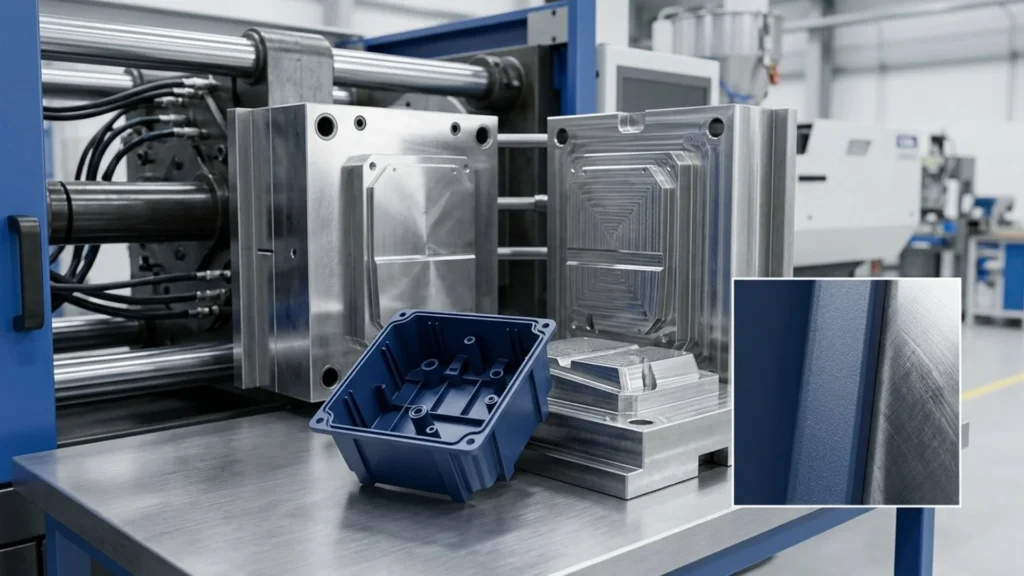
Acetal can produce dimensionally precise, low-friction injection molded parts, but processors must maintain tight control over molding conditions. In particular, excessive melt temperature or residence time can degrade the resin. Therefore, processors must carefully manage both temperature and residence time.
Acetal also undergoes meaningful molding shrinkage because of its semi-crystalline structure. Consequently, mold designers must compensate for that behavior when they establish cavity dimensions and plan critical tolerances.
In addition, gate location, cooling, wall thickness, material grade, and process consistency can all influence final dimensions. Engineers should evaluate these factors together when designing precision acetal components.
Design Consideration
Designers often select acetal for its dimensional stability. However, molding shrinkage still affects final dimensions. Therefore, engineering teams should review critical dimensions alongside material grade, mold design, expected shrinkage, and process variation before they finalize tooling.
Frequently Asked Questions
Is acetal the same as Delrin?
Not exactly. Delrin® is a well-known brand of homopolymer acetal, while acetal is the broader generic material category. Acetal includes both homopolymer and copolymer POM grades. Although these materials are closely related, their mechanical properties, chemical resistance, and processing behavior can differ.
What is the difference between homopolymer and copolymer acetal?
Homopolymer acetal, such as Delrin®, typically provides slightly higher strength, stiffness, and hardness. In contrast, copolymer acetal generally provides better chemical and hot-water resistance, greater thermal stability during processing, and a wider processing window. Therefore, the right choice depends on the application’s mechanical, environmental, and manufacturing requirements.
Why is acetal used for gears?
Acetal combines stiffness, low friction, wear resistance, dimensional stability, and strong fatigue performance. As a result, it works well for gears that must move smoothly, maintain their dimensions, and withstand repeated operation.
Can acetal replace metal?
Yes, in some precision mechanical applications. Acetal can replace metal when its stiffness, wear resistance, low friction, dimensional stability, and lower weight meet the part’s performance requirements. However, metal may remain the better choice for applications involving very high loads, extreme temperatures, or other demanding service conditions.
Choosing the Right Material for Your Part
Choosing acetal (POM) requires matching its properties, including stiffness, strength, wear behavior, dimensional stability, temperature resistance, chemical resistance, and cost, to the actual demands of the application.
Ultimately, the strongest material choice aligns its advantages with what the part must do while avoiding limitations that could affect performance.
For any injection molding project, engineering teams should confirm material selection alongside a design-for-manufacturability review before they cut tooling. By selecting the right resin and refining part geometry early, manufacturers can better protect cost, quality, dimensional performance, and lead time throughout production.