A complete guide to thermoplastic elastomers (TPEs), their major families, properties, applications, and how to choose the right grade for an injection molded part.
Thermoplastic elastomers, or TPEs, combine rubber-like flexibility with the processing advantages of thermoplastics. They are widely used for soft-touch grips, seals, flexible components, vibration dampers, and overmolded parts that need elasticity without the curing process required by traditional thermoset rubber.
The challenge is that TPE is not a single material. It is a broad category that includes several polymer families with significantly different hardness ranges, temperature capabilities, chemical resistance, compression set, and bonding characteristics.
This guide explains the major TPE families, how they differ, where they are commonly used, and the practical considerations that should drive material selection for injection molding.
What Is a Thermoplastic Elastomer?
A thermoplastic elastomer (TPE) is a material that combines the flexibility and elastic behavior associated with rubber with the melt-processability of a thermoplastic.
Unlike thermoset rubber, which undergoes permanent chemical crosslinking during curing, TPEs soften when heated and solidify again when cooled. As a result, they can be processed using conventional thermoplastic manufacturing methods such as injection molding and extrusion.
This processing behavior can provide several manufacturing advantages. Depending on the formulation and application, TPEs can offer shorter molding cycles than thermoset rubber, allow manufacturing scrap to be reprocessed, and enable soft elastomeric surfaces to be molded directly onto rigid thermoplastic substrates.
However, TPE is an umbrella category rather than one specific resin. Each TPE family offers a different balance of hardness, elasticity, heat resistance, chemical resistance, abrasion resistance, compression set, and cost.
Key Material Selection Factor
When selecting a TPE, consider hardness, elastic recovery, compression set, operating temperature, chemical exposure, abrasion resistance, substrate adhesion, and cost together. No single TPE family provides the best performance in every category.
The Main TPE Families
TPS / TPE-S — Styrenic Thermoplastic Elastomers
Styrenic thermoplastic elastomers are among the most commonly used TPEs for soft-touch applications. This family includes materials based on styrenic block copolymers such as SEBS and SBS.
TPE-S grades can provide a soft, rubber-like feel, good flexibility, and relatively easy processing. Many grades are formulated specifically for overmolding onto rigid thermoplastics.
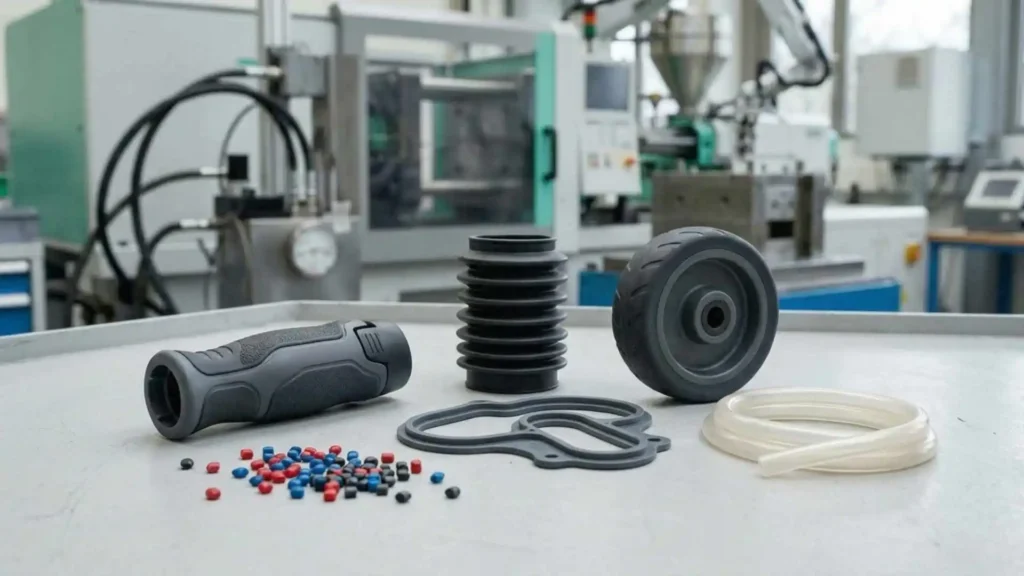
Common applications include soft-touch grips, handles, consumer products, seals, flexible closures, and overmolded components.
TPU / TPE-U — Thermoplastic Polyurethane
Thermoplastic polyurethane is known for high toughness, tensile strength, abrasion resistance, and wear performance.
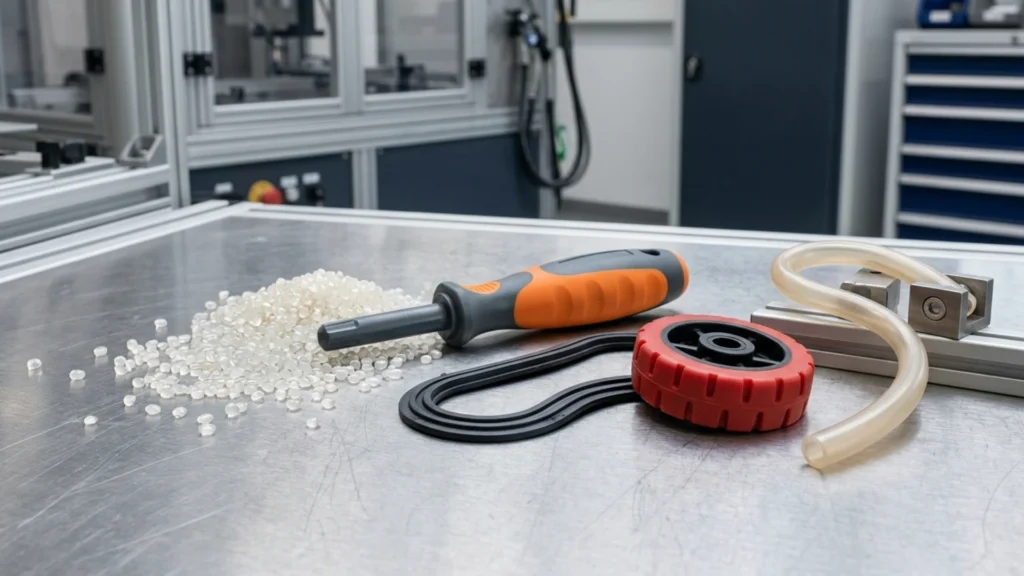
TPU is commonly used when a flexible component must withstand repeated mechanical stress, friction, or contact with demanding environments. Applications include wheels, protective components, seals, footwear parts, flexible industrial components, and overmolded grips.
Many TPU grades are hygroscopic and require controlled drying before injection molding.
TPO / TPE-O — Thermoplastic Olefin
Thermoplastic olefins combine polyolefin materials with elastomeric components to provide flexibility, impact resistance, and weatherability.
TPOs are widely used in automotive applications, including exterior components, interior skins, flexible trim, and impact-resistant parts.
They generally offer good chemical resistance and relatively low density, although their elasticity and compression-set performance may be lower than higher-performance TPE families.
TPV / TPE-V — Thermoplastic Vulcanizate
Thermoplastic vulcanizates contain a finely dispersed, crosslinked rubber phase within a thermoplastic matrix.
This structure allows TPVs to provide more rubber-like performance while retaining thermoplastic processing characteristics. Compared with many general-purpose TPEs, TPVs can provide improved compression set and elevated-temperature performance.
They are frequently used for automotive seals, weatherstripping, gaskets, boots, flexible ducts, and industrial sealing applications.
COPE / TPE-E — Copolyester Elastomer
Copolyester elastomers combine flexibility with strong mechanical performance and relatively high temperature capability.
They are often selected for applications that require repeated flexing, fatigue resistance, chemical resistance, and good mechanical strength. Common examples include bellows, boots, flexible couplings, industrial components, and automotive parts.
Many COPE grades require proper drying before processing.
COPA / TPE-A — Thermoplastic Copolyamide Elastomer
Thermoplastic copolyamide elastomers provide a combination of flexibility, strength, chemical resistance, and elevated-temperature performance.
These materials are typically used in demanding applications where lower-performance TPE families may not provide enough thermal or mechanical capability.
Applications can include tubing, flexible connectors, industrial components, automotive parts, and other elastomeric components exposed to demanding environments.
TPE Family Comparison
TPE families can differ considerably in hardness, mechanical performance, compression set, temperature resistance, chemical resistance, and processing requirements. The best choice depends on how the finished component will be used.
| TPE Family | Key Characteristics | Common Applications | Injection Molding Considerations |
|---|---|---|---|
| TPS / TPE-S | Soft feel, good flexibility, broad hardness range, and strong overmolding potential. | Soft-touch grips, handles, seals, consumer products, and flexible closures. | Bonding depends on the specific grade and substrate. Often selected for overmolding applications. |
| TPU / TPE-U | High toughness, abrasion resistance, tensile strength, and wear resistance. | Wheels, seals, industrial components, protective parts, and overmolded grips. | Many grades are hygroscopic and require proper drying before molding. |
| TPO / TPE-O | Good impact resistance, weatherability, chemical resistance, and relatively low density. | Automotive skins, exterior trim, flexible panels, and impact-resistant components. | Material behavior varies significantly by formulation and hardness. |
| TPV / TPE-V | Rubber-like behavior with improved heat resistance and compression-set performance compared with many general-purpose TPEs. | Seals, gaskets, weatherstripping, boots, ducts, and automotive components. | Useful where rubber-like performance is required while retaining thermoplastic processing. |
| COPE / TPE-E | Strong mechanical performance, fatigue resistance, chemical resistance, and elevated-temperature capability. | Bellows, boots, flexible couplings, industrial components, and automotive parts. | Many grades require controlled drying before molding. |
| COPA / TPE-A | High-performance balance of flexibility, chemical resistance, strength, and heat resistance. | Tubing, connectors, automotive parts, and demanding industrial components. | Often selected for applications requiring higher thermal or chemical performance. |
Key Properties of TPEs
TPE properties vary widely by family and formulation. Engineers should evaluate the specific material datasheet rather than assuming all TPEs behave alike.
| Property | Typical TPE Behavior | Design Consideration |
|---|---|---|
| Hardness | Ranges from very soft elastomeric grades to semi-rigid materials. | Hardness may be measured on Shore OO, Shore A, or Shore D scales depending on the grade. |
| Elastic Recovery | Good to excellent depending on family and formulation. | Evaluate recovery under the actual expected strain and temperature. |
| Compression Set | Varies significantly across TPE families. | Critical for seals, gaskets, and components that remain compressed for long periods. |
| Abrasion Resistance | Ranges from moderate to excellent. | TPU is commonly considered where wear or repeated friction is important. |
| Chemical Resistance | Highly dependent on family and formulation. | Evaluate exposure to oils, fuels, cleaners, solvents, and other chemicals before selecting a grade. |
| Heat Resistance | Ranges from relatively low to high depending on TPE family. | TPV, TPU, COPE, and COPA grades may be considered for elevated-temperature applications. |
| Overmolding | Compatible grades can bond to selected rigid thermoplastics. | The TPE grade must be matched to the substrate, geometry, and molding conditions. |
Advantages of TPEs
- Rubber-like performance with thermoplastic processing: TPEs can provide flexibility and elasticity while being processed on conventional thermoplastic molding equipment.
- Broad hardness range: TPE formulations range from extremely soft elastomers to semi-rigid materials.
- Overmolding capability: Compatible grades can bond directly to selected rigid thermoplastics to create soft-touch surfaces, seals, grips, and bumpers.
- Potentially shorter manufacturing cycles: TPE processing can eliminate the curing step required for conventional thermoset rubber.
- Color and surface flexibility: Many TPE formulations can be pigmented and textured for both functional and cosmetic applications.
- Reprocessing potential: Because TPEs are thermoplastics, manufacturing scrap can often be reprocessed depending on the material, contamination level, and application requirements.
Limitations of TPEs
- Performance varies significantly by family: Hardness, elasticity, chemical resistance, compression set, and heat capability can differ substantially between TPE chemistries.
- Thermoset rubber may still outperform TPEs in demanding environments: Certain cured elastomers provide superior long-term heat resistance, compression set, or chemical performance.
- Some grades require drying: Many TPU, COPE, and other moisture-sensitive grades require controlled drying before molding.
- Overmold adhesion is material-specific: Not every TPE bonds to every rigid substrate without mechanical interlocks, surface treatment, or a specially formulated bonding grade.
- Material cost varies widely: Higher-performance TPE families and specialty grades can cost significantly more than general-purpose formulations.
What Products Are Made from TPEs?
TPEs appear across consumer, industrial, automotive, medical, and housewares applications because they can combine flexibility with efficient injection molding.
| Industry | Typical TPE Applications |
|---|---|
| Consumer Products | Soft-touch grips, toothbrush handles, protective cases, flexible buttons, and non-slip surfaces. |
| Automotive | Seals, bellows, weatherstripping, interior skins, flexible trim, and vibration-control components. |
| Medical | Tubing, seals, grips, wearable components, and flexible housings using application-appropriate grades. |
| Industrial | Gaskets, bumpers, vibration dampers, boots, protective covers, and flexible couplings. |
| Housewares | Non-slip bases, handles, flexible closures, grips, and protective surfaces. |
TPEs in Injection Molding
TPEs are well suited to injection molding because they process using many of the same fundamental methods as conventional thermoplastics. However, processing conditions vary substantially between TPE families and grades.
Material temperature, mold temperature, injection speed, moisture content, cooling time, and gate design can all influence appearance and final mechanical performance.
TPEs are especially valuable in overmolding. During this process, a soft TPE is molded onto a rigid thermoplastic substrate to create an integrated component with both rigid and flexible areas.
Typical examples include tool handles, grips, seals, bumpers, non-slip surfaces, and ergonomic consumer products.
Successful overmolding depends on selecting a TPE grade that is compatible with the substrate. Specialized TPE compounds are available for substrates such as polypropylene, ABS, polycarbonate, nylon, and other engineering thermoplastics.
In some applications, chemical adhesion provides the necessary bond. In others, the part design may incorporate undercuts, holes, ribs, or other mechanical interlocks to retain the elastomer.
Design Note
TPE selection should happen before the overmolded part and tooling are finalized. Substrate compatibility, wall thickness, flow length, gate location, mechanical retention, and processing temperature can all affect bond strength and final part performance.
TPE vs. Traditional Rubber
Traditional thermoset rubber and TPE can provide similar flexibility, but they behave very differently during manufacturing.
Thermoset rubber undergoes curing or vulcanization that permanently crosslinks the polymer structure. Once cured, the material cannot simply be melted and molded again.
TPEs soften when heated and solidify when cooled. This allows them to run on conventional thermoplastic processing equipment and can eliminate the separate curing cycle required by many rubber processes.
For many flexible components, this can reduce production time and simplify manufacturing. TPEs can also enable direct overmolding onto rigid thermoplastic parts.
However, conventional thermoset elastomers remain important when an application requires extremely low compression set, long-term elevated-temperature performance, or specialized resistance to chemicals and aggressive environments.
The right choice depends on the application rather than on processing method alone.
TPE vs. TPU
TPE and TPU are not competing material categories.
TPE is the broad category. TPU, or thermoplastic polyurethane, is one specific family within that category.
TPU is generally selected when an application requires high abrasion resistance, toughness, tensile strength, or repeated mechanical wear. Other TPE families may offer advantages in softness, cost, compression set, weatherability, processing, or substrate adhesion.
The term TPR, or thermoplastic rubber, is also used in the industry. It is often applied commercially to styrenic TPE compounds, although terminology can vary between material suppliers. For technical material selection, the specific TPE chemistry and grade are more useful than relying on the TPE or TPR label alone.
Frequently Asked Questions
What is the difference between TPE and rubber?
TPE behaves similarly to rubber in many applications but remains thermoplastic. It softens when heated and can be processed using methods such as injection molding.
Traditional thermoset rubber is permanently crosslinked during curing and cannot be re-melted and molded in the same way. TPE can provide faster processing and easier overmolding, while thermoset rubber may offer better compression set, heat resistance, or chemical performance in certain demanding applications.
What is the difference between TPE and TPU?
TPE is the overall category of thermoplastic elastomers, while TPU is one specific TPE family.
TPU is known for toughness, strength, abrasion resistance, and wear performance. Other TPE families may provide different advantages in softness, weatherability, compression set, temperature resistance, cost, or overmolding performance.
Can TPE be overmolded onto hard plastic?
Yes. Overmolding TPE onto rigid thermoplastics is one of the most common uses of these materials.
Specialized TPE grades can be formulated to bond to substrates such as polypropylene, ABS, polycarbonate, and nylon. However, adhesion depends on selecting a compatible grade and controlling part design and molding conditions. Mechanical interlocks may also be used when chemical adhesion alone is not sufficient.
Is TPE recyclable?
TPEs are thermoplastics, so manufacturing scrap can often be re-melted and reprocessed depending on the material, contamination level, and application requirements.
End-of-life recyclability is more complicated. It depends on the TPE chemistry, additives, contamination, whether the TPE is bonded to another material, and the recycling infrastructure available. A TPE being technically reprocessable does not necessarily mean that a finished product can be recycled through conventional municipal recycling systems.
What is compression set in a TPE?
Compression set measures how much permanent deformation remains after an elastomer has been compressed for a specified period and then released.
Low compression set is especially important for seals, gaskets, and other parts that must remain compressed while continuing to provide sealing force. Compression-set performance varies significantly between TPE families and grades.
Does TPE need to be dried before injection molding?
It depends on the TPE family and grade. Many TPU, COPE, and other moisture-sensitive TPEs require drying before molding because absorbed moisture can cause processing defects or material degradation.
Other TPE families may require little or no drying under normal storage conditions. Always follow the material supplier’s processing recommendations.
Choosing the Right TPE for Your Part
Choosing a thermoplastic elastomer requires more than specifying that a part needs to be soft or flexible.
The material should be selected according to the application’s hardness, elastic recovery, compression-set requirements, operating temperature, chemical exposure, abrasion resistance, weatherability, substrate adhesion, and cost.
For overmolded components, substrate compatibility should also be confirmed early because the choice of rigid resin can determine which TPE grades will produce reliable adhesion.
For any injection molding project, the most reliable approach is to confirm material selection alongside a design-for-manufacturability review before tooling is built. Selecting the correct TPE family, grade, and part geometry early helps protect molding performance, product durability, cost, and lead time.
Related Guides
- What Is TPU? Advantages and Usage in Injection Molding
- Overmolding Explained: Process Overview, Design Rules, and Material Combinations
- Insert Molding vs. Overmolding: What Is the Difference?
- Guide to Injection Molding Material Selection
- What Is Polypropylene? Advantages and Usage in Injection Molding