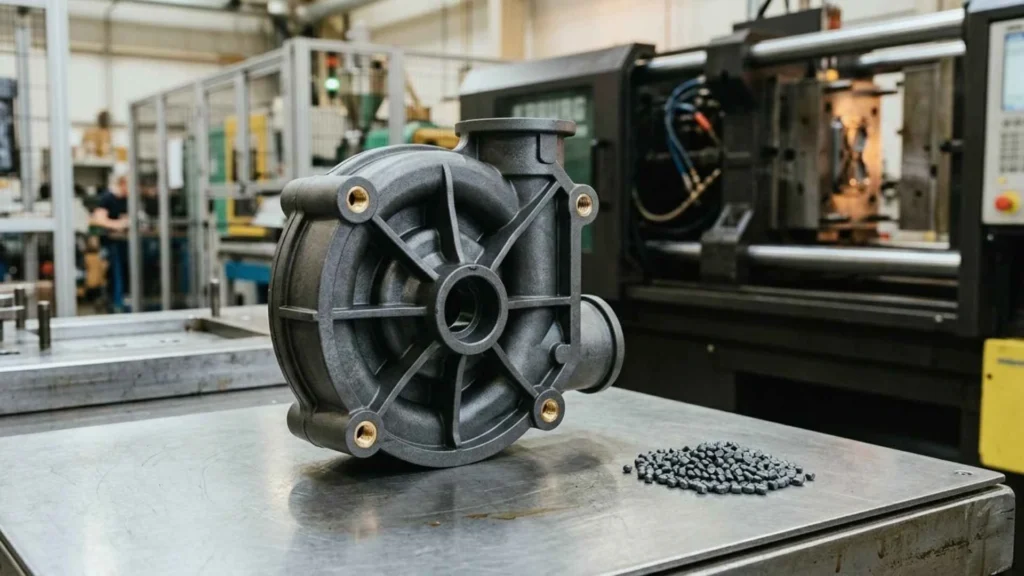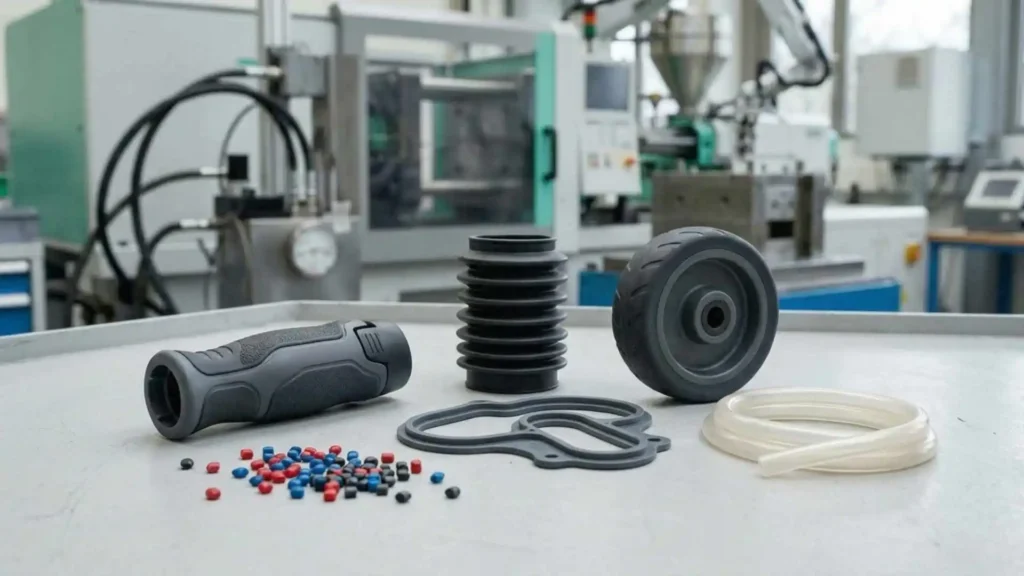
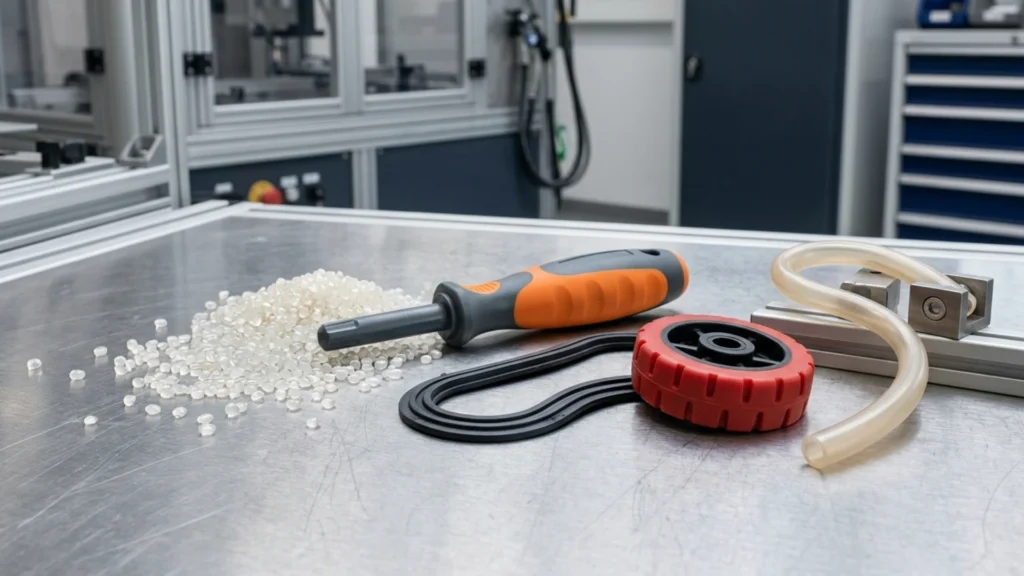
A complete guide to the properties, grades, and molding of TPU — for engineers and buyers choosing a flexible material.
If you are an engineer designing a part that must flex, grip, cushion, or seal, a product manager evaluating a rubber replacement, or a buyer sourcing a molder, this guide explains what TPU is, how its grades differ, and when it may be the right choice.
At Texas Injection Molding, we mold TPU and overmold it onto rigid substrates for consumer, automotive, and industrial programs. Everything here reflects the real decisions our customers face.
What Is Thermoplastic Polyurethane?
Thermoplastic polyurethane — TPU — is a versatile elastomer that bridges the gap between rubber and rigid plastic. It offers rubber-like flexibility and elasticity while still melting and flowing like a thermoplastic. As a result, manufacturers can process it through injection molding and other common plastic manufacturing methods.
TPU belongs to the broader thermoplastic elastomer (TPE) family. Unlike traditional thermoset rubber, TPU can soften again when heated after processing. This characteristic can provide advantages in manufacturing, reprocessing, and certain recycling applications.
TPU gets its properties from alternating hard and soft segments within the material. The hard segments contribute strength, rigidity, and temperature performance. In contrast, the soft segments provide flexibility, elasticity, and low-temperature performance. By changing the balance between these segments, resin manufacturers can produce TPU grades with a wide range of hardness and mechanical properties.
Key Material Insight
TPU combines elastomer-like flexibility with thermoplastic processing. Therefore, it can be a strong choice for molded parts that need to flex, grip, absorb impact, seal, or provide a soft-touch surface without using traditional thermoset rubber.
TPU Grades
The two primary TPU chemistries commonly considered for injection molded parts are polyester-based and polyether-based TPU. Each provides a different balance of mechanical and environmental performance.
Polyester-Based TPU
Engineers often choose polyester-based TPU when abrasion resistance, oil and grease resistance, mechanical strength, and heat performance are important.
These grades can work well for industrial, automotive, and high-wear applications. However, polyester TPU can be more sensitive to hydrolysis, which is material breakdown caused by prolonged exposure to hot and humid conditions.
Polyether-Based TPU
Polyether-based TPU generally provides better resistance to hydrolysis, along with strong low-temperature flexibility and microbial resistance.
Because of these characteristics, polyether grades can perform well in wet, humid, outdoor, or low-temperature environments where the part must remain flexible and durable.
Manufacturers offer TPU across a broad hardness range, from approximately 60 Shore A for soft, rubber-like materials to around 75 Shore D for firmer, semi-rigid formulations. However, the available hardness range depends on the specific TPU chemistry and resin supplier.
Grade Selection Note
Choosing between polyester and polyether TPU should depend on the environment in which the part will operate. For example, oil exposure, moisture, temperature, abrasion, flexibility, and long-term durability can all influence which TPU chemistry is the better fit.
Properties of TPU
Designers value TPU because it combines flexibility with mechanical strength, abrasion resistance, and thermoplastic processing. However, actual properties vary significantly by grade, hardness, formulation, and supplier.
| Property | Characteristic | Design Note |
|---|---|---|
| Hardness Range | Approximately 60 Shore A to 75 Shore D | A single material family can cover soft, rubber-like through firm, semi-rigid applications. |
| Abrasion Resistance | Very good to outstanding | Designers often consider TPU for high-wear parts such as wheels, rollers, footwear, and protective components. |
| Elasticity | Excellent | Depending on the grade, TPU can stretch, flex, and recover repeatedly. |
| Oil & Grease Resistance | Generally very good | Polyester-based grades often perform best when resistance to oils and greases is important. |
| Low-Temperature Flexibility | Good, particularly in polyether grades | Appropriate grades can maintain flexibility in cold operating environments. |
| Tear & Tensile Strength | High for an elastomer | TPU can work well for parts exposed to repeated flexing, stretching, or mechanical loading. |
| Processing | Absorbs moisture from the air | Processors generally need to dry TPU properly before injection molding. |
One of TPU’s key advantages over traditional thermoset rubber is its thermoplastic processing behavior. Thermoset rubber undergoes a permanent curing reaction and cannot simply melt again after processing. TPU, on the other hand, can be heated and processed with conventional thermoplastic manufacturing equipment.
For suitable applications, this characteristic can support efficient injection molding at production scale. In addition, TPU works especially well for overmolding soft-touch surfaces, grips, seals, and protective features directly onto rigid components.
Advantages of TPU
- Rubber-like flexibility with thermoplastic processing: TPU can provide elastomer-like performance while remaining injection-moldable. Under appropriate conditions, manufacturers may also be able to reprocess the material.
- Strong abrasion resistance: Many TPU grades perform very well in applications involving repeated friction, contact, or wear.
- Wide hardness range: TPU formulations range from soft cushioning materials to much firmer, semi-rigid grades.
- Oil, grease, and chemical resistance: Certain TPU grades provide strong resistance to oils, greases, fuels, and other chemicals. However, performance depends on the TPU chemistry and the specific exposure environment.
- Overmolding capability: Manufacturers can overmold compatible TPU grades onto rigid substrates to create soft-touch grips, seals, bumpers, and protective surfaces.
- Good low-temperature performance: Polyether-based grades can maintain flexibility in cold environments where some other elastomers may stiffen.
Limitations of TPU
- Requires careful drying: TPU absorbs moisture from the air. Therefore, excess moisture before molding can cause processing defects and reduce material performance. Processors should follow the resin supplier’s drying recommendations.
- Hydrolysis sensitivity: Polyester-based grades can break down more quickly during prolonged exposure to hot, humid environments. In contrast, polyether-based TPU generally handles these conditions better.
- Higher material cost: TPU is a specialty engineering material and typically costs more than commodity thermoplastics.
- Processing sensitivity: Its elastic melt behavior and sensitivity to moisture can require tighter process control than many rigid thermoplastics.
- Limited high-temperature structural use: TPU is generally not the first choice for applications that require sustained high-temperature structural performance. Instead, engineers should evaluate temperature capability based on the specific grade and operating conditions.
What Products Are Made from TPU?
Manufacturers use TPU across industries where parts need flexibility, durability, abrasion resistance, grip, cushioning, or sealing performance.
| Industry | Typical TPU Parts |
|---|---|
| Footwear | Shoe soles, heel counters, cleats, and other flexible or wear-resistant components |
| Electronics | Phone cases, cable jacketing, wearable straps, and soft-touch grips |
| Automotive | Seals, gaskets, bushings, boots, and instrument-panel components |
| Industrial | Rollers, wheels, drive belts, hoses, and pneumatic tubing |
| Medical | Catheters, tubing, and wearable components using appropriate medical-grade TPU formulations |
TPU in Injection Molding
TPU brings elastomer-like performance into conventional thermoplastic injection molding. As a result, it can provide an advantage over thermoset rubber for parts that benefit from scalable molding, complex geometry, or integration with rigid plastic components.
Because TPU absorbs moisture from the air, processors must dry the material properly before molding. Excess moisture can cause surface defects, inconsistent processing, or reduced material properties. Drying temperature, time, and acceptable moisture levels vary by resin grade, so we recommend following the material supplier’s processing specifications.
TPU’s elastic behavior also requires thoughtful mold and process design. For example, flexible parts can behave differently during filling, cooling, and ejection than rigid thermoplastics. Therefore, part geometry, draft, gate design, mold surface, and ejection strategy all deserve careful attention.
One of TPU’s most valuable capabilities is overmolding. With the right material combination, manufacturers can mold a soft TPU layer onto a rigid substrate to create grips, seals, bumpers, protective surfaces, and other multi-material features.
However, good adhesion depends on the TPU grade, substrate material, part design, surface condition, and molding process. Resin suppliers offer TPU formulations for substrates such as ABS, polycarbonate, and nylon. Even so, designers should confirm material compatibility before finalizing the tooling.
For related processes, see our Overmolding and Insert Molding guide.
Design Note
If TPU will be overmolded onto another plastic, select the TPU and rigid substrate together. In addition to material compatibility, hardness, part geometry, mechanical interlocks, and processing conditions can influence overmold adhesion and long-term performance.
Frequently Asked Questions
Is TPU the same as rubber?
No, although TPU can provide many rubber-like properties. TPU is a thermoplastic elastomer, so it combines flexibility and elasticity with the ability to melt and flow during processing. Traditional thermoset rubber, in contrast, undergoes a permanent cure and cannot simply melt again after processing.
What is the difference between TPU and TPE?
TPE is the broader family of thermoplastic elastomers, while TPU is a specific type of TPE. Compared with many general-purpose TPE formulations, TPU often provides stronger abrasion resistance, mechanical strength, and resistance to oils and chemicals. However, those benefits typically come with a higher material cost and more demanding processing requirements.
What is the difference between polyester and polyether TPU?
Polyester-based TPU generally provides strong abrasion resistance, oil and grease resistance, mechanical strength, and heat performance. Polyether-based TPU, meanwhile, generally offers better resistance to hydrolysis, low-temperature flexibility, and microbial growth. Therefore, the operating environment and performance requirements of the part should guide the choice.
Can TPU be overmolded onto other plastics?
Yes. Manufacturers commonly overmold TPU onto rigid plastics such as ABS, polycarbonate, and nylon. However, adhesion varies by TPU formulation, substrate, surface condition, part geometry, and processing conditions. For that reason, we recommend confirming material compatibility early in the design process rather than assuming every TPU grade will bond equally well to every substrate.
Working with Texas Injection Molding
At Texas Injection Molding, we help teams evaluate polyester and polyether TPU, design overmolded soft-touch components, and establish the drying and process controls TPU requires.
We manufacture in Texas. As a result, our customers can benefit from simpler communication, reduced overseas supply-chain exposure, and shorter lead times for appropriate programs.
If you are evaluating TPU for a current or upcoming program, contact us to discuss your project. We can help determine whether TPU is the right material for the application and explain what the tooling, processing, and production requirements may involve.
Related Guides
- What is Nylon: Advantages and Usage in Injection Molding
- Polycarbonate Injection Molding: How to Design, Process, and Specify PC Parts
- How Plastic Manufacturing Works: Which Process is Right for Your Part?
- Types of Nylon: How to Choose the Right Grade for Your Part?
- Guide to Injection Molding Material Selection