A complete guide to PET — the clear, strong packaging polymer — for engineers and buyers selecting a food-safe, recyclable resin.
If you are an engineer designing packaging or a clear container, a product manager targeting recyclability, or a buyer sourcing a molder, this guide explains what PET is and when it is the right choice.
In this guide, PET refers to polyethylene terephthalate, the thermoplastic polyester used extensively in beverage bottles, food packaging, fibers, and engineered applications.
Understanding PET, PETG, and other polyester resins — how they perform, where they excel, and how they are molded — is the foundation of smart material selection for injection molding.
What Is PET?
Polyethylene terephthalate — PET or PETE — is a strong, lightweight, transparent thermoplastic polyester. It is one of the world’s most widely used packaging plastics, particularly for beverage bottles, food containers, and other transparent packaging.
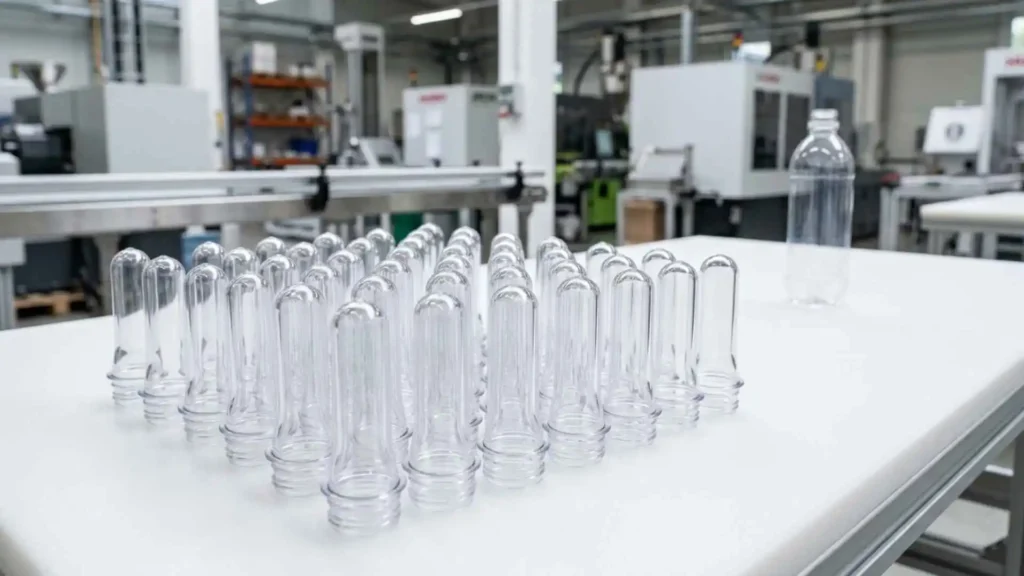
PET offers high optical clarity, good gas and moisture barrier properties, shatter resistance, and an established recycling stream. In injection molding, it is best known for preforms that are later stretch-blow-molded into bottles and containers, although engineering PET grades are also used for directly molded components.
Properties of PET
PET combines clarity, strength, barrier performance, and recyclability, making it especially useful for packaging and engineered applications where appearance, product protection, and mechanical performance matter.
| Property | Characteristic | Design Note |
|---|---|---|
| Clarity | Excellent in amorphous PET | Provides high optical clarity for transparent packaging |
| Strength | High tensile strength | Supports strong, lightweight parts |
| Barrier Properties | Good gas and moisture barrier | Helps protect food, beverages, and other packaged products |
| Chemical Resistance | Good | Resists many dilute acids, oils, and common chemicals; compatibility depends on concentration, temperature, and exposure |
| Heat Resistance | Moderate; Tg approximately 70–80°C | Heat performance depends strongly on crystallinity and grade; CPET provides substantially greater heat resistance |
| Moisture Sensitivity | Hygroscopic | Requires thorough drying before melt processing to prevent hydrolytic degradation |
| Recyclability | Well established; resin code 1 | Widely collected and recycled in many packaging streams, with rPET used in new products |
Amorphous vs. Crystalline PET
When cooled quickly, PET remains largely amorphous, clear, and glassy, making it suitable for transparent packaging applications. When crystallized, PET becomes more opaque, stiffer, and more heat-resistant. This form, commonly called CPET, is used for applications such as oven-safe food trays.
Both forms use the same base polymer. Their different properties result from how the material is processed, cooled, and nucleated.
Advantages of PET
- Excellent clarity: Provides high optical clarity for packaging and other applications where product visibility matters.
- Strong and lightweight: Offers a high strength-to-weight ratio while remaining shatter-resistant.
- Good barrier properties: Helps protect contents from gas and moisture.
- Widely used for food-contact packaging: PET is commonly used for beverage bottles and food containers, while qualifying recycled PET can also be used in food-contact applications.
- Recyclable: PET is identified by resin code 1 and has one of the most established recycling streams among packaging plastics.
- Chemically resistant: Performs well against many dilute acids, oils, and common chemicals.
Limitations of PET
- Requires careful drying: PET absorbs moisture that can degrade the polymer during processing if it is not properly dried.
- Moderate heat resistance: Amorphous PET softens at relatively modest temperatures compared with higher-temperature engineering plastics.
- Hydrolytic sensitivity: Processing PET while wet can reduce molecular weight and weaken the finished part.
- Crystallization requires process control: Cooling rate, mold temperature, and grade selection can significantly affect clarity, shrinkage, and heat resistance.
What Products Are Made from PET?
PET is most closely associated with beverage packaging, but its combination of strength, clarity, barrier properties, and processability supports a broad range of applications.
| Industry | Typical PET Products | Common Manufacturing Process |
|---|---|---|
| Packaging | Bottle preforms, bottles, jars, clamshells, and blister packs | Injection molding for preforms, followed by stretch-blow molding; thermoforming for many thin-wall packages |
| Food Service | Trays, cups, and containers, including CPET oven-safe trays | Primarily thermoforming from PET sheet |
| Consumer | Clear packaging and display components | Thermoforming, blow molding, or injection molding depending on the part |
| Industrial | Strapping, films, and engineered polyester components | Extrusion, film processing, and injection molding |
| Textiles | Polyester fiber | Fiber spinning and extrusion |
PET vs. PETG
PET and PETG belong to the same polyester family, but they behave differently during processing. Standard PET is semi-crystalline and is widely used for fibers, thermoformed packaging, and injection-molded preforms.
PETG is glycol-modified to suppress crystallization. This helps it remain clear in thicker sections and can make it easier to process for certain transparent applications.
The right choice depends on the manufacturing process and performance requirements. PET is typically preferred when barrier performance, stiffness, established packaging infrastructure, or controlled crystallization behavior are beneficial. PETG is often considered when clarity, toughness, and easier processing of thicker transparent parts are priorities.
PET in Injection Molding
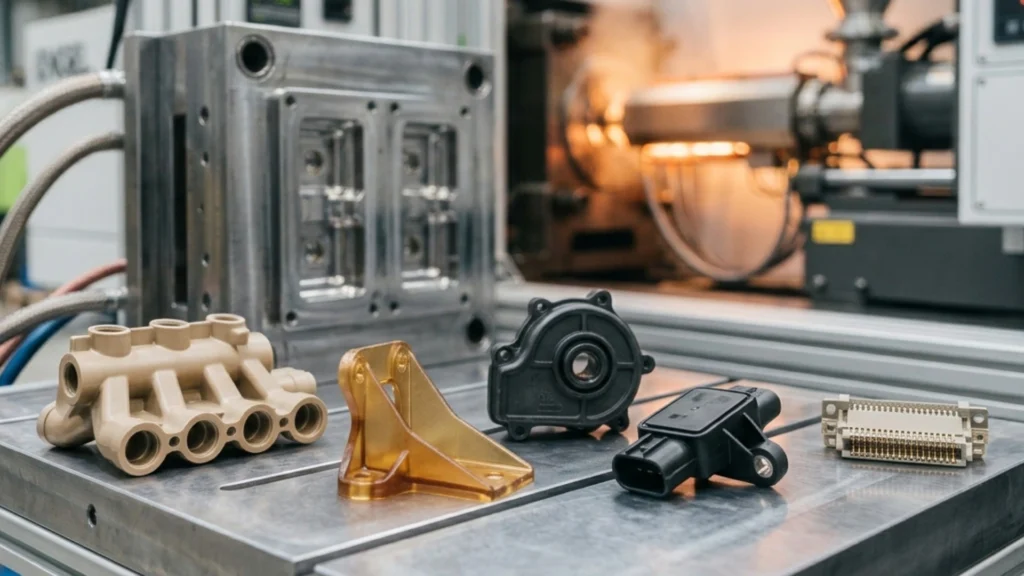
In injection molding, PET is best known for the production of preforms that are subsequently stretch-blow-molded into bottles and containers. PET is also available in engineering grades for directly injection molded components, including reinforced formulations used where strength, stiffness, dimensional stability, or electrical performance are important.
Many PET trays, clamshells, cups, and similar thin-wall packaging products, however, are produced by thermoforming PET sheet rather than by injection molding.
The non-negotiable processing requirement is drying. PET is hydrolytically sensitive, meaning absorbed moisture can break down the polymer during processing and reduce the molecular weight and mechanical properties of the finished part.
Engineering PET grades, including glass-filled formulations, can serve structural and electrical applications where additional stiffness, heat resistance, and dimensional performance are required.
Processing Consideration
PET must be thoroughly dried before injection molding. Processing material with excessive moisture can cause hydrolytic degradation, reducing molecular weight and producing weaker, lower-quality parts.
Drying requirements should always follow the resin supplier’s processing recommendations because acceptable moisture levels, drying temperature, and drying time can vary by grade.
Frequently Asked Questions
Is PET plastic safe for food and drink?
Yes. PET is widely used in food-contact applications, including water and beverage bottles and food packaging. Virgin PET and appropriately processed recycled PET, or rPET, can be used for food-contact applications when they meet applicable FDA requirements and conditions of use.
What is the difference between PET and PETG?
PETG is PET modified with glycol, which suppresses crystallization. PETG generally stays clear more easily in thicker sections and can be easier to process for certain applications, while standard PET is widely used for bottles, thermoformed packaging, fibers, and injection-molded preforms.
Is PET recyclable?
Yes. PET is identified by resin code 1 and has one of the most established recycling streams among packaging plastics. Recycled PET, commonly called rPET, is widely used in new packaging, fibers, and other products.
Why does PET need to be dried before molding?
PET is hygroscopic and absorbs moisture from the air. If the material is processed while wet, heat can trigger hydrolytic degradation, reducing molecular weight and producing weaker, lower-quality parts. Thorough drying before processing is therefore essential.
Are PET trays and clamshells injection molded?
Usually not. Many PET trays, clamshells, and similar thin-wall packages are thermoformed from PET sheet. Injection molding is most commonly used in PET packaging to produce preforms that are later stretch-blow-molded into bottles and containers.
Choosing the Right Material for Your Part
Whether to specify PET comes down to matching the material’s properties — including strength, temperature resistance, chemical resistance, clarity, processing requirements, and cost — to the actual demands of the application.
The strongest material choice is the one whose advantages align with what the part must do and whose limitations do not create problems for its intended use.
For any injection molding project, the most reliable approach is to confirm material selection alongside a design-for-manufacturability (DFM) review before tooling is cut. Getting both the resin and part geometry right early helps protect cost, quality, and lead time throughout production.