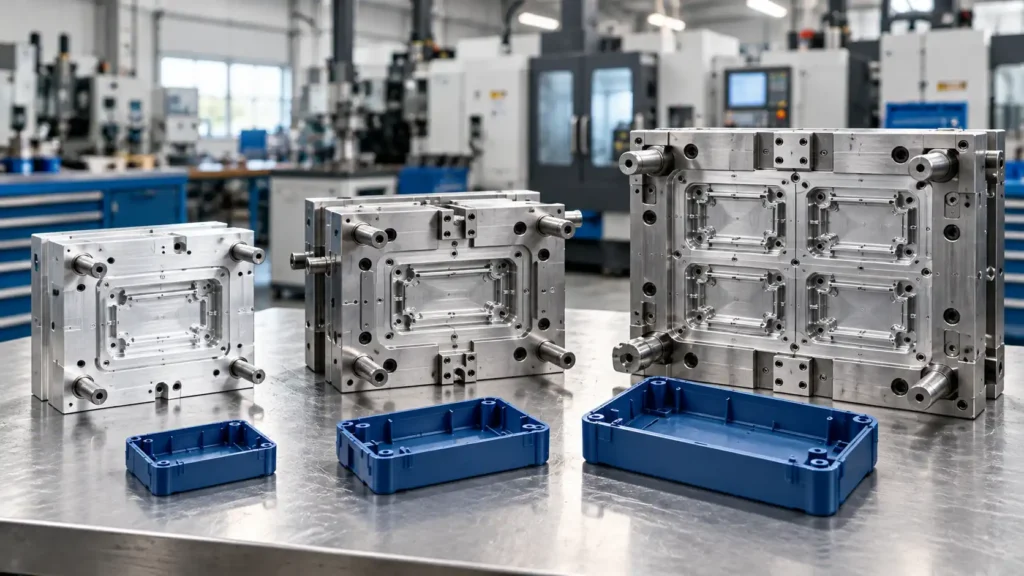
Understanding prototype vs. production tooling helps you choose the right mold for your project. Learn how each approach works and where bridge tooling fits.
Choosing an injection mold involves more than selecting aluminum or steel. The tool must support the parts you need today while accounting for design changes, expected demand, and the life of the program.
Prototype tooling helps validate a design with molded parts. Bridge tooling supports initial production while a longer-term solution is prepared. Production tooling supports ongoing manufacturing. Understanding these roles can help you avoid premature tooling investment and reduce launch risk.
What Is Prototype Tooling?
Prototype tooling produces injection molded parts for design evaluation before a company commits to a full production mold. Engineers can use these parts to assess fit, assembly, function, and material performance.
Often called soft tooling, prototype molds commonly use aluminum or prehardened steel. Simplified construction and fewer cavities can help reduce build time and upfront cost.
Using the intended production resin provides a closer representation of molded-part behavior than a prototype made through a different process. However, differences in gating, cooling, and processing can still affect the results.
Prototype tooling has a defined purpose and expected service life. It may produce accurate parts, but its construction may not support the wear resistance, cycle efficiency, or output required for sustained production.
What Is Production Tooling?
Production tooling supports repeatable manufacturing over the expected life of a program. Its design accounts for production volume, resin, dimensional requirements, maintenance, and manufacturing efficiency.
Production molds often use prehardened or hardened tool steel. Hardened steel is especially useful when high volumes or abrasive resins make wear resistance a priority. However, some lower-volume production applications can use aluminum.
Compared with a simplified prototype mold, a production tool may incorporate more cavities, more extensive cooling, and features that support reliable part ejection and automated handling. These decisions depend on the application.
The initial investment and build time are often higher. In return, a properly specified production mold can support consistent output and distribute its tooling cost across more parts. Tool life still depends on mold construction, resin, processing conditions, and maintenance.
What Is Bridge Tooling?
Bridge tooling supports an interim production need, often while a longer-life production mold is under construction. It can help manufacturers fill early orders, support a launch, or address uncertain demand before committing to additional tooling capacity.
A bridge mold may use aluminum or prehardened steel. Its material and construction must match the required quantity, resin, geometry, and delivery schedule.
Unlike a tool used only for design evaluation, a bridge tool must produce parts that meet the requirements for their intended use. Those parts still need the appropriate inspection, testing, and customer approval before shipment.
Once the main production mold is ready, the bridge tool may be retired, retained as a backup, or used for smaller orders if its condition and capability allow.
Prototype vs. Production Tooling at a Glance
The main distinction is the tool’s role in the program. Material alone does not determine whether a mold is a prototype, bridge, or production tool.
For additional background on mold construction and part design, see the Protolabs Network injection molding design guide.
| Factor | Prototype Tooling | Bridge Tooling | Production Tooling |
|---|---|---|---|
| Primary Purpose | Evaluate design, fit, function, and material performance | Support interim production or early orders | Support ongoing manufacturing |
| Common Materials | Aluminum or prehardened steel | Aluminum or prehardened steel, depending on requirements | Prehardened or hardened steel; aluminum for suitable applications |
| Design Status | Design may still need changes | Design must meet requirements for the intended production use | Design is sufficiently stable for sustained manufacturing |
| Investment Priority | Limit the cost and time needed for validation | Balance launch timing with interim production needs | Balance durability, output, maintenance, and cost per part |
| Main Consideration | Results may not fully represent the final production process | A second tool adds cost and requires a planned transition | Changes can become more expensive after tooling is complete |
Choosing Between Prototype and Production Tooling
Not every injection molding program needs all three stages. The right sequence depends on what remains uncertain and when approved parts must be available.
- Choose prototype tooling when you need molded parts to evaluate a design or material before committing to production tooling.
- Consider bridge tooling when approved parts are needed before the main production mold is ready, or when early demand does not yet justify the final tooling investment.
- Move directly to production tooling when the design is sufficiently validated, demand supports the investment, and the schedule allows a complete tool build and qualification.
When comparing prototype vs. production tooling, evaluate expected lifetime volume, resin abrasiveness, critical dimensions, likely design changes, and launch timing with your molding partner.
Also account for the cost of building and qualifying multiple tools. Starting with a less expensive mold can reduce early financial exposure, but it does not automatically lower the total program cost.
Plan the Transition Before Building a Bridge Tool
Define how many approved parts the bridge tool must deliver and when the production tool must take over. Allow time for sampling, inspection, and qualification so the transition supports the launch schedule.
Texas Injection Molding can help evaluate tooling strategy alongside part design, material selection, and production requirements. Discussing these factors early helps align the tooling investment with the program’s needs.
Frequently Asked Questions
What is bridge tooling?
Bridge tooling supports interim production, often while a longer-life production mold is being built. It must produce parts that meet the requirements for their intended use and may remain useful as backup tooling after the main mold enters production.
What is the difference between prototype and production tooling?
Prototype tooling primarily supports design and material evaluation. Production tooling supports repeatable manufacturing over the expected life of the program. Differences may include mold material, cavity count, cooling, durability, and maintenance provisions.
Is prototype tooling made from aluminum?
Often, but not always. Aluminum is common because it is relatively easy to machine. Prehardened steel can also be appropriate. The choice depends on resin, part geometry, expected quantity, and the tool’s required service life.
Do I need prototype, bridge, and production tooling?
No. Some programs move directly to production tooling. Others need a prototype mold for validation or a bridge mold to support early orders. Each additional tool should address a specific technical, timing, or commercial need.
Related Guides
- Aluminum vs. Steel Injection Molds: Cost, Tool Life & Lead Time
- What Is Rapid Injection Molding? How It Works & When to Use It
- How Much Does Injection Molding Cost? Tooling, Parts & Key Drivers
- Injection Molding vs. 3D Printing: How to Choose the Right Process
- Design for Manufacturability (DFM) in Injection Molding