A complete guide to polystyrene — its clarity, rigidity, processing, and applications — for engineers and buyers choosing a low-cost commodity resin.
If you are an engineer designing a cost-sensitive housing or transparent part, a product manager evaluating material cost, or a buyer sourcing a molder, this guide explains what polystyrene is and when it fits.
Understanding polystyrene and other commodity resins — how they perform, where they excel, and how they are molded — is the foundation of smart material selection for injection molding.
What Is Polystyrene?
Polystyrene — PS — is a rigid thermoplastic known for low cost, easy processing, dimensional stability, and, in some grades, excellent clarity.
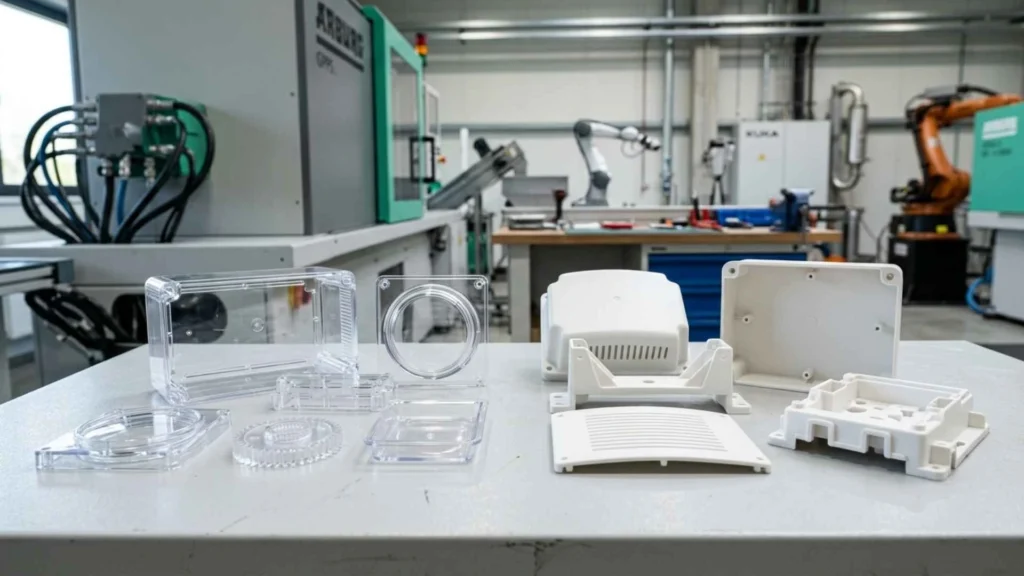
For injection molding, two of the most common forms are general-purpose polystyrene (GPPS) and high-impact polystyrene (HIPS). GPPS offers a rigid, glossy, transparent structure but remains relatively brittle. HIPS incorporates rubber modifiers that significantly improve impact resistance while making the material opaque.
Because polystyrene flows well and reproduces mold detail accurately, manufacturers use it for cost-sensitive consumer products, housings, packaging components, displays, and other rigid molded parts that do not require high mechanical or thermal performance.
Grades of Polystyrene
General-Purpose Polystyrene (GPPS)
GPPS is the unmodified form of polystyrene. It provides rigidity, transparency, gloss, dimensional stability, and low material cost.
Brittleness is its primary limitation. GPPS performs well where transparency, stiffness, appearance, and low cost matter more than impact resistance.
High-Impact Polystyrene (HIPS)
Manufacturers create HIPS by modifying polystyrene with an elastomer, typically polybutadiene rubber. The rubber phase improves impact resistance and toughness while sacrificing the transparency of GPPS.
As a result, manufacturers commonly use HIPS for housings, appliance components, panels, packaging, and other applications that must withstand more handling or impact than GPPS can tolerate.
Expanded Polystyrene (EPS)
EPS is the lightweight foam form of polystyrene commonly used for protective packaging, insulation, and food-service products.
Manufacturers produce EPS through foaming and bead molding rather than conventional solid-part injection molding. For that reason, EPS belongs to a separate processing category from GPPS and HIPS.
Properties of Polystyrene
Engineers primarily select polystyrene for low cost, stiffness, dimensional consistency, and easy processing. Exact performance depends heavily on whether the application uses GPPS or an impact-modified grade such as HIPS.
| Property | Characteristic | Design Note |
|---|---|---|
| Clarity | Excellent in GPPS | Rubber modification generally makes HIPS opaque |
| Rigidity | High | GPPS provides high stiffness but relatively low impact toughness |
| Impact Resistance | Low in GPPS; improved in HIPS | Consider HIPS when handling and impact resistance are important |
| Dimensional Stability | Excellent | Low, predictable molding shrinkage supports dimensional consistency |
| Heat Resistance | Relatively low | Grade and loading conditions influence continuous-use and heat-deflection performance |
| Chemical Resistance | Limited against many solvents and hydrocarbons | Confirm compatibility with the actual fluid, concentration, temperature, and exposure time |
| Cost | Very low | One of the more economical rigid thermoplastics for high-volume molded parts |
GPPS or HIPS?
Choose GPPS when clarity, rigidity, appearance, and low material cost are the main priorities and the part will not experience significant impact.
Choose HIPS when the part must withstand greater handling, drops, or mechanical abuse. The material trades transparency for substantially better toughness, although exact impact performance depends on the specific formulation and rubber content.
Advantages of Polystyrene
- Very low cost: Polystyrene is one of the more economical rigid thermoplastics used in injection molding.
- Excellent clarity in GPPS: General-purpose polystyrene can provide high transparency and a glossy surface.
- Easy to mold: The material flows readily, fills detailed cavities, and reproduces molded features accurately.
- Dimensionally stable: Low, predictable shrinkage supports consistent molded dimensions.
- Easy to decorate and assemble: Manufacturers can print, paint, bond, and otherwise finish many polystyrene grades effectively with the appropriate process.
Limitations of Polystyrene
- Brittleness in GPPS: Unmodified polystyrene has relatively poor impact resistance and can crack under mechanical shock.
- Limited solvent resistance: Many organic solvents and hydrocarbons can attack, craze, or dissolve polystyrene.
- Low heat resistance: Standard grades do not perform well in applications that require sustained elevated-temperature exposure.
- Limited outdoor durability: Prolonged UV exposure can cause unmodified polystyrene to yellow and lose mechanical properties.
- Flammability: Standard polystyrene burns readily unless manufacturers specify a flame-retardant grade.
What Products Are Made from Polystyrene?
Manufacturers use polystyrene across applications where cost, rigidity, appearance, and processing efficiency matter more than high-end mechanical or thermal performance.
| Industry | Typical Polystyrene Parts |
|---|---|
| Packaging | Clear containers, cosmetic packaging, trays, cases, and protective packaging components |
| Consumer | Disposable cutlery, cups, toys, organizers, and household products |
| Appliances | HIPS refrigerator liners, housings, panels, and interior components |
| Electronics | Low-cost enclosures, covers, and internal components |
| Retail & Display | Display cases, merchandising components, and point-of-sale fixtures |
Polystyrene in Injection Molding
Polystyrene is generally easy to injection mold. It flows readily, fills detailed cavities well, produces crisp molded features, and offers relatively low and predictable shrinkage.
GPPS also absorbs relatively little moisture compared with hygroscopic engineering plastics such as nylon, PET, or polycarbonate. Therefore, processors usually face less demanding drying requirements, although they should still store and process the resin according to the supplier’s recommendations.
Durability and environmental resistance represent the primary design trade-offs. GPPS is brittle, while both GPPS and HIPS offer limited heat, solvent, and outdoor-weathering performance compared with many engineering thermoplastics.
When a part needs greater impact resistance while retaining good moldability and cosmetic performance, ABS is often a logical material to evaluate. For transparent parts that also require substantially greater toughness, polycarbonate may offer a better fit.
Material Selection Note
Polystyrene works best when the application prioritizes low cost, stiffness, dimensional consistency, and easy molding over high impact strength, heat resistance, chemical resistance, or outdoor durability.
More demanding service environments may justify moving to ABS, polycarbonate, polypropylene, or another engineering or commodity resin.
Frequently Asked Questions
What is the difference between GPPS and HIPS?
GPPS, or general-purpose polystyrene, provides transparency, rigidity, gloss, and low cost but offers relatively low impact toughness. HIPS, or high-impact polystyrene, uses rubber modification to improve toughness and impact resistance, making it typically opaque. Applications that prioritize clarity and low cost often favor GPPS, while housings, panels, and other parts that must withstand handling or impact often use HIPS.
Is polystyrene the same as Styrofoam?
No. Styrofoam™ is a brand of extruded polystyrene (XPS) insulation, not a generic name for all polystyrene foam. People often use the term informally for expanded polystyrene (EPS), but EPS and XPS are different materials. Injection-molded GPPS and HIPS are solid forms of polystyrene rather than foam.
Is polystyrene strong?
Polystyrene is relatively stiff, but standard GPPS is also brittle and offers limited impact resistance. Rubber modification gives HIPS substantially greater toughness. Engineers typically choose polystyrene for cost, rigidity, appearance, and easy processing rather than high structural strength.
Is polystyrene recyclable?
Yes. Polystyrene carries resin identification code 6 and can technically be recycled. However, collection and recycling availability varies considerably by location and product form, and polystyrene generally has less extensive recycling infrastructure than materials such as PET or HDPE.
Does polystyrene need to be dried before injection molding?
Polystyrene absorbs relatively little moisture compared with many engineering thermoplastics, so processors often face less demanding drying requirements. However, moisture, surface contamination, storage conditions, and specific grade requirements can still affect molding quality. Always follow the material supplier’s handling and processing recommendations.
Choosing the Right Material for Your Part
Choosing polystyrene comes down to matching its properties — including rigidity, impact resistance, temperature performance, chemical exposure, appearance, and cost — to the actual demands of the application.
Polystyrene can be an effective choice for high-volume parts that prioritize economy, dimensional consistency, and straightforward processing over demanding mechanical or environmental performance. Parts that must withstand significant impact, heat, chemicals, or outdoor exposure may require another resin.
For any injection molding project, confirm material selection alongside a design-for-manufacturability (DFM) review before cutting tooling. Getting both the resin and part geometry right early helps protect cost, quality, and lead time throughout production.