A practical guide to ultra-high-molecular-weight polyethylene (UHMWPE), its wear resistance, common applications, and why it is rarely injection molded.
UHMWPE is a durable, low-friction plastic used in conveyor guides, wear strips, liners, and other components exposed to repeated sliding contact or abrasion. It combines excellent wear resistance with high impact strength and very low moisture absorption.
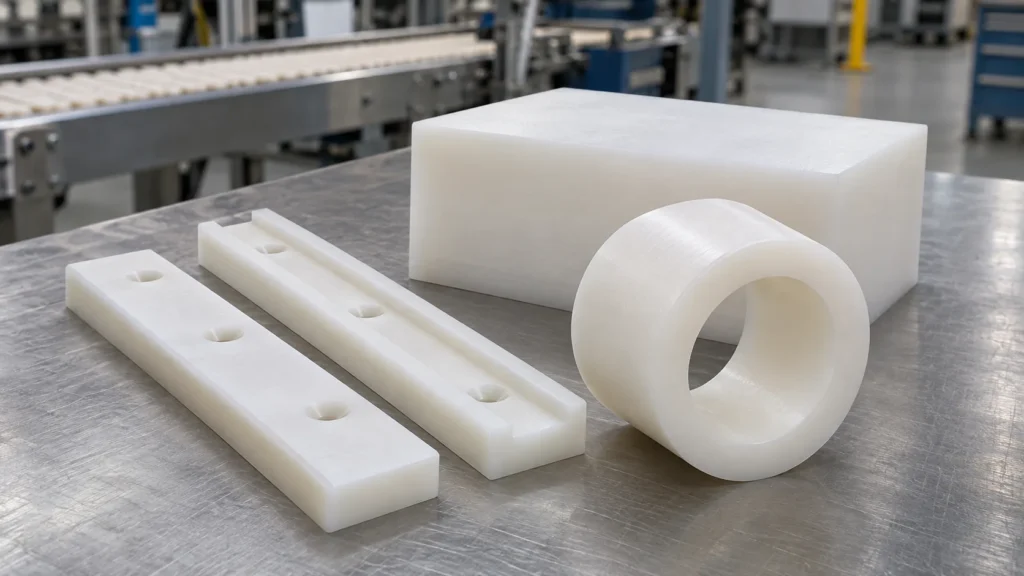
However, those benefits come with an important processing limitation. UHMWPE does not flow readily when heated, so manufacturers typically compression mold or ram extrude it into stock shapes, then machine the finished parts.
This guide explains what UHMWPE is, where it performs well, and when an injection-moldable alternative may be a better fit.
What Is UHMWPE?
Ultra-high-molecular-weight polyethylene, also called UHMWPE or UHMW, is a semi-crystalline thermoplastic in the polyethylene family. Its molecular chains are substantially longer than those of conventional high-density polyethylene (HDPE).
These long, entangled chains help the material resist abrasion and absorb impact. Combined with a low coefficient of friction, they make UHMWPE useful for components that guide, support, or slide against moving surfaces.
The same molecular structure creates extremely high melt viscosity. Although UHMWPE has a melting point, it does not develop the flow needed for conventional injection molding.
Key Processing Consideration
Specify the material and manufacturing process together. A part that benefits from UHMWPE’s wear resistance may require machining from stock rather than conventional injection molding.
Properties of UHMWPE
UHMWPE is primarily selected for wear resistance, low friction, and toughness. Actual performance depends on the grade, load, operating temperature, mating surface, and service environment.
| Property | Characteristic | Design Note |
|---|---|---|
| Abrasion resistance | Excellent | Useful for wear strips, liners, and guides; performance depends on contact conditions. |
| Coefficient of friction | Low | Supports low-friction sliding contact; confirm lubrication needs for the application. |
| Impact strength | High, including at low temperatures | Useful for components exposed to shock and repeated impact. |
| Chemical resistance | Resists many chemicals | Verify compatibility with the specific chemical, concentration, and temperature. |
| Moisture absorption | Very low | Limits moisture-related dimensional changes, but thermal expansion and deformation under load still matter. |
| Melt viscosity | Extremely high | Generally unsuitable for conventional injection molding. |
| Heat resistance | Moderate | Some grades list long-term service temperatures around 80°C (176°F); confirm the grade and loading conditions. |
Advantages of UHMWPE
For the right wear application, UHMWPE offers several practical benefits:
- Excellent abrasion resistance: Helps extend the life of components exposed to repeated rubbing and abrasive contact.
- Low-friction surfaces: Supports smooth movement in guides, wear strips, and sliding components.
- High impact strength: Provides toughness for parts exposed to shock, including in cold environments.
- Broad chemical resistance: Performs well against many chemicals when the grade and exposure conditions are compatible.
- Very low moisture absorption: Supports use in wet or humid environments with minimal moisture-related swelling.
Limitations of UHMWPE
UHMWPE’s wear performance does not make it suitable for every mechanical component. Consider these limitations before specifying it:
- Limited conventional processing options: Its high melt viscosity makes standard injection molding impractical.
- Relatively low stiffness: It is less rigid than many engineering plastics and can deform under sustained load.
- Moderate heat resistance: Elevated temperature can limit load capacity and dimensional performance.
- Dimensional movement: Low moisture absorption does not eliminate thermal expansion or creep. Tight-tolerance designs need appropriate allowances.
- Difficult bonding: Low surface energy makes adhesive bonding challenging without suitable surface preparation or specialized joining methods.
What Products Are Made from UHMWPE?
Manufacturers use UHMWPE where abrasion resistance, impact strength, and low-friction contact matter more than high stiffness or high-temperature performance. Common examples include:
| Industry | Typical UHMWPE Parts |
|---|---|
| Material handling | Conveyor wear strips, guide rails, and chain guides |
| Industrial equipment | Bushings, bearings, liners, and sprockets |
| Food processing | Low-friction guides, wear parts, and cutting surfaces made from suitable food-contact grades |
| Medical | Joint-replacement bearing components made from specialized medical grades |
| Marine | Wear pads and protective components exposed to impact and abrasion |
Food-contact and medical applications require grades selected for the intended use.
UHMWPE and Injection Molding
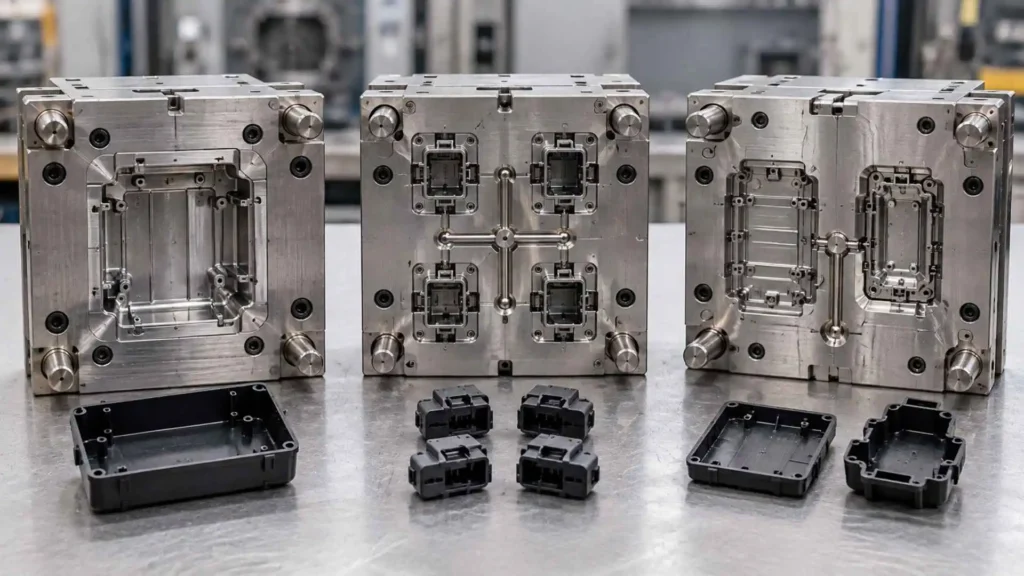
Conventional injection molding relies on molten resin flowing through a gate and filling a mold cavity. UHMWPE’s extremely high melt viscosity prevents it from flowing like common injection molding resins.
As a result, manufacturers commonly use compression molding or ram extrusion to produce UHMWPE sheets, rods, and profiles. They can then machine these stock shapes into finished components. Specialized processing approaches exist, but standard UHMWPE should not be treated as a conventional injection molding resin.
If your design requires injection molding, evaluate whether another material can meet the actual wear, friction, impact, and dimensional requirements:
- HDPE: An option when toughness, chemical resistance, and low moisture absorption are priorities, but UHMWPE-level abrasion resistance is unnecessary.
- Acetal (POM): A candidate for low-friction mechanical parts that also require stiffness and dimensional control.
- Wear-modified nylon: An option for moving components that need wear resistance and mechanical strength, with moisture behavior accounted for in the design.
These materials are alternatives to evaluate, not direct substitutes. Compare specific grades under representative operating conditions before changing the specification.
For a broader overview of resin selection factors, see our injection molding material selection guide.
Frequently Asked Questions
Can UHMWPE be injection molded?
Standard UHMWPE is generally unsuitable for conventional injection molding because its melt viscosity is extremely high. Manufacturers typically compression mold or ram extrude it into stock shapes, then machine the finished parts. Specialized grades or processes require separate evaluation.
Why is UHMWPE so wear-resistant?
Its very long, entangled molecular chains help resist material removal during abrasive contact. This gives UHMWPE excellent wear resistance, although actual service life depends on the load, mating surface, speed, temperature, and abrasive conditions.
What is the difference between UHMWPE and HDPE?
Both belong to the polyethylene family, but UHMWPE has much longer molecular chains. It generally offers better abrasion resistance and impact performance, while conventional injection molding grades of HDPE are much easier to process into molded parts.
What if I need UHMWPE properties in an injection molded part?
Evaluate which properties the application actually needs. Acetal, wear-modified nylon, or HDPE may meet the requirements, but none automatically matches UHMWPE’s full performance profile. If UHMWPE is essential, machining from compression-molded or ram-extruded stock is often the practical route.
Choosing the Right Material for Your Part
Start with the part’s operating conditions: contact surfaces, load, sliding speed, temperature, chemical exposure, impact, and dimensional requirements. Then evaluate the material and manufacturing process together.
UHMWPE may be appropriate when wear resistance and low friction justify machining or compression molding. An injection-moldable resin may be a better fit when it meets the performance requirements and supports the part geometry, production volume, and cost target.
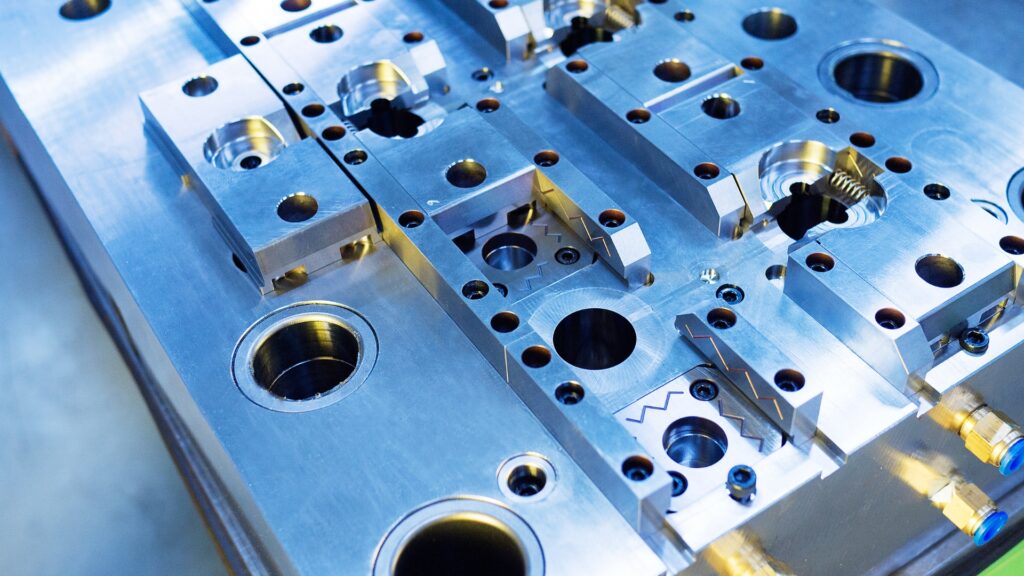
For an injection molding project, confirm resin selection alongside a design-for-manufacturability review before tooling is built. Resolving material and geometry requirements early helps protect part quality, tooling investment, and production lead time.