A practical framework for choosing between injection molding and 3D printing based on volume, geometry, material requirements, and timeline.
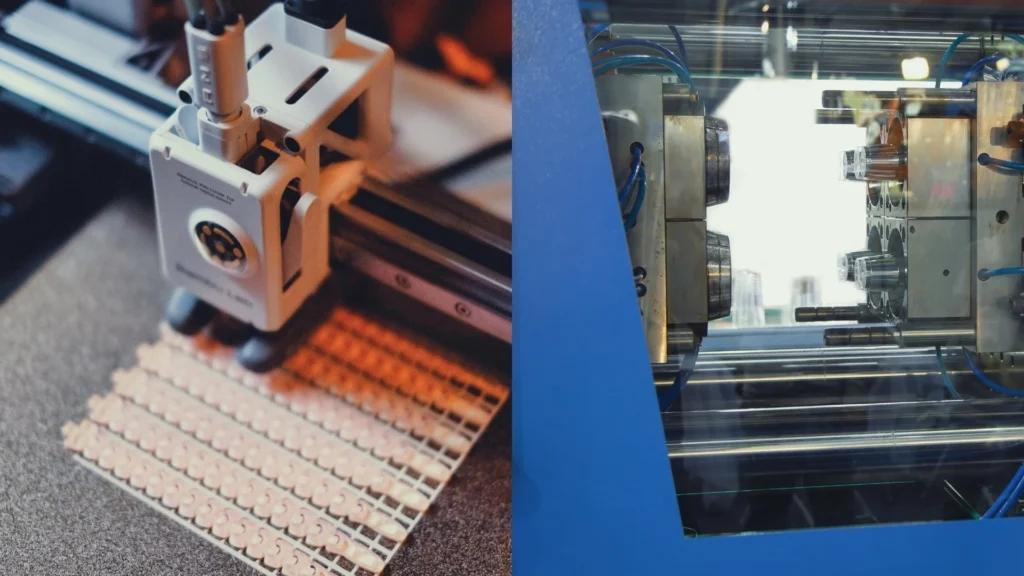
Injection molding and 3D printing, also known as additive manufacturing, are both plastic part manufacturing processes, but they serve fundamentally different points in a product’s lifecycle. The choice between them is not primarily about quality or capability — it is about economics, timeline, and fit to the specific production scenario.
This guide gives you a clear decision framework based on the variables that actually determine which process wins for your application, so you can get to the right answer and learn where the crossover point falls for your part.
The Core Economic Difference
Injection molding has a high fixed cost in tooling and a low variable cost in piece price. 3D printing has zero fixed cost and a higher variable cost per part. This creates a volume crossover point — below which 3D printing is cheaper, above which injection molding is cheaper — that is the foundation of every process selection decision.
The crossover volume depends on tooling cost and piece price for the specific part. For a simple part with a relatively inexpensive mold and a low piece price, the crossover may be 500–1,000 parts. For a complex part with expensive tooling, the crossover may be 5,000–15,000 parts. Comparing tooling cost against piece price this way is the first calculation to do before making any process decision, and it can save significant time and budget later in the program.
Key Process Selection Factor
The right manufacturing method depends on the total production scenario, not just the part design. Volume, tooling cost, material requirements, lead time, surface finish, and design maturity should all be evaluated before choosing between injection molding and 3D printing, since the best manufacturing process is built to scale with the program.
Where Injection Molding Wins
- High volume: 1,000 parts and above where tooling is amortized across a large run.
- Consistent material properties: Injection molded parts use validated engineering thermoplastics with predictable, isotropic properties; 3D printed parts have layer-by-layer anisotropy.
- Surface finish: Injection molding delivers production-quality surfaces directly from the mold, reducing costly post-processing; 3D printing requires post-processing for most functional surfaces.
- Material range: Hundreds of engineering resins, including medical-grade, flame-rated, and chemical-resistant materials not available in 3D printing.
- Part-to-part consistency: Injection molding achieves shot-to-shot repeatability that 3D printing cannot match for tight-tolerance production.
- Long-term economics: Once tooling is paid for, per-part cost is low for the life of the tool, which is why injection molding wins on total costs for long, high-volume programs.
Where 3D Printing Wins
- Low volume: Under 500 parts where tooling cannot be justified economically.
- Design iteration: No tooling means design changes cost nothing; iterate freely before committing to a mold, which is why prototyping teams reach for 3D printing first.
- Complex internal geometry: Conformal cooling channels, lattice structures, and internal voids impossible to mold are native to 3D printing.
- One-off and custom parts: Unique jigs, fixtures, prototypes, and end-use parts produced in single digits.
- Fast turnaround: Parts in hours or days, not weeks; no tooling lead time, which makes 3D printing faster to a first part than any molding process.
- No minimum order: 1 part costs the same per unit as 10 parts.
The Material Gap
3D printing materials have improved significantly as the underlying technology has matured, but the gap with injection molding materials remains real and consequential for production applications:
| Injection molding | Full range of engineering and high-performance thermoplastics — PA 6/6, PC, PEEK, PEI, PPS, LSR, flame-rated grades, FDA-compliant grades. |
| FDM filament | Limited to extrudable filament materials — PLA, ABS, PETG, nylon, and limited grades of PC. Layer bonding creates anisotropic properties. |
| SLA resin | Photopolymers — good surface finish and detail but limited material certifications and UV sensitivity in many grades. |
| SLS / MJF | PA 12, PA 11, TPU — best 3D printing materials for functional parts, but still not equivalent to molded PA 6/6 or PC in isotropic properties. |
Material Selection Note
For functional production parts, material behavior is often the deciding factor. Modern industrial 3D printers can be highly effective for prototypes and limited production, but injection molding offers a broader range of validated engineering resins and more predictable long-term performance.
A Decision Framework
| Volume < 100 | 3D printing is almost always the right answer — no tooling, fast turnaround, free design iteration. |
| Volume 100–1,000 | Evaluate based on part complexity, material requirements, and timeline. Rapid injection molding or urethane casting may compete. |
| Volume 1,000–10,000 | Injection molding is usually more economical for simple to moderate parts. Evaluate tooling cost vs. 3D printing total cost. |
| Volume > 10,000 | Injection molding wins on economics in almost all cases unless the geometry is impossible to mold. |
| Design not final | Use 3D printing to validate before committing tooling — always. |
| Production start urgent | Rapid injection molding bridges the gap while production tooling is built. |
Frequently Asked Questions
Is 3D printing or injection molding better?
Neither is universally better — they serve different production scenarios. 3D printing is better for low volume, complex geometry, and early design iteration. Injection molding is better for volume production, consistent material properties, and long-term economics. Most products use both: 3D printing for prototyping and validation, injection molding for production.
Can you 3D print injection molds?
Yes — 3D printed molds made from high-performance resins or metal are used for short-run injection molding. They typically last for 50–500 shots before wear becomes an issue, making them useful for small-batch validation runs. They cannot match the precision, finish, or longevity of machined aluminum or steel tooling.
What is the minimum quantity for injection molding?
There is no fixed minimum, but injection molding is generally cost-competitive starting at 1,000 parts with standard aluminum tooling, or higher with production steel tooling. Short run and low volume injection molding services with simplified tooling can make smaller quantities economical. For quantities under 500 parts, evaluate 3D printing or urethane casting first.