Part design determines everything in injection molding. The shape of the part defines what the mold must do, what the process must achieve, and what the final production run and finished part can cost. Design decisions made before the mold is cut are essentially free to change. The same decisions after steel is cut can create tens of thousands dollars of tooling costs and development delays.
This guide covers the fundamental part design rules every engineer must understand before sending parts to an injection molder.
Wall Thickness
Uniform wall thickness is the most important single rule in injection molding design. Walls that vary significantly in thickness cool at different rates — thick sections cool slowly and shrink more, pulling thin sections with them and causing warpage, sink marks, and residual stress. For most engineering thermoplastics, the recommended nominal wall is 1.5–4 mm. Polypropylene and polyethylene can run thinner; PC and nylon prefer the middle of this range.
Where wall thickness must transition, taper gradually over a distance of at least 3× the wall thickness difference. Abrupt steps create stress concentrations and fill discontinuities.
Draft Angles
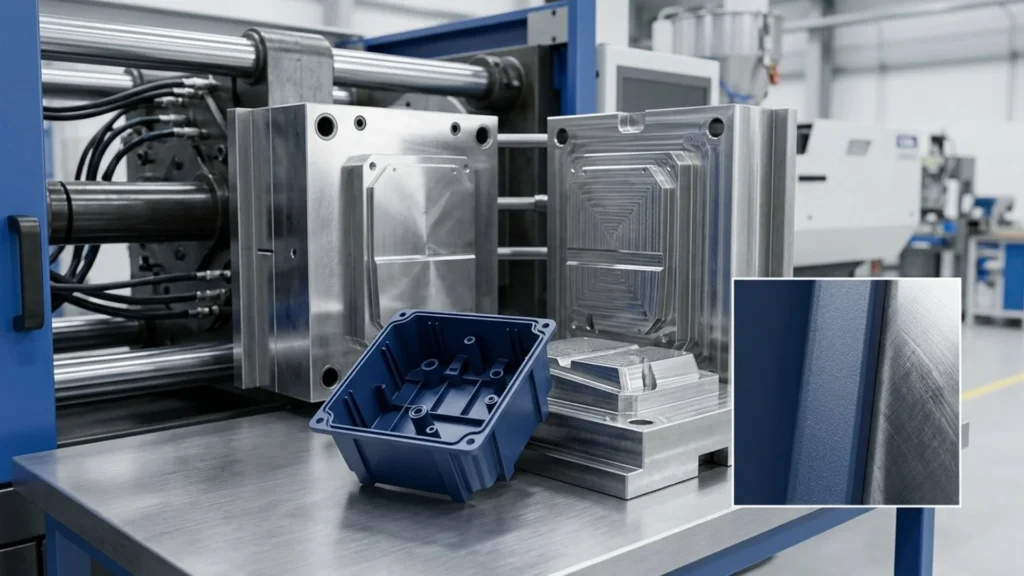
Every surface parallel to the mold opening direction must be tapered slightly — this is draft. Without draft, the part grips the metal mold core as it shrinks during cooling, and ejection requires excessive force that mars the surface or ejects the part warped.
- Minimum draft: 1° per side for most smooth-surface applications
- Textured surfaces: 1° per 0.025 mm texture depth, minimum 3° for light textures, 5° or more for heavy grain
- Polished surfaces (SPI A-1/A-2): 1.5–2° minimum — polished surfaces grip the mold more than textured ones
- Side walls of ribs and bosses: 0.5° minimum; 1° preferred
Ribs
Ribs are the injection molder’s substitute for thick walls — they add stiffness and bending resistance without adding cycle time, material cost, or sink marks. The design rules:
- Rib thickness: 50–65% of the nominal wall to prevent sink on the opposite surface
- Rib height: maximum 3× the nominal wall. Taller ribs require aggressive draft to eject cleanly
- Rib spacing: minimum 2× the nominal wall between adjacent ribs, to allow plastic to flow and cool without knitting problems
- Rib base: add a fillet radius of 0.25–0.5× the nominal wall at the rib base — stress concentration at sharp corners causes cracking under flex loading
Bosses
Bosses are cylindrical features that accept screws, pins, or inserts. They are among the most common sources of warpage and sink in injection molded parts because they concentrate material thickness.
- Boss outer wall: no greater than 60% of nominal wall to prevent sink on the opposite face
- Boss height: maximum 3× the outer diameter without gusseting support
- Boss positioning: attach bosses to a wall or rib rather than isolating them in open space — isolated bosses warp and sink more severely
- Gussets: add two or more gussets from the boss base to the adjacent wall for any boss that will carry shear or bending load from a fastener
Gates and Parting Lines
Gate location and parting line placement are critical decisions that affect fill balance, weld line location, surface appearance, and tooling costs:
- Gate into thick sections: plastic flows from thick to thin, which is correct for pressure transmission and part fill
- Keep gates away from structural zones: the gate area has highest residual stress — avoid placing gates at load-bearing features
- Parting lines create witness marks: design the part so parting lines fall in non-cosmetic locations where possible
- Simple parting geometry reduces tooling cost: flat parting lines are the least expensive; complex stepped or contoured parting lines increase machining complexity, add costs and mold maintenance
Undercuts
Undercuts are features that prevent straight-pull ejection — recesses, side holes, threads, and snap hooks that are perpendicular to the mold opening direction. They require additional tooling mechanisms, impacting tool machining and total project costs:
- Side actions (slides): additional mold components that retract sideways to clear the undercut before ejection — adds tooling cost
- Lifters: angled pins that move diagonally during ejection to clear undercuts on the core side
- Bumpoffs: elastic undercuts on flexible materials (TPE, PE) that can be pushed off the core without additional tooling
- Shutoffs: the preferred approach — redesign the undercut geometry so the mold can be machined to achieve the feature without a side action
Frequently Asked Questions
How much draft do I need for injection molding?
A minimum of 1° per side for smooth, non-critical surfaces. Textured surfaces require more draft — typically 1° per 0.025 mm of texture depth. For heavily grained surfaces, 5° or more per side is required to avoid drag marks during ejection. Your mold builder should review draft angles before tooling begins.
How thick should injection molded walls be?
The optimum nominal wall for most engineering thermoplastics is 1.5–4 mm. The right target within that range depends on material, structural requirement, and cycle time economics. Thinner walls are achievable but require high injection speeds and careful gating. Walls above 4 mm create long cooling times and sink marks.
Where should I place the gate?
Gate into the thickest section of the part, away from cosmetic and structural critical surfaces. Gate location determines fill pattern, weld line location, and residual stress distribution. A mold flow analysis before cutting steel will show how different gate locations affect fill and weld line position.
Downloadable Mold Design Resources
Use these checklists to support design review conversations before tooling begins. They help identify critical mold design details such as material shrink, parting line location, draft, ejector pin layout, cooling, runner balance, gate type, side actions, and machine fit.