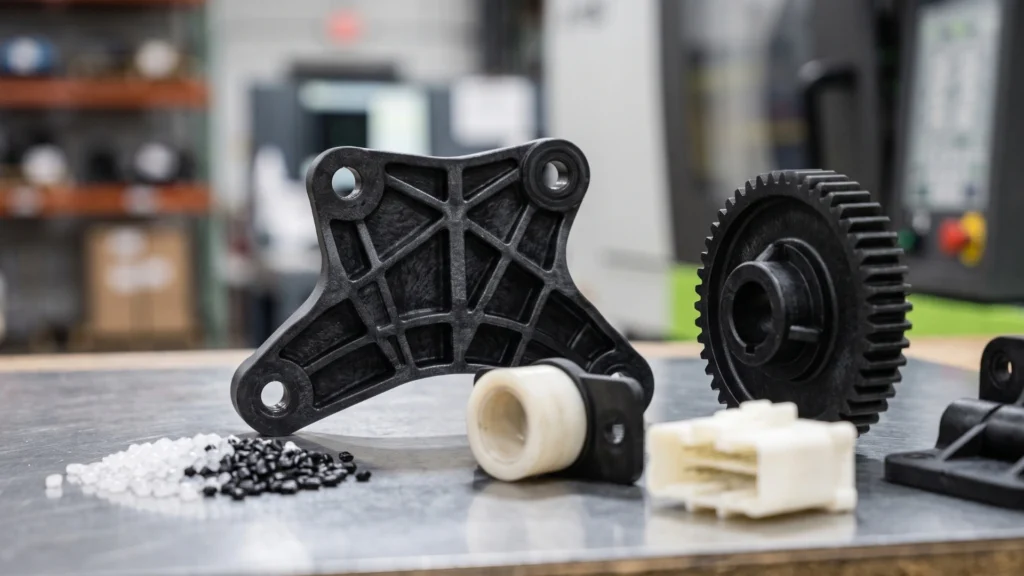
Metal injection molding (MIM) is a manufacturing process that combines the geometric freedom of plastic injection molding with the material properties of metal. In this specialized molding process, fine metal powder is mixed with a thermoplastic binder to create a feedstock that processes through standard injection molding equipment. The molded part — called a green part — then goes through debinding and sintering stages that burn off the binder and fuse the metal powder particles into a fully dense, strong metal component.
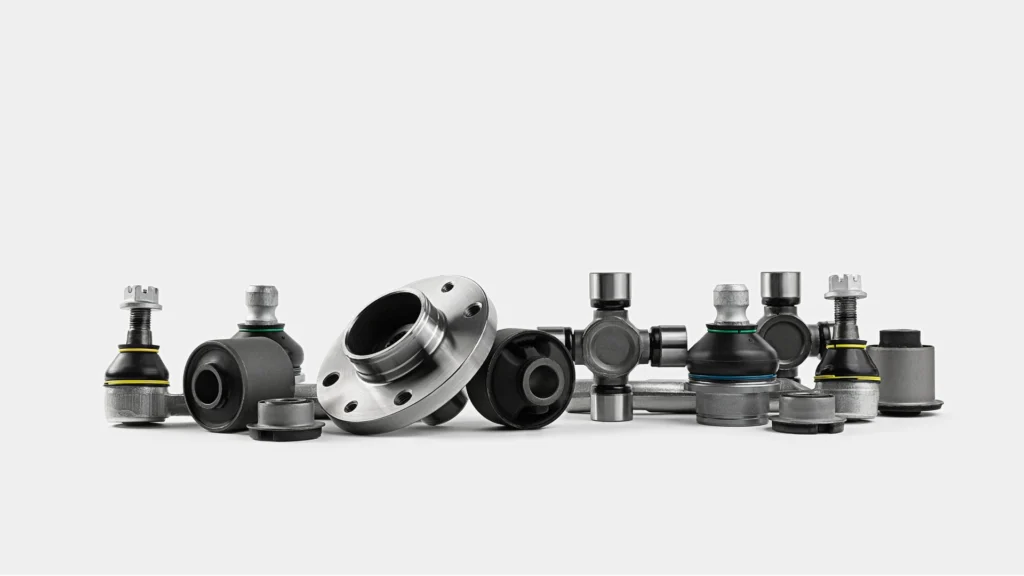
MIM allows engineers to produce complex, high-precision metal parts products with intricate geometries that would be prohibitively expensive or impossible to shape at volumes and geometries using traditional machining or alternative technologies, like die casting, cannot match. It is a key manufacturing process behind surgical instruments, defense hardware, firearms components, orthodontic brackets, watch components, and precision aerospace parts.
The Metal Injection Molding (MIM) Process Step by Step
Step 1 — Feedstock Preparation
Fine metal powder, typically 5–15 micrometers in diameter, is compounded with a multi-component thermoplastic binder to create feedstock pellets. The binder is precisely formulated to maintain uniform powder distribution so the material flows reliably through an injection mold to satisfy strict component requirements.
Step 2 — Injection Molding
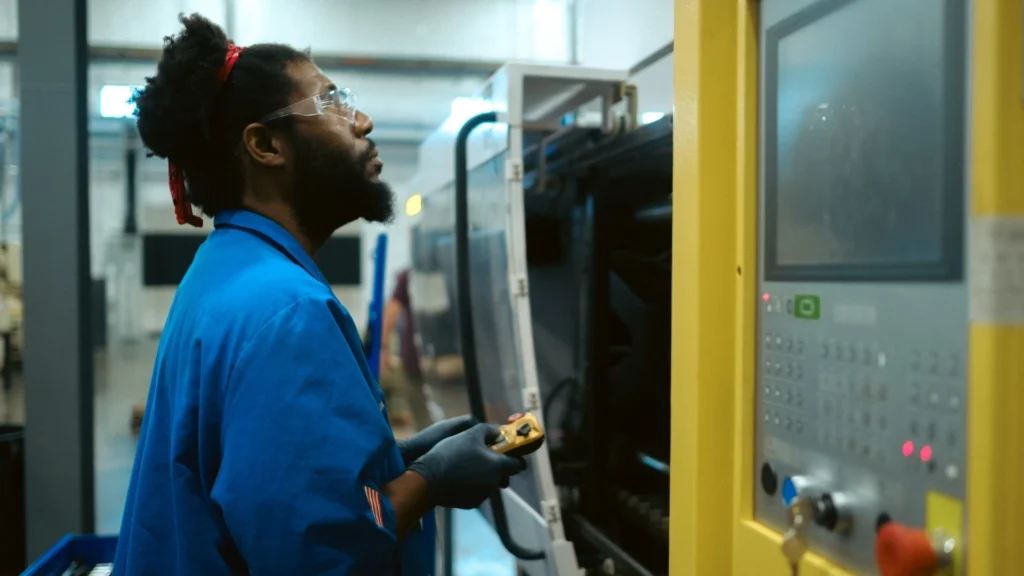
The feedstock is processed in a standard injection molding machine at relatively low temperatures, 150–200°C — lower than most engineering thermoplastics. The mold cavity fills with the powder-binder mixture and the green part is ejected. While green parts are dimensionally accurate, they significantly larger than the finished part — they must shrink during sintering, and that shrinkage is factored into the mold design.
Step 3 — Debinding
The binder is removed from the green part through chemical, thermal, or catalytic debinding technologies. Chemical debinding immerses the part in a solvent that dissolves one binder component; the residual binder holds the part together as a porous “brown part.” Thermal debinding burns off remaining binder in a controlled atmosphere furnace.
Step 4 — Sintering
During the sintering stage, the brown part is heated in a high-heated sintering furnace to 80–98% of the metal’s melting point. At this elevated temperature, metal powder particles fuse and the part densifies, contracting approximately 15–20% linearly from its green-part dimensions. Final products achieve 95–99% of theoretical density, with mechanical properties approaching those of wrought metal.
Metals and Alloys Available in Metal Injection Molding
| Metal / Alloy | Common Applications |
|---|---|
| Stainless steels, including 316L, 17-4 PH, and 420 | Most common — medical instruments, food processing, watch components, structural hardware |
| Low-alloy steels, including 4140 and 8620 | Automotive and industrial components requiring strength and wear resistance |
| Titanium, including Ti-6Al-4V | Aerospace and medical implants — exceptional strength-to-weight ratio and biocompatibility |
| Cobalt chrome | Surgical implants, dental prosthetics — biocompatible, wear-resistant |
| Tungsten alloys | Radiation shielding, counterweights, electrical contacts — very high density |
| Nickel alloys, including Inconel | High-temperature aerospace and energy components |
Process Comparison: Metal Injection Molding vs. Die Casting vs. CNC Machining
| Comparison | How Metal Injection Molding (MIM) Compares |
|---|---|
| MIM vs. Die Casting | MIM technology produces finer features, thinner walls, and tighter tolerances. Die casting is faster and better for larger parts; MIM is typically limited to under 100g. Die casting alloys are primarily aluminum, zinc, and magnesium but MIM can utilize stainless, titanium, and other alloys that are unsuited for traditional die casting equipment. |
| MIM vs. CNC Machining | MIM is significantly more economical for complex parts at high production volumes — machining from billet wastes raw material and requires many setups for complex geometry wherease the MIM process produces near-net-shape parts in a single cycle. Machining is preferred for low-volume programs, large parts, and materials not available in MIM feedstock. |
| MIM vs. Investment Casting | Both technologies handle complex geometry, but metal injection molding produces finer features, tighter tolerances, and better surface finish. Investment casting scales to much larger parts and a wider alloy range. |
Metal Injection Molding Design Guidelines & Requirements
- Wall thickness: MIM parts typically have walls of 0.5–6 mm. Very thin walls, under 0.5 mm, can be difficult to fill while very thick sections slow debinding and create density gradients.
- Undercuts and complex geometries: MIM as a process easily handles undercuts, internal threads, blind holes, and cross-holes that would be impossible or very expensive to machine, requiring secondary machining operations— this is a key advantage of the process.
- Shrinkage allowance: Molds must be designed approximately 15–20% oversize to account for sintering shrinkage. The shrinkage rate is consistent and predictable once the process is validated.
- Tolerances: Achievable tolerances in sintered MIM parts are typically ±0.3–0.5% of feature dimension, with ±0.1% possible after sizing/coining operations.
- Surface finish: As-sintered MIM surface roughness finish is approximately Ra 1.6–3.2 μm. Secondary finishing, including tumbling, grinding, EDM, and polishing, can be applied to meet specific aesthetic or friction requirements.
Frequently Asked Questions
What is the maximum size for a metal injection molded part?
MIM is typically used to produce precision parts under 100 grams. The debinding and sintering stages become more difficult and time-consuming as part mass increases. Very large parts are better served by investment casting, die casting, or machining technologies. Most MIM parts are in the 1–50 gram range.
How strong are metal injection molded parts?
Sintered MIM parts achieve 95–99% of theoretical density and mechanical properties that approach wrought metal. 316L stainless MIM typically achieves tensile strength of 510–690 MPa and elongation of 40–50% — comparable to wrought 316L. 17-4 PH after heat treatment achieves 1,000–1,300 MPa tensile strength.
Is metal injection molding suitable for medical devices?
Yes — MIM is extensively used in medical and pharmaceutical product manufacturing. Stainless 316L and 17-4 PH, titanium, and cobalt chrome are all MIM-processable and biocompatible. MIM surgical instruments, endoscopic components, and orthopedic implant components are all produced commercially.