
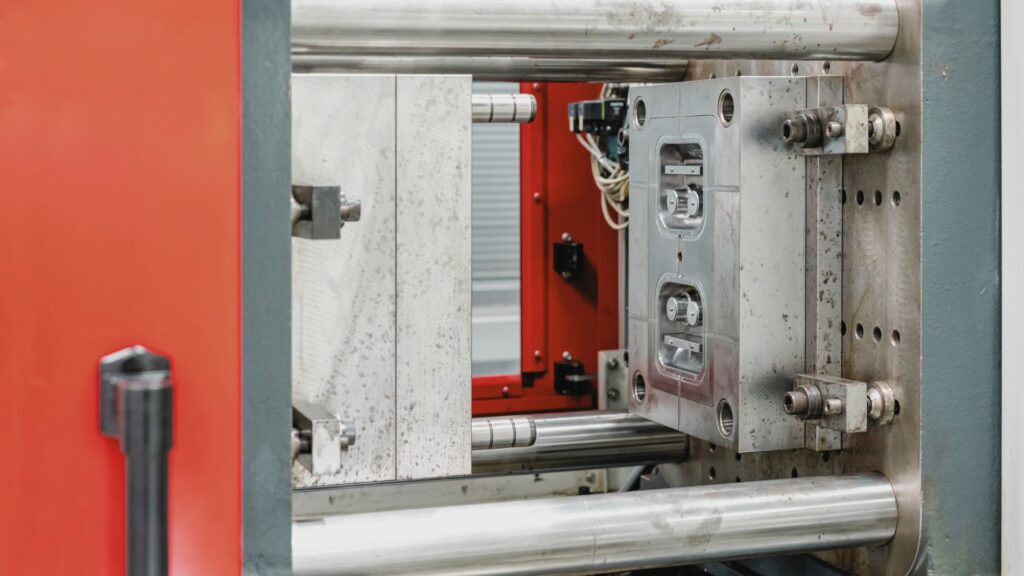
A complete overview of the major types of injection molding — for engineers and buyers who need to choose the right process.
Injection molding is not a single process. The major types of injection molding share the same core principle — forcing molten material into a closed mold — but differ fundamentally in machine configuration, material state, part geometry, and output. Choosing the right type determines part performance, tooling cost, lead time, and what geometries are even achievable.
This guide covers the major injection molding variants, what distinguishes each, and when to use them.
Key Process Selection Factor
The right injection molding process depends on more than part material. Buyers and engineers should also consider part geometry, production volume, tooling budget, required tolerances, secondary operations, and whether the part needs multiple materials, metal features, hollow sections, or specialized performance properties.
Standard Thermoplastic Injection Molding
Standard injection molding is the baseline process — molten thermoplastic is injected into a closed steel or aluminum mold under high pressure, cooled, and ejected as a solid part. It is the most common manufacturing process for plastic parts globally and applies to virtually any thermoplastic resin: PP, ABS, PC, nylon, Delrin, PEEK, and hundreds more.
The process is cyclic — typically 15 to 90 seconds per shot — and highly repeatable. It is the right choice for any solid plastic part produced at 1,000 units or more, where consistency, surface finish, and material selection matter. Tooling is the entry cost, and per-part cost falls as volume grows.
Overmolding
Overmolding produces a part from two different materials by molding the second material directly over the first, known as the substrate. The result is a single part with a rigid structural core and a soft, grippy, or aesthetically distinct outer layer — without adhesives or assembly.
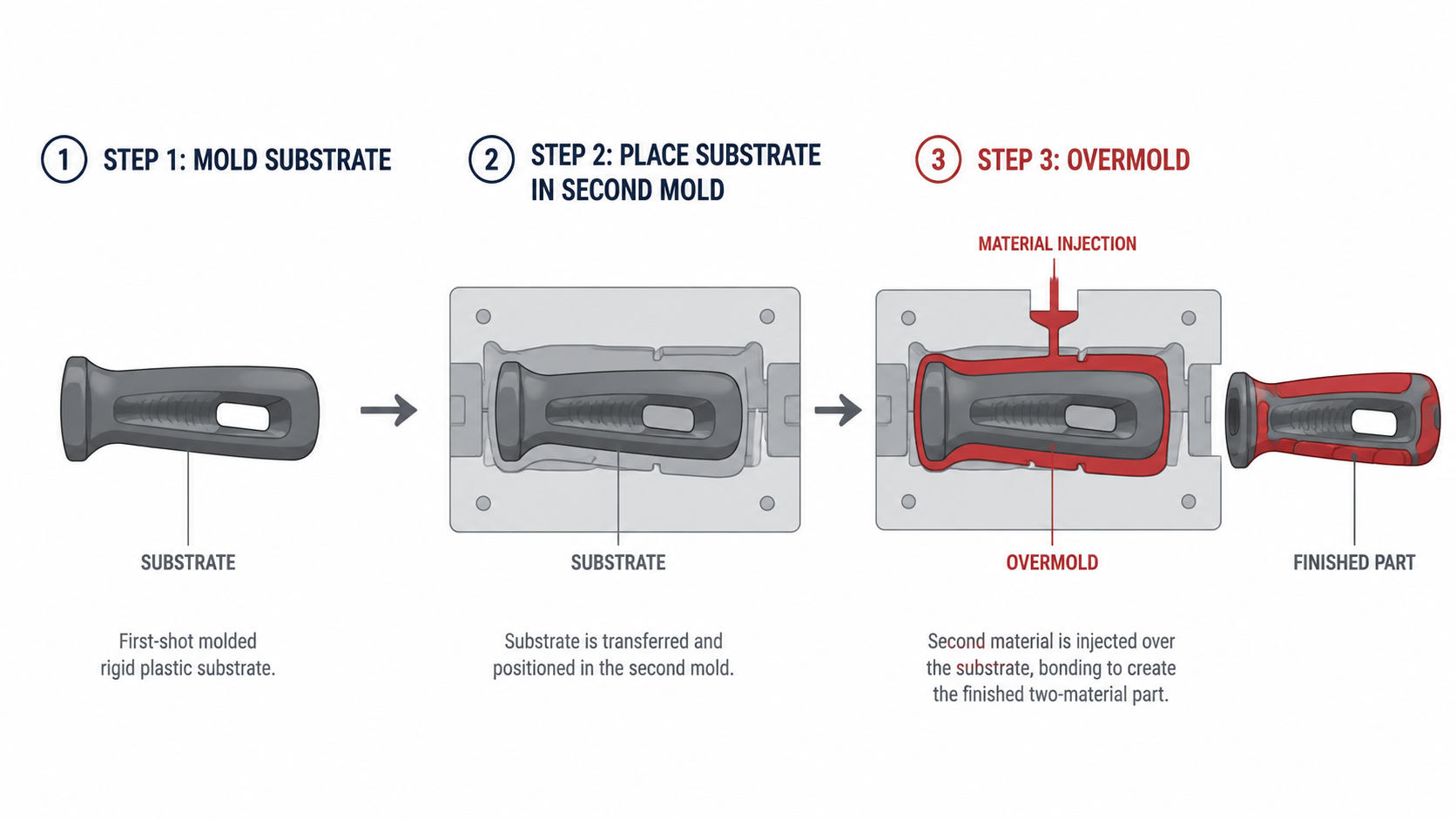
Overmolding starts with a rigid substrate, then adds a second molded material over selected surfaces.
Common applications include toothbrush handles with a rigid nylon core and soft TPE grip, medical device handles with a PC body and LSR overmold, and power tool housings with an ABS structure and TPE vibration-damping layer. The key design challenge is material compatibility — the overmold material must bond chemically or mechanically to the substrate.
See our Overmolding Design Guide for substrate selection, material pairing, and geometry rules.
Insert Molding
Insert molding encapsulates a pre-placed component — typically a metal insert — within the injection molded part in a single cycle. The mold is opened, the insert, such as a threaded brass insert, stamped metal part, or electronic component, is placed into the mold, and plastic is injected around it.
The result is a plastic part with integral metal features: threaded interfaces that can be torqued repeatedly without stripping, conductive pathways embedded in a housing, or metal reinforcement in a load-bearing region. Insert molding eliminates secondary press-in operations and produces a stronger, more consistent result than heat staking or ultrasonic insertion after molding.
Gas-Assist Injection Molding
Gas-assist injection molding injects pressurized nitrogen into the molten plastic immediately after the cavity fills. The gas creates a hollow channel through the thickest sections of the part, replacing material that would otherwise require excessive cooling time and generate sink marks.
It is used for parts with thick sections that must be rigid and lightweight — furniture handles, automotive grab bars, medical equipment frames, and large structural housings. Gas assist reduces part weight, eliminates sink marks on thick ribs, shortens cycle time, and reduces clamp tonnage requirements.
Metal Injection Molding (MIM)
Metal injection molding (MIM) combines fine metal powder with a thermoplastic binder to create a feedstock that processes through a standard injection molding machine. After molding, the part goes through debinding, which removes the binder, and sintering, which fuses the metal particles at high temperature, producing a fully dense metal part.
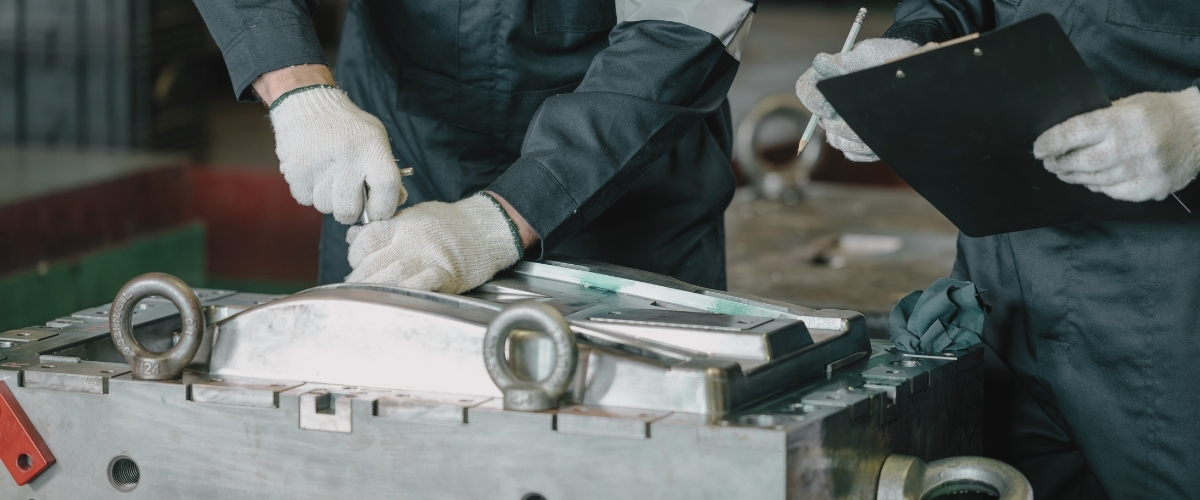
MIM produces complex geometries in metals — stainless steel, titanium, cobalt chrome, tungsten alloys — that would be extremely expensive or impossible to machine. It is used for surgical instruments, firearm components, orthodontic brackets, and precision aerospace hardware where complexity and material strength are both critical. Part size is limited — MIM is typically used for parts under 100 grams.
Liquid Silicone Rubber (LSR) Injection Molding
LSR injection molding processes liquid silicone rubber — a two-part thermoset — through a modified injection molding machine. Unlike thermoplastics that solidify when cooled, silicone cures when heated. The mold is kept hot, and the cooled delivery system keeps the silicone liquid until it enters the cavity.
LSR produces parts with outstanding biocompatibility, chemical resistance, flexibility across temperature extremes, and electrical insulation. It is the material of choice for medical seals and gaskets, baby bottle nipples, respiratory masks, and automotive seals. The process requires dedicated equipment and longer cure times than thermoplastic molding.
Reaction Injection Molding (RIM)
Reaction injection molding (RIM) mixes two liquid components — typically polyurethane — at low pressure in a mixing head and injects the reactive mixture into the mold, where it cures chemically. Unlike thermoplastic injection molding, RIM operates at very low injection pressures, which means molds can be made from lower-cost materials including aluminum and composites.
RIM is used for large, lightweight structural parts — automotive fascias, bumper systems, medical imaging equipment housings, and agricultural equipment panels — where thermoplastic injection molding would require enormous clamp tonnage and tooling cost. Part size in RIM is limited mainly by the mixing head capacity, not machine tonnage.
Thin-Wall Injection Molding
Thin-wall injection molding is standard injection molding optimized for parts with wall thicknesses below approximately 1 mm. Achieving these walls requires high injection speeds, elevated injection pressure, and precisely engineered gate and runner systems to fill the cavity before the melt freezes.
It is the dominant process for food packaging, disposable medical containers, and high-volume consumer goods where material content is a major cost driver. Tooling for thin-wall applications is typically multi-cavity — 8, 16, 32, or 64 cavities — and cycle times are measured in seconds rather than minutes.
Multi-Shot / Two-Shot Injection Molding
Two-shot molding, also called 2K or multi-component molding, produces a part from two different materials or colors in a single machine cycle, using a rotating platen or index plate. Unlike overmolding, which requires a second machine and manual transfer, two-shot molding is a continuous automated process with no handling between shots.
It is used for toothbrushes, automotive instrument panels with integral color accents, and medical device components where two-material integration must be both cosmetically perfect and structurally reliable. Tooling is significantly more complex and expensive than single-shot tools, and the process requires specialized two-shot molding machines.
Choosing the Right Injection Molding Type
The right injection molding technology depends on the material, part geometry, performance requirements, production volume, and whether the part needs multiple materials, hollow sections, metal features, or specialized mechanical properties.
| Injection Molding Type | Best Use Case |
|---|---|
| Standard thermoplastic | Default for most solid plastic parts — high volume, good precision, wide material selection. |
| Overmolding | Rigid substrate plus soft overmold in one part — grips, seals, and soft-touch surfaces. |
| Insert molding | Integral metal features in plastic — threaded inserts, conductors, and reinforcement. |
| Gas-assist | Large parts with thick sections — reduces sink, weight, and cycle time. |
| Metal injection molding | Complex metal geometries at volume — precision hardware and surgical instruments. |
| LSR molding | Flexible, biocompatible, temperature-stable parts — medical, automotive, and food-contact applications. |
| Reaction injection molding | Large, low-pressure structural panels — automotive fascias and equipment housings. |
| Thin-wall | High-speed, high-volume packaging and disposables with walls below 1 mm. |
| Two-shot | Two materials or colors in one automated cycle — no manual transfer and tight registration. |
Frequently Asked Questions
What is the most common type of injection molding?
Standard thermoplastic injection molding is by far the most common — it covers the vast majority of plastic parts in every industry. Overmolding and insert molding are the next most common variants, used wherever multi-material integration is required.
What is the difference between overmolding and insert molding?
Overmolding molds a second plastic material over a first plastic substrate. Insert molding molds plastic around a pre-placed non-plastic component, typically metal. Both produce multi-material parts in a single mold, but through different mechanisms. See our Insert Molding vs. Overmolding comparison for a full breakdown.
Is metal injection molding the same as die casting?
No. Metal injection molding (MIM) uses a polymer binder mixed with fine metal powder, processes like plastic injection molding, and then sinters the part to full density. Die casting injects molten metal under pressure directly into a die. MIM produces more complex geometries and finer features; die casting is faster and better suited to larger parts.