What V-0, V-1, V-2, HB, and 5V mean for injection molded plastic parts — and how to specify the right rating for your application.
UL 94 is the standard for flammability testing of plastic materials for parts in devices and appliances, published by Underwriters Laboratories. It classifies plastics by how they respond to a standardized ignition source — whether they self-extinguish, how quickly, whether they drip burning material, and whether drips ignite the cotton indicator below the sample. This classification system is used globally by regulators, OEMs, and testing labs to communicate flammability performance in a consistent, comparable way.
Virtually every plastic part inside an electrical or electronic product must meet a UL 94 rating appropriate to its position in the device. Specifying the wrong rating — or not specifying one — exposes the product to safety certification failures, regulatory non-compliance, and field liability.
The UL 94 Test Methods
Horizontal Burn Test HB
The simplest test. A horizontal sample is exposed to a flame. The sample passes HB classification if it self-extinguishes before reaching a mark 100 mm from the ignition point, or burns at a rate slower than 40 mm/minute for samples 3–13 mm thick or 75 mm/minute for samples under 3 mm. HB is the lowest flammability classification — it means “slow-burning,” not “self-extinguishing.”
Vertical Burn Test — V-2, V-1, V-0
The vertical tests are more demanding. A vertical sample is exposed to a flame twice, each for 10 seconds. Classification is determined by afterflame time, total afterflame plus afterglow time, and whether dripping burning particles ignite the cotton indicator below:
| UL 94 Rating | Classification Criteria |
|---|---|
| V-0 | Afterflame ≤ 10 sec per application; total ≤ 50 sec for 5 specimens; no burning drips; no afterglow beyond 30 sec. The most stringent vertical rating. |
| V-1 | Afterflame ≤ 30 sec per application; total ≤ 250 sec for 5 specimens; no burning drips. Less stringent than V-0 on time but still no burning drips. |
| V-2 | Same time criteria as V-1, but burning drips that ignite cotton are permitted. Least stringent vertical rating — materials self-extinguish but may drip. |
| HB | Horizontal test only — slow burning. Many commodity plastics, including PP, ABS, and PC without FR additives, achieve HB at standard thickness. Not suitable for device interiors. |
5VA and 5VB
The 5V tests use a larger, more severe flame and are required for enclosures and structural components in some device categories. 5VA requires no burn-through of the test sample; 5VB permits burn-through. These ratings are specified for device enclosures by some safety standards including IEC 60950.
Which Rating Does Your Part Need?
The required rating is not chosen arbitrarily — it is determined by the device standard that governs your product. Common requirements:
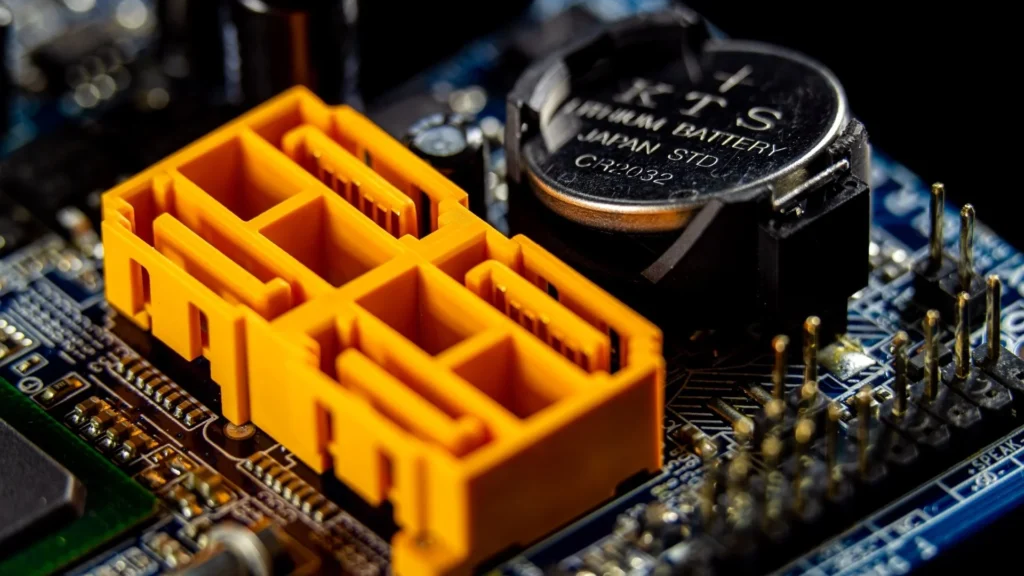
- UL 94 V-0: Required for internal parts near power circuitry in most consumer electronics, information technology equipment, and medical devices — driven by IEC 60950-1, IEC 62368-1, and IEC 60601 standards.
- UL 94 V-1: Used for some structural components where V-0 performance is cost-prohibitive and the part is not in direct contact with current-carrying conductors.
- UL 94 V-2: Sometimes acceptable for parts at low fire risk locations within a device, where burning drips can be contained.
- UL 94 HB: Acceptable for external non-structural parts and consumer products not subject to device safety standards — furniture, household goods, toys.
- UL 94 5VA/5VB: Required for enclosures and panels in specific device categories — network infrastructure, industrial control equipment.
Important Specification Note
The correct UL 94 rating should be based on the governing safety standard for the finished product, not selected arbitrarily from a material datasheet. Part location, electrical exposure, wall thickness, and enclosure requirements all affect the rating needed. As these standards are periodically revised, it is worth checking regulatory news and updated UL Yellow Card data before finalizing a material specification.
Common Flame-Rated Injection Molding Materials
Not all plastics perform the same way in a flame test, even within the same resin family. The table below summarizes commonly specified flame-rated materials:
| Material | Typical Flame Rating and Application Fit |
|---|---|
| FR ABS | V-0 at 1.6 mm typical — the standard FR material for enclosures and panels in IT and consumer electronics. |
| FR PC / PC Blends | V-0 at 0.8 mm possible — thin-wall rated performance for compact electronic enclosures. |
| FR Nylon PA 6/6 | V-0 rated — electrical connectors, relay housings, circuit breaker components. |
| FR PBT | V-0 at 0.8 mm — connector bodies and electronic components requiring high heat resistance combined with flame rating. |
| PPS | Inherently V-0 without additives — high-temperature electrical and automotive applications. |
| PEEK | Inherently V-0 — extreme-environment aerospace and industrial electrical components. |
| LCP | V-0 at very thin walls — surface-mount components and miniature connectors. |
Thickness Dependence of UL 94 Ratings
A critical point that is frequently missed: UL 94 ratings are not material properties — they are material-thickness combinations. A material rated V-0 at 3.0 mm may only achieve V-2 or HB at 1.5 mm. Always verify the flame rating at the intended production wall thickness, not just the maximum rated thickness on the datasheet.
Material Selection Factor
When specifying a flame-rated material for a part with thin walls, confirm the UL 94 rating at the minimum wall thickness of your part. Request the full UL Yellow Card for the specific material grade to verify the rating at the actual wall thickness you will be molding.
Frequently Asked Questions
What does V-0 mean on a plastic material?
V-0 is the most stringent vertical flame rating in the UL 94 standard. A V-0 rated material self-extinguishes within 10 seconds of each flame application, with no burning drips and no afterglow beyond 30 seconds. It is the rating required for most internal plastic parts in electrical and electronic devices.
Does every plastic part in an electronic device need a flame rating?
Parts directly in or adjacent to current-carrying assemblies, power supplies, and heat-generating components typically require V-0 or better. Non-structural external parts that do not contact electrical elements may only require HB. The specific requirement is defined by the applicable device safety standard — IEC 60950-1, IEC 62368-1, IEC 60601, or equivalent — for your product category.
Can standard ABS meet V-0?
Standard ABS is typically rated HB — it burns slowly but does not self-extinguish reliably, and can still produce flaming drips under the vertical test. Flame-retardant ABS grades with brominated or phosphorous-based FR additive systems are rated V-0 at 1.6 mm or thicker. Specify FR ABS explicitly; standard ABS will not pass V-0 testing.
Related Guides