Material properties, processing requirements, design guidelines, and applications for ABS injection molding — one of the most common injection molding plastics.
ABS (acrylonitrile butadiene styrene) is the most widely used engineering thermoplastic in injection molding. It is not a single material but a versatile terpolymer whose three components each contribute distinct properties: acrylonitrile adds chemical resistance and heat resistance; butadiene adds impact toughness; styrene adds rigidity and allows easy processing and finishing. The result is a balanced material that is strong, tough, and dimensionally stable, processes reliably across a broad window, and accepts paint, chrome, and other finishes exceptionally well.
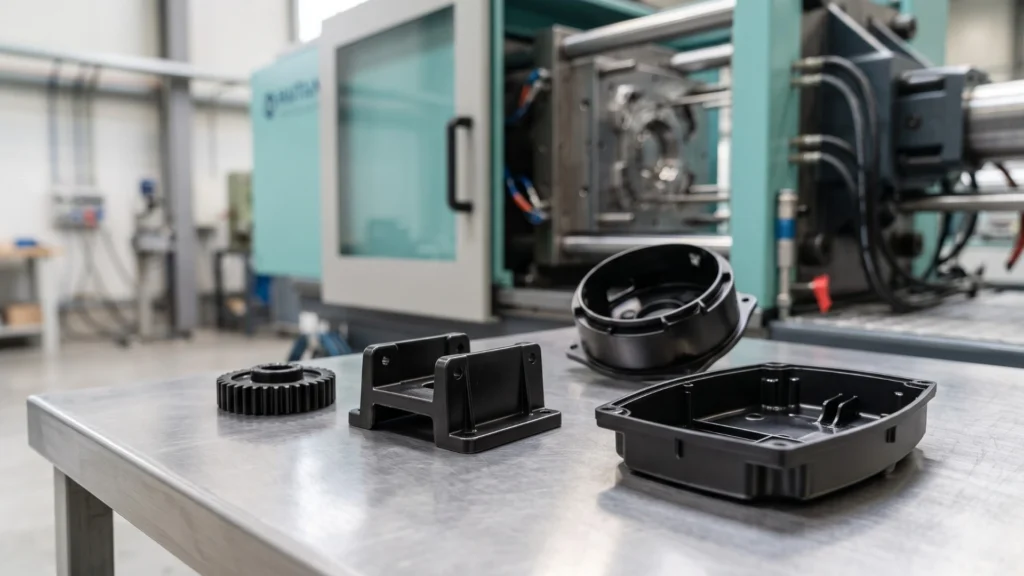
ABS is the material behind Lego bricks, automotive interior trim, computer housings, consumer appliances, and countless industrial enclosures. Understanding how it processes and what it requires is foundational to injection molding design.
ABS Material Properties
| Property | Typical Performance | Design Consideration |
|---|---|---|
| Tensile Strength | 6,000–8,000 psi | Good structural performance for non-critical load-bearing applications. |
| Impact Strength | Good; notched Izod typically 5–10 ft-lb/in | ABS is significantly tougher than PS or SAN and performs well in many enclosure and housing applications. |
| Heat Deflection Temperature | 85–100°C at 1.8 MPa | Suitable for most indoor consumer and industrial environments. |
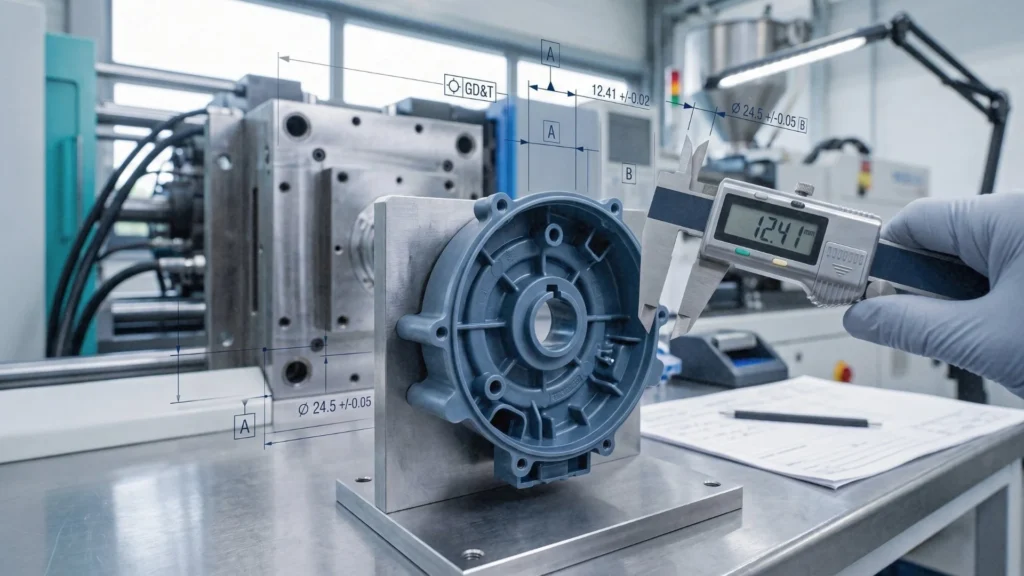
| Shrinkage | 0.4–0.8% | Relatively low shrinkage allows good dimensional control in tight-tolerance parts. |
| Chemical Resistance | Resistant to water, weak acids, and alkalis; attacked by ketones, esters, and aromatic solvents | Good for many indoor and industrial applications, but material compatibility should be reviewed when solvents are present. |
| Surface Finish | Excellent | Accepts high-gloss polish, paint, metallization, and textured finishes readily. |
| Flammability | Standard ABS is HB rated; FR grades achieve UL 94 V-0 | Flame-retardant ABS should be specified for electrical or electronic housings that require UL-rated performance. |
Material Selection Note
ABS is often selected when a molded product needs a strong balance of impact resistance, dimensional stability, processability, and cosmetic finish. It is especially useful for housings, trim components, appliance parts, and industrial enclosures.
Processing ABS in Injection Molding
ABS injection molding is considered relatively forgiving compared to PC (polycarbonate) or nylon. The key processing parameters are drying, melt temperature, injection speed, and mold temperature.
Drying
ABS is mildly hygroscopic and should be dried at 80°C for 2–4 hours before molding. Wet ABS produces silver streaks, or splay, on the part surface and can cause cosmetic defects in appearance parts.
Melt Temperature
The typical processing range is 210–260°C depending on grade and application. Appearance parts typically run at the lower end to minimize volatiles. Parts requiring thin-wall fill or complex geometry may require higher temperatures to maintain adequate flow as the molten polymer fills the cavity.
Injection Speed
ABS can be run at moderate to high injection speeds. For appearance parts, moderate speed reduces the risk of jetting and flow marks. For thin-wall or long-flow parts, higher speeds are needed to fill before freeze-off.
Mold Temperature
A mold temperature of 60–80°C gives the best surface finish and minimizes weld line visibility. Cold molds below 40°C produce dull surfaces and prominent weld lines on appearance parts.
Design Guidelines for ABS Parts
- Wall thickness: 1.2–3.5 mm is the practical production range. Thinner walls require fast injection and careful gating; thicker walls create sink marks and long cycle times.
- Draft angles: 1–2° minimum on non-textured surfaces. ABS has low mold shrinkage, and parts release readily with minimal draft.
- Ribs: Rib thickness should be 50–65% of nominal wall thickness to prevent sink on the opposite face.
- Bosses: Boss wall thickness should be no greater than 60% of nominal wall thickness. Support bosses with gussets in load-bearing applications.
- Weld lines: ABS produces visible weld lines at flow fronts. Gate location and fill direction should be chosen to place weld lines in low-stress, non-cosmetic zones.
Design Note
ABS is more dimensionally stable than many semi-crystalline plastics, but wall thickness, gate location, cooling, and ejection temperature still determine whether the finished part stays flat, fills cleanly, and meets cosmetic requirements.
ABS Grades and Variants
Standard ABS is the baseline grade; but manufacturers can also select specialized variants:
- High-impact ABS: Increased butadiene content for improved low-temperature impact resistance.
- Heat-resistant ABS / PC-ABS blend: Raised heat deflection temperature to 110–120°C for under-hood or high-temperature environments.
- Flame-retardant ABS: UL 94 V-0 rated for electrical and electronic housings.
- Plating-grade ABS: Optimized butadiene distribution for uniform adhesion of electroplated finishes.
- Clear ABS / SAN: Sacrifices impact resistance for transparency. Acrylic or PC should be considered when better clarity is required.
Common ABS Applications Across Industries
Due to its durable nature and ease of finishing, key applications for ABS span across a wide variety of sectors including:
- Consumer electronics: Laptop housings, keyboard bezels, phone cases, and television enclosures.
- Automotive interior: Dashboard panels, A/B pillar trim, center console components, and door handle bezels.
- Appliances: Vacuum cleaner housings, coffee maker bodies, and power tool enclosures.
- Industrial: Electrical enclosures, instrument panel faces, and connector housings.
- Medical: Non-sterile instrument housings, equipment panels, and diagnostic device covers.
Frequently Asked Questions
Is ABS better than polycarbonate?
ABS and PC (Polycarbonate) serve different application requirements. ABS processes more easily, costs less, finishes more readily, and is less notch-sensitive. PC has higher impact strength, better heat resistance, and optical clarity. For most enclosures and consumer goods, ABS is the right choice. For applications requiring maximum impact resistance, high heat, or transparency, PC or PC/ABS is preferred.
Can ABS be painted?
Yes. ABS accepts paint, lacquer, and metallization exceptionally well. It is one of the best injection molding materials for painted finishes. Solvent-based paints bond well to ABS without a primer in many cases. Chrome plating grade ABS is available for applications requiring electroplated decorative finishes.
Does ABS warp in injection molding?
ABS has relatively low shrinkage and good dimensional stability, so warpage is less common than with semi-crystalline materials like PP or nylon. It can warp when walls are excessively thick and uneven, when mold temperature is too low, or when the part is ejected too hot. Uniform wall thickness and adequate cooling largely prevent warpage in ABS parts.