How the overmolding process works, which material combinations bond, and the design rules that determine whether your overmolded part succeeds or fails.
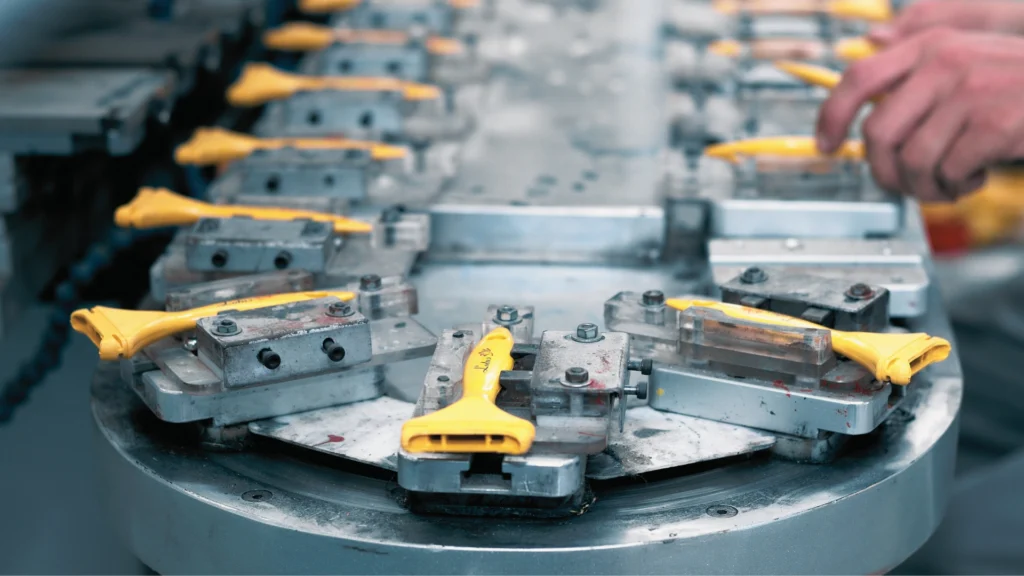
Overmolding is an injection molding process that produces a single part from two different materials by molding the second material directly over the first. The result is a multi-material part — a rigid structural substrate with a soft, grippy, or aesthetically distinct overmold layer — without adhesives, mechanical fasteners, or secondary assembly operations.
It is one of the most useful processes in injection molding for products where ergonomics, sealing, vibration damping, or multi-color aesthetics matter. Toothbrush handles, power tool grips, medical device handles, waterproof connectors, and consumer electronics housings all rely on overmolding to deliver a product that is both structurally sound and comfortable or functional to touch.
How Overmolding Works
Overmolding is a two-shot process. In the first shot, the substrate is molded from a rigid thermoplastic — typically ABS, PC, nylon, or a glass-filled engineering grade. The substrate is then either transferred to a second mold or repositioned in the same mold, as in two-shot molding, where the overmold material — typically a thermoplastic elastomer (TPE), TPU, or silicone — is injected over it.
For the overmold to bond to the substrate, one of two mechanisms must occur:
- Chemical bonding: The two materials are chemically compatible, and the heat and pressure of injection cause molecular entanglement at the interface. This is the preferred bond mechanism and requires careful material pairing.
- Mechanical bonding: The overmold material flows through holes, around features, or into undercuts in the substrate, locking mechanically. This works even with incompatible materials but requires design features to create the interlock.
Key Design Principle
A successful overmolded part depends on both material compatibility and part geometry. Chemical bonding is ideal, but mechanical interlocks are often used to improve bond reliability, especially when the substrate and overmold materials are not naturally compatible.
Overmolding vs. Two-Shot Molding
These terms are often used interchangeably, but they describe different manufacturing approaches.
- Overmolding: The substrate is molded in one machine, then manually transferred to a second machine where the overmold is applied. This is more flexible and typically has lower tooling cost, but it adds handling time and creates some risk of substrate contamination between shots.
- Two-shot molding: Both shots happen in a single machine with a rotating platen — no transfer and no manual handling. This produces tighter registration between substrate and overmold, shorter cycle time, and eliminates contamination risk, but it requires a specialized two-shot press and more complex tooling.
Material Compatibility in Overmolding
Chemical bonding between substrate and overmold depends on material compatibility. Not all combinations bond. A poor bond can result in delamination in service, which is a product failure.
The general rules are outlined below:
| Substrate or Overmold Material | Bonding Characteristics | Injection Molding Considerations |
|---|---|---|
| ABS substrate | Bonds well with TPE, Santoprene, Krayton G, TPU, and soft PVC. Does not bond with silicone. | Common choice for rigid substrates that require soft-touch grips or cosmetic overmold features. |
| PC substrate | Bonds with TPE and TPU. PC/ABS blends also bond reliably with most TPEs. | Useful when the substrate requires higher impact strength, dimensional stability, or heat resistance. |
| Nylon substrate | Bonds with select TPE grades formulated for nylon bonding. | Requires higher overmold temperatures and careful resin selection to achieve reliable adhesion. |
| PP substrate | Bonds with TPE grades based on PP/EPDM, including Santoprene. PP to PP-based TPE bonds are reliable. | Often used where chemical resistance, flexibility, or lightweight part design matters. |
| Silicone overmold | Bonds chemically to silicone-compatible primers. Mechanical bonding to most rigid substrates is an alternative. | Commonly used when soft-touch performance, sealing, high-temperature resistance, or biocompatibility is required. |
Always verify bond strength with physical testing — lap shear, peel testing, and environmental conditioning — before committing to production tooling. Datasheet compatibility claims from material suppliers are a starting point, not a validation.
Validation Note
Material compatibility charts are useful during early design, but they should not replace physical testing. Bond strength should be validated under the real environmental and mechanical conditions the finished part will experience.
Design Rules for Overmolding
Substrate Wall Thickness
The substrate must be rigid enough to resist deflection during overmold injection. Walls thinner than 1.5 mm in the overmold zone often flex under injection pressure, causing flash or dimensional variation. Ribs or gussets in the substrate can reinforce thin sections.
Overmold Thickness
The overmold layer should be uniform in thickness — typically 1.5–3 mm. Thick sections create sink marks and long cooling times; thin sections may not develop adequate bond strength. Avoid abrupt thickness transitions in the overmold layer.
Gate Location for the Overmold Shot
Gate the overmold away from the bond interface where possible. Gating directly at the interface can cause jetting or washing of the substrate surface before bonding occurs. Side or edge gating into the overmold zone is typically preferable.
Draft Angles
Both the substrate and the overmold require draft for release. TPE and TPU overmolds are elastic and tolerate minimal draft, but standard draft rules — 1° minimum — should still be applied to substrate features covered by the overmold.
Frequently Asked Questions
What materials are used in overmolding?
The substrate is typically a rigid engineering thermoplastic: ABS, PC, nylon, PP, or a glass-filled grade for structural demands. The overmold is typically a thermoplastic elastomer, such as TPE, TPU, or SEBS-based compounds, for soft-touch or sealing applications. Liquid silicone rubber, or LSR, may also be used for biocompatible and high-temperature applications.
Does overmolding require a chemical bond?
Not always. Parts can rely on mechanical bonding alone — the overmold flows through holes, around posts, or into undercuts to lock physically to the substrate. Chemical bonding produces a stronger, more reliable interface and is preferred for parts under shear or peel stress. Many designs use both mechanisms simultaneously.
What is the difference between overmolding and insert molding?
Overmolding molds a second plastic material over a plastic substrate. Insert molding molds plastic around a pre-placed non-plastic component — typically metal. Both are multi-material processes, but insert molding is used to integrate metal features, such as threads, conductors, or reinforcement, into a plastic part.