A complete guide to nylon grades, properties, and how to choose the right one for your injection molded part.
Nylon, technically polyamide (PA), is one of the most versatile and widely used engineering thermoplastics in injection molding. It combines mechanical strength, wear resistance, and thermal stability in a material that processes reliably and costs far less than high-performance alternatives like PEEK or PEI.
The challenge is that nylon is not a single material. It is a family of resins with meaningfully different properties, and choosing the wrong grade can result in a part that absorbs moisture and loses its dimensions, or one that cracks under impact when it should flex.
This guide covers the major nylon grades used in injection molding, how they differ, and the practical considerations that should drive your material decision.
What Is Nylon Polyamide?
Nylon is a semi-crystalline thermoplastic first developed by DuPont in the 1930s. Its defining characteristic is the amide linkage in its polymer backbone, which gives it both its chemical name, polyamide, and its key mechanical properties: strong intermolecular bonding that translates to high tensile strength, good fatigue resistance, and a relatively high melting point compared to commodity plastics.
In injection molding, nylon is valued for applications that involve sliding wear, structural loading, elevated temperatures, or chemical exposure. It is the dominant material in gears, bushings, cable ties, fasteners, structural brackets, and a wide range of industrial and automotive components.
The trade-off every engineer must manage is moisture absorption. Nylon is hygroscopic, meaning it absorbs water from the environment, causing it to swell dimensionally and lose stiffness. This affects tight-tolerance applications and parts exposed to outdoor or high-humidity environments. The degree of moisture sensitivity varies substantially by grade.
Key Material Selection Factor
When selecting a nylon polyamide grade, consider moisture exposure, dimensional tolerance, load requirements, heat exposure, impact performance, and production cost together. No single nylon grade is the best fit for every molded part.
The Major Nylon Grades for Injection Molding
Nylon 6 PA 6
PA 6 is polymerized from caprolactam. It has a slightly lower melting point than PA 6/6 and is somewhat more flexible, which improves impact resistance in thin sections.
PA 6 is widely used for automotive housings, electrical connectors, and consumer goods. Its moisture absorption is slightly higher than PA 6/6, which can affect dimensional stability in precision applications.
Nylon 6/6 PA 6/6
Nylon 6/6 is the workhorse of the family. Its melting point is higher than PA 6, approximately 255 degrees C vs. 220 degrees C, and its stiffness and tensile strength are excellent at room temperature.
PA 6/6 is the first choice for structural brackets, gears, fasteners, and load-bearing clips in automotive and industrial applications. Its weakness is moisture absorption: unfilled PA 6/6 in a humid environment can absorb 2.5 to 3 percent moisture by weight, causing measurable dimensional change and stiffness loss.
Nylon 11 PA 11
Nylon 11 is a long-chain polyamide known for its low moisture absorption, strong dimensional stability, and excellent toughness. It absorbs less moisture than PA 6 and PA 6/6, which makes it a strong option for parts exposed to humidity, outdoor conditions, or fluid contact.
Compared to PA 6/6, PA 11 typically offers greater flexibility, better impact resistance, and improved resistance to chemicals and environmental stress cracking. These properties make it useful in applications where the part must retain performance while flexing, absorbing impact, or operating in demanding environments.
PA 11 is often used in fluid handling components, tubing, connectors, cable jacketing, automotive parts, and industrial components that require a balance of toughness, chemical resistance, and dimensional stability. The primary trade-off is cost. PA 11 is generally more expensive than PA 6 and PA 6/6, so it is usually specified when the application requires its lower moisture absorption, flexibility, or environmental resistance.
Nylon 12 PA 12
PA 12 has the lowest moisture absorption of the common nylon grades, roughly one-fifth that of PA 6/6. This makes it the material of choice when dimensional stability in humid environments is critical, or when parts will be in direct contact with water.
PA 12 is used extensively in fluid handling components, pneumatic tubing, and medical device housings. The trade-off is lower stiffness and a higher price point than PA 6 or 6/6.
Glass-Filled Nylon PA 6/6 GF15, GF30, GF50
Glass-filled nylon is the most common reinforced grade. Adding chopped glass fibers to nylon dramatically increases stiffness, tensile strength, and heat deflection temperature while reducing moisture absorption and dimensional change.
A 30 percent glass-filled PA 6/6 has roughly 2 to 3 times the stiffness of unfilled PA 6/6. The trade-off is brittleness: glass-filled grades are notch-sensitive and have lower impact strength than unfilled nylon. Surface finish also degrades with increasing glass content, and the glass fibers abrade mold tooling more aggressively, requiring harder steels.
Nylon 6/6 with Mineral Filler
Mineral-filled nylons use calcium carbonate, talc, or glass beads rather than glass fibers. They improve stiffness and reduce warpage while maintaining better surface finish and isotropy than glass-fiber-filled grades.
They are used where a smooth appearance matters and the structural demands are moderate.
Heat-Stabilized Nylon
Standard nylon degrades when exposed to elevated temperatures over extended periods, which can be an issue for parts near engines, heat exchangers, or under-hood automotive applications.
Heat-stabilized grades incorporate additives that slow oxidative degradation, extending service life at temperatures that would cause standard PA 6/6 to discolor and embrittle. These grades are increasingly specified for automotive components that must survive thousands of hours at elevated temperature.
Flame-Retardant Nylon
Flame-retardant nylon grades incorporate halogenated or non-halogenated FR additives to meet UL 94 V-0 requirements. They are widely used in electrical connectors, relay housings, and circuit breaker components where ignition risk must be controlled.
The FR additive packages reduce mechanical properties compared to standard grades and must be selected carefully for compatibility with the application environment.
Nylon Grade Comparison
Nylon, also known as polyamide, is used in injection molding for parts that require toughness, wear resistance, strength, and heat performance. The best nylon grade depends on the application’s mechanical requirements, operating environment, dimensional stability needs, and processing conditions.
| Nylon / Polyamide Grade | Key Characteristics | Common Applications | Injection Molding Considerations |
|---|---|---|---|
| PA 6 / Nylon 6 | Good toughness, wear resistance, and impact strength. Absorbs moisture more readily than some other nylon grades. | Gears, bushings, housings, clips, brackets, and general-purpose molded components. | Requires proper drying before molding. Moisture absorption can affect dimensional stability. |
| PA 6/6 / Nylon 6/6 | Higher strength, stiffness, and heat resistance compared to PA 6. | Automotive components, electrical connectors, industrial parts, fasteners, and structural components. | Requires controlled processing temperatures and thorough material drying. |
| PA 11 / Nylon 11 | Low moisture absorption, good flexibility, strong impact resistance, and excellent environmental resistance. | Fluid handling components, tubing, connectors, cable jacketing, automotive parts, and industrial components. | Often specified when lower moisture absorption, flexibility, or environmental resistance justify the higher material cost. |
| PA 12 / Nylon 12 | Very low moisture absorption and strong dimensional stability in humid or wet environments. | Fluid handling components, pneumatic tubing, water-contact parts, and medical device housings. | Useful for moisture-sensitive applications, but typically has lower stiffness and a higher price point than PA 6 or PA 6/6. |
| Glass-Filled Nylon | Improved stiffness, strength, dimensional stability, and heat resistance. | Load-bearing parts, brackets, housings, automotive parts, and industrial components. | Glass fiber content can increase tool wear and may influence part orientation and surface finish. |
| Impact-Modified Nylon | Enhanced toughness and impact resistance, especially in demanding environments. | Protective housings, clips, snap-fit parts, and components exposed to vibration or shock. | Material selection should balance toughness with stiffness, heat resistance, and dimensional requirements. |
| Heat-Stabilized Nylon | Designed to maintain performance at elevated temperatures over time. | Under-hood automotive parts, industrial equipment components, and high-temperature applications. | Processing conditions should be matched to the specific resin supplier’s datasheet. |
| Lubricated / Wear-Resistant Nylon | Reduced friction and improved wear performance for moving components. | Bearings, bushings, rollers, gears, and sliding components. | Useful where long-term wear, friction, or noise reduction is a priority. |
How Nylon Grade Affects Mold Design
Material grade is not just a mechanical decision. It affects how the injection mold must be designed and run.
- Shrinkage: Unfilled PA 6/6 shrinks 1.5 to 2.0 percent, significantly more than glass-filled grades, which typically shrink 0.3 to 0.7 percent. The mold cavity must be machined oversize to compensate, and the shrinkage must be consistent for dimensions to land correctly.
- Moisture management: Nylon pellets must be dried to below 0.2 percent moisture before molding. Wet nylon produces splay, bubbles, and degraded mechanical properties. Dryers and mold temperature control are mandatory.
- Mold temperature: Nylon requires elevated mold temperatures, typically 60 to 90 degrees C for PA 6/6, to achieve the degree of crystallinity that delivers design mechanical properties. Cold molds produce parts with lower-than-expected strength.
- Gate and runner design: Nylon is a low-viscosity melt and fills molds easily. Gates can be smaller than those required for ABS or PC, but the low viscosity also means the mold must be well-vented to prevent trapped gas.
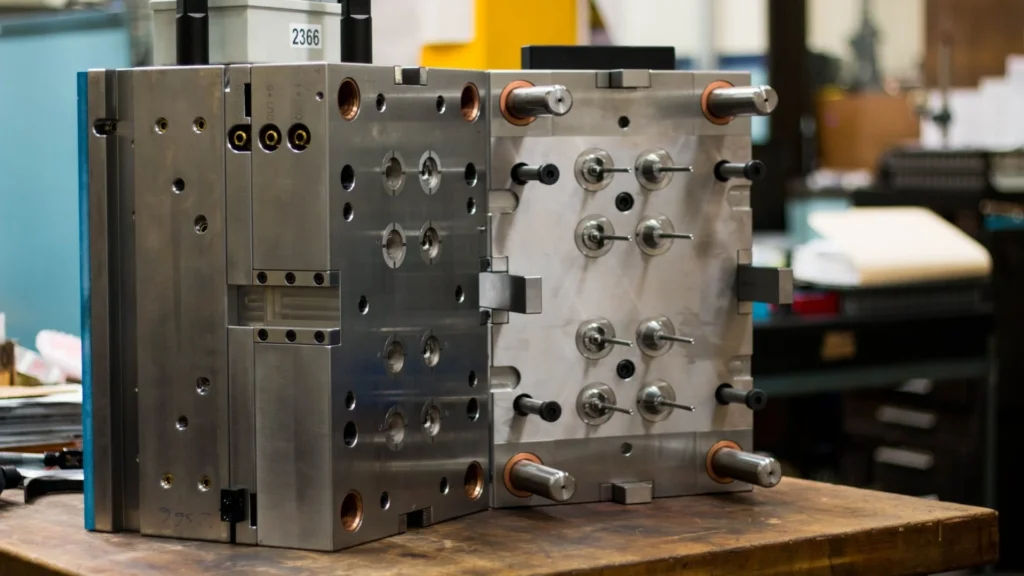
- Tool steel selection: Glass-filled grades require harder mold steels, such as H13 or S7 hardened to 50 Rockwell C or higher, to resist fiber abrasion on cavity and gate surfaces.
Design Note
Nylon grade selection should happen before mold design is finalized. Shrinkage, glass content, moisture behavior, and processing temperature can all affect tooling decisions, dimensional planning, and long-term part performance.
When to Choose Nylon Over Other Engineering Plastics
Nylon is the first choice when the application involves:
- Sliding wear or dynamic contact, such as bushings, gears, cams, and slides
- Structural loading with moderate impact, such as brackets, clips, and fasteners
- Elevated temperature service in the 120 to 150 degrees C range
- Chemical exposure to fuels, oils, and mild solvents
- Cost-sensitive applications that require genuine engineering performance
Consider alternatives when:
- Dimensional stability in humid environments is critical. Consider Delrin, or POM, which has lower moisture absorption than many nylon grades.
- Impact resistance in cold temperatures is paramount. PA 6, PA 11, or rubber-toughened grades may outperform PA 6/6, but TPU or PC may be better still depending on the application.
- Optical clarity is required. Nylon is not transparent; consider PC or acrylic.
Frequently Asked Questions
What is the difference between nylon 6 and nylon 6/6?
Both are polyamides, but PA 6/6 has a higher melting point and slightly higher stiffness at room temperature. PA 6 is more flexible and impact-resistant in thin sections. For most structural injection molding applications, PA 6/6 is the default, but PA 6 is preferred where toughness in thin walls is more important than stiffness.
What is Nylon 11 used for?
Nylon 11 is used for applications that require low moisture absorption, flexibility, impact resistance, and chemical resistance. Common uses include fluid handling components, tubing, connectors, cable jacketing, automotive components, and industrial parts exposed to humidity or chemicals.
How is Nylon 11 different from Nylon 12?
Nylon 11 and Nylon 12 are both long-chain polyamides with lower moisture absorption than PA 6 and PA 6/6. PA 12 generally has the lowest moisture absorption, while PA 11 is often selected for its balance of toughness, flexibility, chemical resistance, and environmental durability. The right choice depends on the performance requirements, part geometry, and cost target.
Does nylon absorb water?
Yes. All nylon grades are hygroscopic and absorb moisture from the environment. This causes dimensional swelling and a reduction in stiffness. The degree varies by grade: PA 12 absorbs the least, while PA 6 absorbs more moisture than many other nylon grades. Parts must be conditioned or designed with moisture allowance for tight-tolerance applications.
Is glass-filled nylon stronger than standard nylon?
In terms of tensile strength and stiffness, yes. A 30 percent glass-filled PA 6/6 has roughly 2 to 3 times the stiffness of unfilled PA 6/6. However, glass-filled grades are notch-sensitive and have lower impact resistance. They also have worse surface finish and abrade tooling more aggressively.
What temperature can nylon withstand?
Unfilled PA 6/6 has a heat deflection temperature of approximately 65 to 75 degrees C at 1.8 MPa. Glass-filled PA 6/6 reaches 200 to 250 degrees C under the same conditions, making it suitable for under-hood and other elevated-temperature environments. Heat-stabilized grades extend long-term service life at those temperatures.